
Technology stocks powered Asian markets to significant gains Thursday, following a rebound on Wall Street driven by artificial intelligence momentum and declining oil prices.
The rally received a major boost from chipmaker Nvidia’s impressive quarterly results, showing profits that skyrocketed over 200% compared to the same period last year, with revenue climbing 85% during the February-April timeframe.
The company has emerged as a major winner in the artificial intelligence boom, benefiting from strong demand for its advanced AI processors. While Nvidia’s stock climbed 1.3% on Wednesday ahead of the earnings announcement, shares dropped 1.3% in after-hours trading following the results.
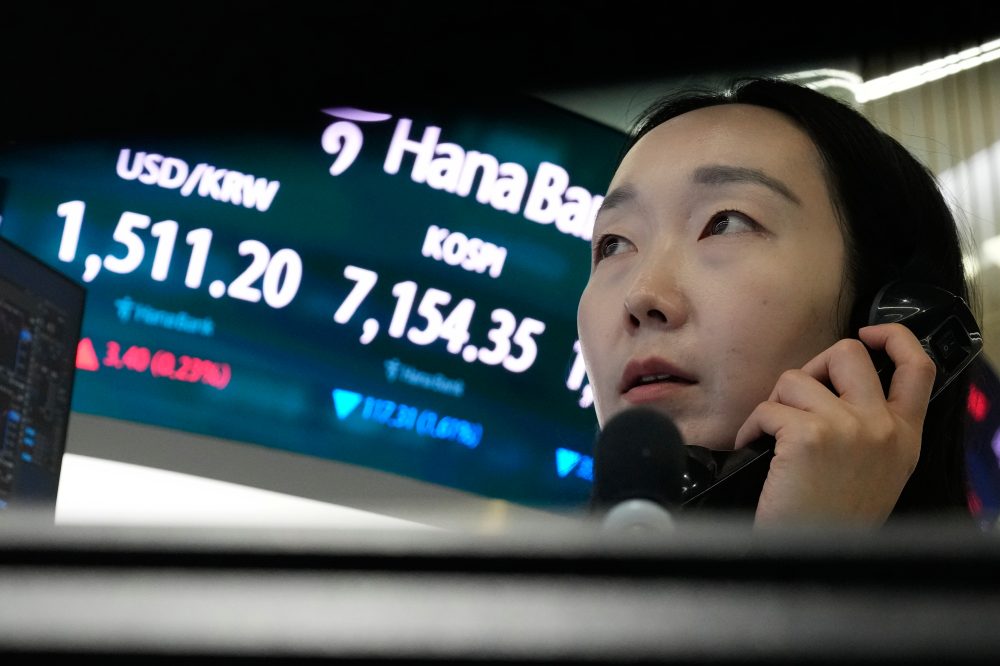
South Korea’s Kospi index led regional gains with a remarkable 6.7% jump to 7,688.43, driven by heavy buying in technology companies including Samsung Electronics, which rose 6.3%. SK Hynix, a memory chip manufacturer that collaborates with Nvidia, saw shares leap 9.5%.
Taiwan’s Taiex, dominated by technology stocks, climbed 3.3% as major semiconductor producer TSMC advanced 2.3%.
Tokyo’s Nikkei 225 posted a strong 3.5% increase, reaching 61,877.89.
Chinese markets showed more restrained growth, with Hong Kong’s Hang Seng gaining 0.2% to 25,702.46, while the Shanghai Composite index rose 0.4% to 4,179.16.
Australia’s S&P/ASX 200 advanced 1.3% to 8,606.70.
Energy prices moved higher early Thursday after Brent crude tumbled 5% the previous day. Brent, the global benchmark, increased 48 cents to $105.50 per barrel, while U.S. crude added 52 cents to $98.78 per barrel.
Brent continues trading well above its approximately $70 level from before the conflict with Iran. Energy prices have fluctuated based on changing expectations about whether the United States and Iran might reach a deal enabling full resumption of oil shipments from the Persian Gulf to global markets.
Wednesday saw U.S. markets recover, with the S&P 500 rising 1.1% for its first gain in four sessions, closing at 7,432.97. The Dow Jones Industrial Average increased 1.3% to 50,009.35 while the Nasdaq composite surged 1.5% to 26,270.36.
Equities benefited from declining bond yields, as the 10-year Treasury yield dropped to 4.57% from Tuesday’s close of 4.67%. This represents a substantial shift in a market where movements are typically measured in tiny fractions.
The 10-year Treasury yield had been climbing from below 4% before the conflict with Iran started, along with other global government bond yields, due to concerns that ongoing fighting will maintain elevated oil prices and other factors. Inflation worries decrease the likelihood of Federal Reserve rate cuts this year and increase risks that global central banks may need to raise rates in 2026.
Elevated yields constrain economic growth and pressure prices for stocks, digital currencies and various other investments. Beyond increasing mortgage costs, they could also limit corporate borrowing for artificial intelligence data center construction that has recently supported U.S. economic expansion.
As yields retreated, technology companies helped drive Wall Street’s advance.
Leading technology gainers included Advanced Micro Devices, which jumped 8.1%, and Intel, which rose 7.4%.
Smaller companies often experience greater benefits from lower yields than larger competitors since many rely on borrowing for growth. The Russell 2000 index tracking the smallest U.S. companies surged 2.6%, more than twice the S&P 500’s gain, which tracks the largest U.S. corporations.
Red Robin Gourmet Burgers soared 18.2%, and Cava Group gained 3.1% after delivering stronger-than-anticipated profit results that boosted confidence in consumer spending power despite elevated fuel costs and economic pessimism.
Most major U.S. corporations have delivered better early 2026 profits than analysts predicted, helping drive stocks to record levels. Share prices typically track corporate earnings trends over extended periods.
Among Wall Street’s declining stocks was Target, which dropped 3.9% despite the retailer posting better profit and revenue results than analysts forecasted. A new CEO, Michael Fiddelke, is working to revitalize the company and increase sales.
In early Thursday currency trading, the U.S. dollar weakened to 158.85 Japanese yen from 158.92 yen. The euro strengthened to $1.1631 from $1.1624.