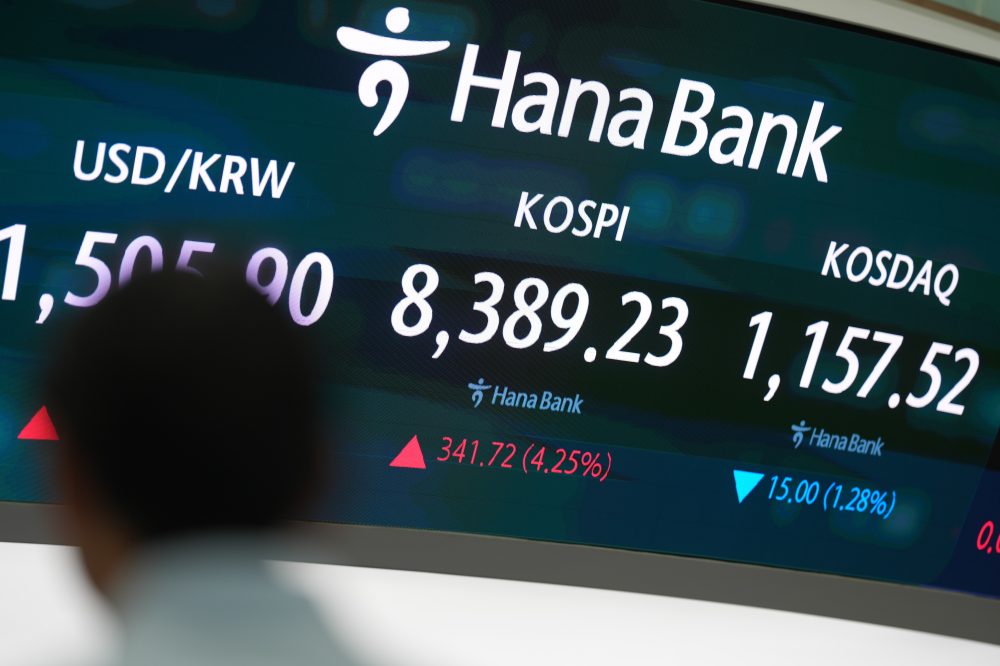

Technology stocks powered gains across Asian markets Wednesday while crude oil prices declined following another record-setting session on Wall Street.
South Korea’s Kospi soared nearly 5% and Taiwan’s main index also posted strong gains as artificial intelligence enthusiasm sparked heavy investment in semiconductor manufacturers and other tech firms.
Tokyo’s Nikkei 225 benefited from technology sector strength, advancing 1.3% to close at 65,816.62. The index crossed above 66,000 during trading for the first time ever.
Shares of computer chip equipment manufacturer Tokyo Electron surged 5.9% while testing equipment producer Advantest climbed 5.7%.
The technology rally followed Micron Technology’s dramatic 19.3% surge, which provided the biggest boost to the S&P 500 after UBS analysts led by Timothy Arcuri increased their 12-month stock price target to $1,625 from $535. Micron finished trading at $895.88.
The analysts predict ongoing robust demand for computer memory products. Micron’s shares have more than tripled this year and the company recently joined the exclusive $1 trillion market value club alongside Nvidia, Apple and Microsoft, each of which has exceeded $3 trillion in value.
Investment enthusiasm for AI technology has driven stock prices in South Korea and Taiwan to new peaks throughout this year.
Seoul’s Kospi climbed 4.9% to reach 8,457.09, establishing a new all-time record as Samsung Electronics shares jumped 7%.
Taiwan’s Taiex advanced 2.7%.
Other Asian markets showed mixed results, with Hong Kong’s Hang Seng declining 0.7% to 25,426.92 and Shanghai’s Composite index falling 0.2% to 4,136.87.
Australia’s S&P/ASX 200 managed a slight 0.1% gain to 8,662.10.
Tuesday’s U.S. trading session produced fresh records as the S&P 500 gained 0.6% to 7,519.12 following the Memorial Day holiday break, reaching a new all-time peak. The Nasdaq composite jumped 1.2% to establish its own record at 26,656.18, while the Dow Jones Industrial Average slipped 0.2% to 50,461.68.
American markets were recovering ground lost to international peers the previous day, when President Donald Trump indicated that discussions were “proceeding nicely” with Iran regarding ending their conflict.
However, uncertainty persists as military operations continue in the area. Financial markets have previously rallied on expectations of a war resolution with Iran, only to see hostilities persist.
Crude oil prices have dominated financial market movements since the United States and Israel launched attacks against Iran in late February. The resulting conflict has shut down the Strait of Hormuz and trapped oil tankers in the Persian Gulf rather than delivering crude to global customers. This situation has elevated oil costs and triggered widespread inflation concerns worldwide.
Expectations for an agreement to restore oil flow patterns boosted shares of companies facing substantial fuel expenses. United Airlines gained 6%, while Norwegian Cruise Line Holdings advanced 4.9%.
Despite market gains, American households remain pessimistic about economic conditions due to rising inflation, with Tuesday’s report showing consumer confidence declining slightly in May, though results exceeded economists’ worst-case projections. This followed Friday’s data indicating U.S. consumer sentiment reached its lowest point on record.
Early Wednesday trading saw Brent crude, the global benchmark, drop 94 cents to $95.73 per barrel. U.S. crude oil prices fell $1.35 to $92.54 per barrel.
Declining oil costs contributed to lower yields in U.S. bond markets, reducing pressure on Wall Street. The 10-year Treasury yield decreased to 4.48% from Friday’s close of 4.56%.
Currency markets showed the U.S. dollar weakening to 159.28 Japanese yen from 159.30 yen. The euro strengthened to $1.1636 from $1.1631.