
TOKYO (AP) — Markets across Asia plummeted Monday following Wall Street’s steepest decline in months, as concerns over technology sector investments and increased likelihood of interest rate increases weighed on investor sentiment.
Japan’s primary Nikkei 225 index tumbled 4.2% to close at 63,804.77. Japanese officials also adjusted their first-quarter economic growth projection downward to an annualized rate of 1.8%, reducing it from the previous forecast of 2.1%.
Energy prices climbed sharply as Israel conducted early Monday airstrikes against central and western regions of Iran, responding to previous missile attacks. Iran’s state-run television confirmed explosions were audible in Isfahan, Tabriz and Tehran, though details were not immediately provided.
While American and Iranian representatives agreed to a preliminary ceasefire extension last week, the arrangement remains incomplete, and Monday’s military actions complicate ongoing peace negotiations.
International benchmark Brent crude oil climbed $3.50 to reach $96.59 per barrel. U.S. benchmark crude increased $3.48 to $94.02 per barrel.
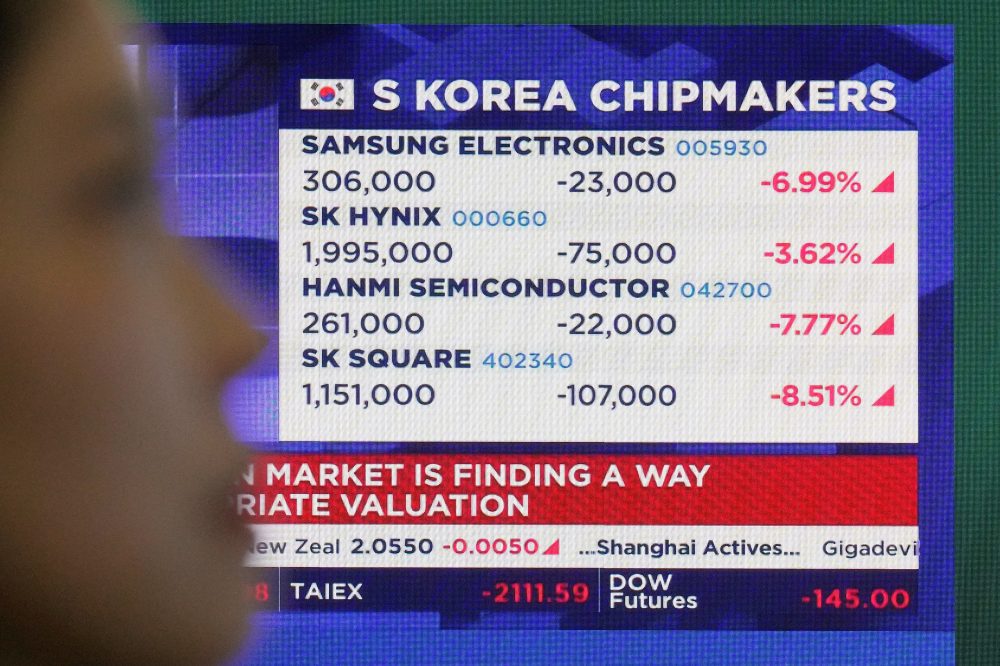
Across other Asian markets, South Korea’s Kospi index dropped 6.8% to 7,605.42, with Samsung Electronics, the nation’s largest corporation, falling 7%. SK Hynix decreased 3.3%.
Taiwan’s Taiex declined 3.8%.
Hong Kong’s Hang Seng index fell 1.3% to 24,631.64. Shanghai’s Composite index decreased 1.1% to 3,984.75.
Australian markets remained closed Monday in observance of the King’s Birthday holiday.
Wall Street concluded last week with the S&P 500 declining 2.6% to 7,383.74, following robust employment data that strengthened predictions the Federal Reserve might implement rate increases this year.
The decline represented the largest single-day loss since Oct. 10, when the Trump administration threatened imposing a 100% tariff on Chinese imports. The Dow Jones Industrial Average decreased 1.4% to 50,866.78. The Nasdaq composite dropped 4.2% to 25,709.43.
Treasury yields rose after Labor Department data revealed the U.S. unexpectedly gained 172,000 jobs in May. The figures represent continued evidence of strong employment conditions despite inflationary pressures affecting businesses and consumers.
The 10-year Treasury yield increased to 4.54% from 4.50% immediately before the employment report’s release. The 2-year Treasury yield, which closely follows Federal Reserve policy, rose to 4.16% from 4.04% prior to the announcement.
The Federal Reserve has maintained current interest rate levels while assessing continuing effects from increasing inflation. Prices had already been rising due to tariff impacts. The U.S. conflict with Iran has effectively prevented crude oil shipments from passing through the Strait of Hormuz.
In early Monday currency markets, the U.S. dollar rose slightly to 160.35 Japanese yen from 160.25 yen. The euro traded at $1.1530, increasing from $1.1515.