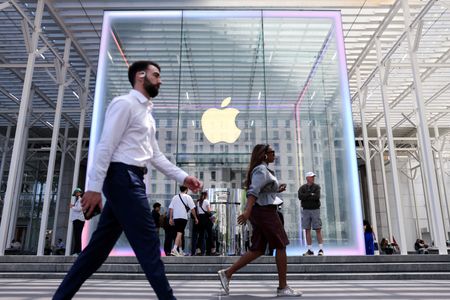

This Wednesday marks a significant milestone for one of the world’s most recognizable technology companies as Apple celebrates its 50th anniversary since its humble beginnings in a California garage.
The story began in early 1976 when Steve Wozniak finished designing a computer circuit board that he planned to demonstrate at a local hobbyist club. His friend Steve Jobs recognized the commercial potential of manufacturing and selling these boards, leading to the birth of Apple.
Over five decades, the company has fundamentally transformed both the technology sector and modern culture by bringing desktop computers and later smartphones into mainstream use, establishing the mobile app ecosystem, and demonstrating the power of seamlessly integrated hardware and software.
However, the iPhone manufacturer now confronts significant challenges as it works to prove its continued relevance in an era dominated by artificial intelligence developments. Competitors including Alphabet and Microsoft are investing tens of billions of dollars to establish leadership in the AI space.
Apple’s stock performance reflects these concerns, ranking as the second-poorest performer among the “Magnificent Seven” technology stocks since OpenAI introduced ChatGPT in November 2022.
While Apple has incorporated machine learning capabilities into its processors since 2017, industry analysts and investors point to delayed feature rollouts, including an updated version of Siri, as evidence that the company was caught off-guard by consumer AI adoption patterns.
The competitive landscape is intensifying as companies like OpenAI develop AI-powered devices designed to challenge the smartphone’s long-standing market dominance.
Nevertheless, Apple’s product lineup continues to attract strong consumer interest.
Robust sales of the newest iPhone 17 series boosted the company’s December quarter financial results, while the $599 MacBook Neo — representing Apple’s most affordable laptop offering to date — experienced a successful product launch.
Independent technology analyst Ben Thompson offered this perspective on Stratechery.com Tuesday: “The company made it fifty years with no one truly competing with its integrated business model; the fate of its next fifty years may rest on the question of just how compelling AI ends up being — and if OpenAI can out-Apple the original.”
The company’s financial trajectory tells a remarkable growth story. Apple went public in 1980, but its stock value accelerated significantly after 2000 as the iPhone achieved bestseller status and the product portfolio expanded. The introduction of in-house M-series processors also contributed to increased Mac computer sales and stock appreciation.
Today, Apple stands among the world’s most valuable corporations and largest companies by revenue. Strong consumer demand for its latest iPhone models is projected to generate approximately $465 billion in sales for the current fiscal year ending in September.
The services division, encompassing the App Store, Apple Music, and streaming platforms, has emerged as a crucial growth engine. This expanding device ecosystem generates consistent revenue through subscription services and app sale commissions, though it has also sparked high-profile disputes with companies like Epic Games over in-app payment control.
Geographically, Apple’s revenue sources are shifting as the U.S. smartphone market reaches saturation. China and developing markets such as India now play increasingly important roles in driving company revenues.
The evolution from Wozniak’s original 1976 circuit board — which became the Apple I computer — to today’s consumer electronics empire spans an impressive product range. Apple’s innovation timeline includes breakthrough devices like the iPod, and current offerings now extend to smartwatches, wireless earbuds, and the mixed-reality Vision Pro headset.