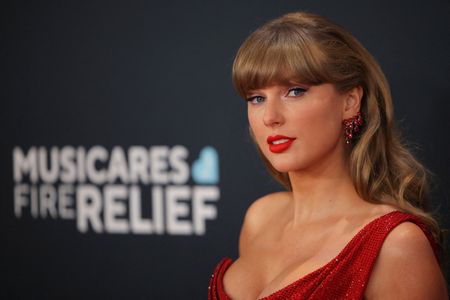

Global music icon Taylor Swift has submitted legal paperwork seeking trademark protection for her voice and image in what experts describe as a defensive move against artificial intelligence-generated deepfakes.
Swift’s legal team filed the applications on Friday with the U.S. Patent and Trademark Office, listing her company TAS Rights Management as the owner of two audio recordings and one photograph.
The first audio sample features Swift stating: “Hey, it’s Taylor Swift, and you can listen to my new album, ‘The Life of a Showgirl,’ on demand on Amazon Music Unlimited.”
In the second recording, she says: “Hey, it’s Taylor. My brand new album ‘The Life of a Showgirl’ is out on October 3 and you can click to presave it so you can listen to it on Spotify.”
The photograph shows the performer on stage wearing a sequined costume while holding a pink guitar.
Neither Swift’s representatives nor the attorneys handling the case responded to requests for comment on Monday.
The singer has become a frequent target of AI-generated content, including fraudulent advertisements, fake political statements, and inappropriate imagery.
Actor Matthew McConaughey has successfully obtained similar trademark protections. He explained to the Wall Street Journal in January that “we want to create a clear perimeter around ownership with consent and attribution the norm in an AI world.”
Trademark lawyer Josh Gerben, who first reported Swift’s applications on his blog Monday, explained that the filings “are specifically designed to protect Taylor from threats posed by artificial intelligence.”
“While existing ‘Right of Publicity’ laws offer some protection against unauthorized use of a famous individual’s likeness, trademark filings can provide an additional layer of protection,” Gerben noted.
According to Gerben, protecting a celebrity’s recorded voice through trademark law represents an untested legal approach.
“Historically, singers relied on copyright law to protect their recorded music,” Gerben explained. “But AI technologies now allow users to generate entirely new content that mimics an artist’s voice without copying an existing recording, creating a gap that trademarks may help fill.”
The attorney said Swift’s photograph filing serves a similar protective function.
“By protecting a distinctive visual, down to Swift’s commonly worn jumpsuit and pose, Swift’s team may gain additional grounds to pursue claims against manipulated or AI-generated images that evoke her likeness,” he wrote.