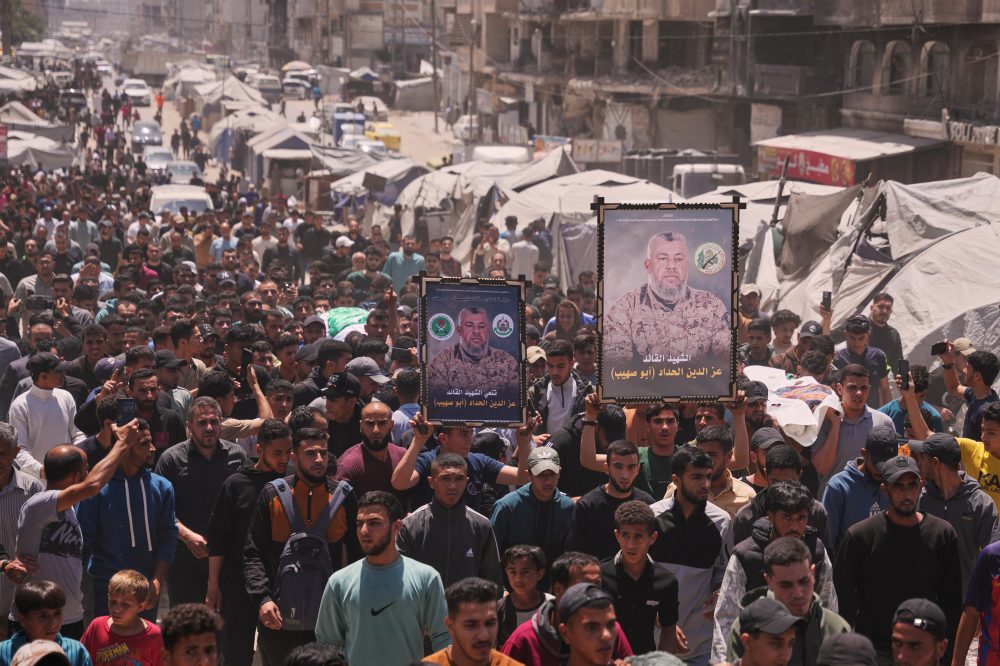

Israeli military forces have eliminated the top commander of Hamas’ armed forces and his successor within the last two weeks, continuing a pattern of targeted operations against high-ranking militants.
The deceased leaders were named as Mohammed Odeh and Izz al-Din al-Haddad, both key planners behind the Oct. 7, 2023, assault on Israel. Military officials describe these eliminations as components of a wider campaign to hunt down those responsible for the attacks that sparked the current Gaza conflict.
However, while such precision strikes may deliver concrete results that political leaders can present as successes, they seldom tackle the fundamental issues that fuel ongoing conflicts.
“The killing of military chiefs such as Odeh and Haddad points to Israel’s operational ability to reach Hamas’ military leadership,” said Nasser Khdour of the nonprofit ACLED, which tracks reports of political violence and conflict worldwide. But, he added, “the killing of senior commanders is unlikely, on its own, to push Hamas toward disarmament or make it accept the complete removal of its role in Gaza’s security and governance.”
Throughout its history, Israel has conducted numerous targeted eliminations, yet Palestinian and Lebanese armed organizations have frequently survived and even strengthened following the deaths of senior figures.
Consider Hezbollah’s experience. Israeli warplanes killed its leader Abbas Musawi in southern Lebanon during 1992. Under Nasrallah, his charismatic successor, Hezbollah developed into the region’s most formidable armed organization and battled Israel to a costly deadlock in 2006.
Nasrallah and almost all his top deputies perished during the 2024 conflict between Israel and Hezbollah. The Iran-supported organization sustained additional significant casualties that year, yet continued launching rocket and drone strikes against Israel within days of the current war’s beginning.
Hamas has repeatedly lost senior leadership. Israel eliminated its founder and spiritual guide, Sheikh Ahmed Yassin, in a 2004 air attack. Almost every planner of the organization’s Oct. 7 assault on Israel has subsequently been killed.
Both organizations have continued operating, driven by longstanding complaints rooted in the Israeli-Palestinian dispute.
The United States has similarly employed targeted eliminations against al-Qaida and the Islamic State group, eliminating Osama bin Laden during a 2011 operation in Pakistan and IS founder Abu Bakr al-Baghdadi in 2019. Both organizations have been significantly weakened, though only following extended conflicts involving ground troops.
Yossi Kuperwasser, the former head of Israel’s military intelligence research division, said in March that targeted killings can be an effective tool but are not a “cure for all problems.”
“These operations by themselves don’t dramatically change the ability of those organizations to cause damage and to carry out attacks,” he said. “But it’s important for Israel to weaken its enemies.”
In Gaza, Lebanon and now Iran, he noted, Israel has taken out dozens of figures, reshaping the leadership structure in lasting ways.
Precision strikes became a primary tactic during the early phases of the Iran conflict. Senior military and civilian leaders up to Supreme Leader Ayatollah Ali Khamenei were eliminated in the war’s initial attacks. Khamenei has been succeeded by his son, Mojtaba, who is viewed as even more uncompromising.
Kuperwasser said that targeted killings in Iran hadn’t transformed the theocracy but had changed it.
“Maybe there’s not ‘regime change’ yet, but there is ‘change in regime.’ The people are not the same people,” he said.
Historically, precision eliminations have sometimes radicalized supporters or members of political movements and armed groups, promoting more extremist successors or transforming killed leaders into martyrs with lasting impact.
Northeastern University political scientist Max Abrahms said data from Afghanistan, Pakistan, Israel and the Palestinian territories shows violence against civilians spikes after targeted killings.
“Leadership decapitation is risky,” he said. “When you take out a leader that prefers some degree of restraint and had influence over subordinates, then there’s a very good chance that, upon that person’s death, you’re going to see even more extreme tactics.”
Precision eliminations can generate leadership gaps and opportunities for transformation, but only when combined with a comprehensive political approach, said Mohanad Hage Ali, deputy director of the Carnegie Middle East Center in Beirut.
“You can decapitate an organization or defeat it militarily, but if you don’t follow through politically, it doesn’t work. And it’s hard to see how this goes much further,” he said.