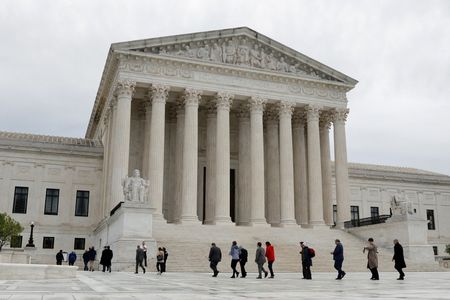

WASHINGTON — The U.S. Supreme Court is gearing up for a consequential new term beginning in October, with a lineup of major cases already taking shape on topics ranging from gun regulations and voting rights to LGBT protections and immigration detention.
The court’s upcoming docket also includes several significant corporate legal battles. Among them: an effort by ExxonMobil and Suncor Energy to derail a climate-related lawsuit filed by officials in Boulder, Colorado; a dispute stemming from an antitrust case brought by the maker of the popular video game “Fortnite,” Epic Games, against Apple; and a trademark dispute involving PepsiCo.
The justices wrapped up their most recent term — one heavily shaped by cases tied to President Donald Trump and his administration — last Monday and Tuesday. Additional Trump-related cases currently working their way through lower courts are expected to reach the high court during the coming term as well.
GUNS AND THE SECOND AMENDMENT
The court, which holds a 6-3 conservative majority, has consistently moved U.S. law in a more conservative direction this decade, including taking a broad interpretation of Second Amendment gun rights. Just last month, the justices handed down two more rulings expanding those rights.
The gun case arriving next term gives the court a chance to strike down state-level bans on assault-style rifles, including the AR-15. The justices agreed to take up two separate appeals after lower courts upheld such bans in Connecticut and in Cook County, Illinois — which encompasses Chicago.
Gun rights advocates argue that Supreme Court precedent protects these weapons because they are in what they call “common use.” On the other side, officials in Connecticut and Cook County have characterized them as weapons of war and the preferred firearms of criminals and terrorists.
In 2022, the court fundamentally changed how gun regulations are evaluated, ruling that modern restrictions must align with what it called “this nation’s historical tradition of firearm regulation” to pass constitutional muster. Since that ruling, four federal appeals courts have upheld state bans on assault-style weapons.
Vanderbilt University law professor Brian Fitzpatrick noted the challenge ahead for the justices. “I think it’s going to be hard for them to kind of sort out what the original understanding is for these kinds of new types of weapons,” he said.
Fitzpatrick added that the court must wrestle not only with whether the bans fit within historical U.S. firearm regulation, but also with a more basic question: whether these weapons even qualify as “arms” under the Second Amendment at all. Some appeals courts have concluded they do not, reasoning that semiautomatic rifles are poorly suited for self-defense and are primarily useful in military settings.
VOTING RIGHTS
A major voting rights case is also on the court’s upcoming agenda. The justices will consider a Republican-backed effort, supported by the Trump administration, to reinstate Arizona voter restrictions that would tighten proof-of-citizenship requirements for people registering to vote and allow the removal of suspected non-U.S. citizens from state voter rolls.
A lower court had blocked portions of Arizona’s law after a lawsuit filed by Mi Familia Vota, a Latino-focused voting advocacy group, arguing the restrictions violated federal voter registration law.
Democrats have accused Republicans of pushing voter suppression measures designed to reduce turnout among groups that traditionally support Democratic candidates. Republicans counter that such measures are necessary to safeguard election integrity.
Hector Sanchez Barba, the head of Mi Familia Vota, released a statement criticizing the administration’s position: “Much like with its mass-deportation agenda, the Department of Justice is asking for something unprecedented: the power to remove voters from the rolls based solely on suspicion that they are not citizens.”
IMMIGRANT DETENTION
While the Supreme Court has sided with Trump on several immigration enforcement matters, it did rule against his administration’s effort to limit birthright citizenship. In the coming term, the justices will take up his administration’s appeal in a case questioning the legality of holding certain convicted immigrants in lengthy detention — without bond hearings — while their deportation cases are pending.
A lower court had ruled that the constitutional guarantee of due process prohibits “unreasonably prolonged” detention without a hearing for non-U.S. citizens facing deportation after criminal convictions.
LGBT RIGHTS
The court will also revisit LGBT rights issues in its next term. In March, the justices struck down a Colorado law that had prohibited psychotherapists from using so-called “conversion” therapy — talk therapy aimed at changing an LGBT minor’s sexual orientation or gender identity — ruling it violated free speech protections.
Now, the Archdiocese of Denver and other Catholic organizations are asking the court to exempt them from a nondiscrimination requirement tied to a Colorado preschool funding program. A lower court found that the program did not infringe on the Catholic plaintiffs’ constitutional religious rights. The case represents the court’s latest confrontation between religious liberty claims and LGBT protections.