
Legal experts are raising concerns about the Supreme Court’s inconsistent handling of voting map disputes, noting that recent rulings have consistently favored Republican interests while applying election timing rules unevenly.
The nation’s highest court last December allowed Texas to proceed with new voting districts that help Republicans, citing concerns about a lower court blocking the maps “on the eve of an election.” However, the primary elections were still four months away and the general election was nearly a year off.
The court referenced the Purcell principle, a legal concept from two decades ago stating that courts should avoid altering voting procedures too close to elections to prevent voter confusion.
However, this month the court permitted Louisiana and Alabama to implement Republican-friendly maps that redraw their House districts, even though in-person voting was about to start and thousands of mail-in ballots had already been submitted.
The court’s seemingly contradictory use of the Purcell principle has resulted in outcomes that benefit Republicans each time, as the party works to maintain congressional control in November’s midterm elections.
These decisions have led some legal scholars to question the motivations of the conservative justices, who hold a 6-3 majority.
“I’ll just say that the Purcell principle is not really a principle anymore, at least if we think ‘principle’ means it is going to be consistently applied,” said University of Kentucky law professor Joshua Douglas.
“Cynics would say this is politics all the way down,” Douglas continued, “and there’s evidence of that given that the court seems to be letting Republican-controlled states implement new maps when previously it had stopped lower court rulings against some of those maps.”
However, not all legal experts see contradiction in the court’s actions.
University of Notre Dame law professor Derek Muller argued the recent rulings share a common theme: reinstating state legislative decisions that lower courts had blocked. While the cases may create election uncertainty due to timing, Muller said this isn’t because the court changed rules.
“It’s because the court has stepped back and allowed the legislature to act,” Muller explained.
The Purcell principle stems from a 2006 case where the Supreme Court removed a judicial block on an Arizona voter-identification law that a lower court had stopped 33 days before midterm elections.
Some legal experts argue that what started as a simple principle of judicial restraint in election cases has been manipulated by conservative justices to benefit Republicans. These experts say the court’s recent actions have created the impression that political outcomes, rather than legal principles, drive decisions.
During redistricting, legislative district boundaries nationwide are redrawn to reflect population changes from the national census every decade. State legislatures traditionally handle this process at each decade’s beginning.
In the current unusual mid-decade redistricting battle, Republicans have gained a clear advantage, strengthened by recent Supreme Court decisions.
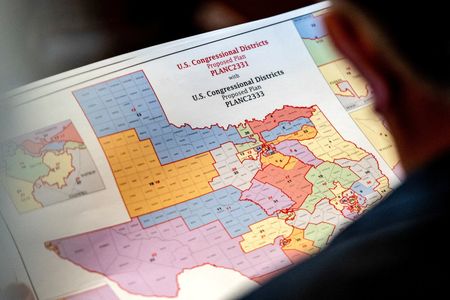
Following urging from the former president, Republican-controlled Texas redrew its electoral map last year attempting to flip five Democratic-held House seats. Democratic-led California responded by reconfiguring its map to target five Republican-held seats. Multiple other states then joined the redistricting fight.
Democrats faced a setback when the Supreme Court last month weakened a key section of the 1965 Voting Rights Act, allowing Republican-led Southern states to eliminate Democratic-held majority-Black and majority-Latino districts before November’s elections. Black and Latino voters typically support Democratic candidates.
In its 6-3 decision with conservative justices in the majority and liberal justices dissenting, the Supreme Court eliminated one of Louisiana’s two majority-Black House districts. The ruling came on April 29, three days before early voting was scheduled to begin for Louisiana’s May 16 primary.
UCLA law professor Richard Hasen, who created the term “Purcell principle” a decade ago, said the Louisiana ruling’s timing indicates the Supreme Court isn’t particularly concerned about preventing electoral disruption under this legal concept.
“The court issued the opinion as people were voting, knowing it was going to lead to this frenzy,” Hasen observed. “If the court was actually concerned about upsetting election rules on the eve of an election, it would either have issued (it) earlier or later.”
Four Republican-led Southern states – Louisiana, Tennessee, Alabama and South Carolina – responded by quickly dismantling several House districts with large Black populations before the midterms.
The Supreme Court’s treatment of Alabama’s voting map redistricting may represent the clearest example of its uneven approach.
In January 2022, a federal court prevented Alabama from using a Republican-drawn map that the court determined illegally denied Black voters an additional House district where they would form a majority or near-majority, likely violating the Voting Rights Act.
The following month, the Supreme Court decided this disputed voting map, which benefits Republicans, must stay in place to avoid disrupting the primary election scheduled more than three months later.
Justice Brett Kavanaugh, in a concurring opinion joined by fellow conservative Justice Samuel Alito, said the election was too close to permit map changes.
“When an election is close at hand,” Kavanaugh wrote, “the rules of the road must be clear and settled.”
Four years later, the court’s conservatives appear to have disregarded those concerns. On May 11, eight days before Alabama’s scheduled primaries, they allowed the state to return to that same map, removing a judicial order that had blocked its implementation. The Supreme Court offered no explanation for its decision.
Republican Governor Kay Ivey immediately delayed the scheduled primaries for four House districts whose boundaries change under the map, effectively nullifying votes already cast in those races.
Loyola Marymount University law professor Justin Levitt said conservative justices seem to have replaced the Purcell principle’s broad requirement for judicial restraint with a new approach: “When we like what’s happening, we rule.”
“I am not quick to accuse the court of indulging purely partisan leanings, but man, oh man, they’re making it real difficult to try and figure out what they’re doing, if not that,” said Levitt, who worked as a White House adviser on democracy and voting rights under the previous Democratic administration.
Some confusion around the court’s Purcell principle decisions may result from these rulings being issued under the court’s emergency docket, or “shadow docket.” In such instances, the court responds to emergency requests, often without providing legal reasoning.
“Part of the problem with the Purcell principle is that it’s never been fully explained in a majority opinion,” Hasen noted. “There’s no hard-and-fast rule.”