
WASHINGTON — President Donald Trump’s administration turned to the nation’s highest court to advance its aggressive immigration agenda, and for the most part, the Supreme Court delivered — with one notable exception involving birthright citizenship.
Time and again, federal courts at lower levels had blocked the administration’s immigration moves. But the Supreme Court stepped in to allow the government to strip temporary legal protections from people who fled war zones and natural disasters, give border officers more authority over green card holders returning from overseas, and restrict how many people can seek asylum at the southern border.
Still, when it came to the question of who qualifies as an American citizen at birth, the court held its ground. Rather than enabling what would have been a historic redefinition of American citizenship, the justices upheld the principle that being born on U.S. soil — regardless of a parent’s immigration status — makes a person a citizen.
Each of these rulings carries significant implications for people trying to build lives in the United States, and may influence how the rest of the world views America as a destination for those seeking a better life.
The Trump administration had sought to deny automatic citizenship to children born in the U.S. to parents who are in the country illegally or on temporary visas. A closely divided court — five justices to four — rejected that effort, reaffirming the long-established reading of the 14th Amendment, which was ratified following the Civil War. Under that interpretation, nearly anyone born on American soil is automatically a citizen.
The ruling was a setback for one of Trump’s signature second-term priorities. He had signed an executive order attempting to limit birthright citizenship on his very first day back in office, though legal challenges kept it from ever taking effect.
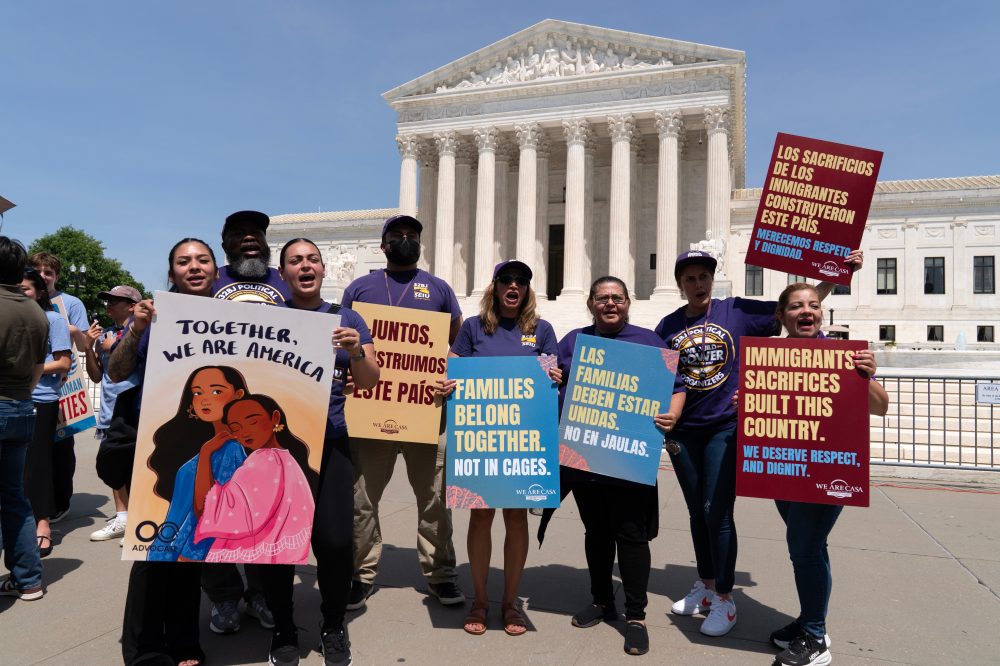
Advocates celebrated the decision, while some Republican lawmakers called for alternative methods to curtail birthright citizenship.
Mark Krikorian, who leads the Center for Immigration Studies — an organization that supports reducing immigration levels — argued the ruling makes the administration’s push for mass deportations even more critical. He said the goal would be to remove people in the country illegally before they have children born on U.S. soil.
Krikorian also said work and student visa programs need to be “tightened up” to prevent people from coming to the U.S., having children, and thereby gaining a citizen family member. He even floated the idea of the State Department adding a pregnancy question to tourist and other visa applications.
“I think it’s going to have real policy impact,” Krikorian said.
In a separate 6-3 ruling announced June 25, the court allowed the administration to end Temporary Protected Status — a form of legal shelter — for migrants from Haiti and Syria who had fled violence and natural disasters. The decision potentially leaves hundreds of thousands of people unable to legally work in the U.S. and at risk of deportation by Immigration and Customs Enforcement.
Since returning to the White House in January 2025, the administration has moved to eliminate these protections for people from 13 countries, including some protections that had been in place for more than a decade.
Republican critics have long argued that what is supposed to be temporary protection ends up becoming permanent. Immigration attorneys, however, contend that places like Haiti and Syria remain too dangerous for people to return.
The court’s conservative majority concluded that federal law does not permit courts to second-guess the process immigration officials use when revoking these protections. The court had previously sided with the administration in a similar case involving people from Venezuela.
It remains uncertain how quickly the ruling will lead to ICE attempting to deport affected Haitians and Syrians, but fear of that possibility has already spread through Haitian communities across the country.
David Bier, who directs immigration studies at the Cato Institute, a libertarian think tank that favors more open immigration, said the impact of the ruling goes far beyond the roughly 350,000 Haitians and 6,000 Syrians directly covered by the case. He noted that approximately 1 million additional people hold Temporary Protected Status, and said the ruling effectively strips them of any meaningful ability to challenge the administration’s decisions.
“It just fully closed the door to any challenges,” Bier said.
Under existing U.S. law, any migrant who reaches American soil has the right to apply for asylum. While the number of migrants arriving at the southern border has dropped sharply under the Trump administration, asylum applications had surged dramatically in prior years.
A policy known as asylum-metering — which caps the number of people allowed to file asylum claims each day at the southern border — was originally launched during the Obama administration and later expanded during Trump’s first term. The Supreme Court’s ruling clears the path for the current administration to potentially bring that policy back, though it is not currently in use.
The administration maintained that asylum-metering was a necessary management tool, arguing that people turned away could simply return later. Critics countered that the policy previously created chaos and a humanitarian emergency in Mexico, where thousands of people waited for months in makeshift camps.
In yet another 6-3 ruling, the court gave immigration officers expanded authority over how they handle green card holders who return to the U.S. after traveling abroad.
The case centered on Muk Choi Lau, a lawful permanent resident who was placed on immigration parole and had his green card taken away in 2012 when he returned from a brief trip to China. He had been accused — though not convicted — of a counterfeiting offense. Lau argued the officer had exceeded their legal authority. He later pleaded guilty to selling counterfeit clothing in New Jersey, and that conviction gave the Department of Homeland Security — at the time under the Obama administration — a simpler avenue to pursue his removal from the country.
Justice Ketanji Brown Jackson, writing in dissent, expressed concern that the ruling handed the government a “massive blank check” when it comes to dealing with the millions of lawful permanent residents who travel internationally.
The American Immigration Council, an advocacy organization, noted in a post-ruling analysis that Congress had established special protections for green card holders who travel abroad, making it more difficult to detain or deport them. Those protections do have limits — including for individuals who have committed certain crimes in the U.S. — but the council said many questions remain about how broadly the ruling will be applied, and it expects the government to push for an expansive interpretation.