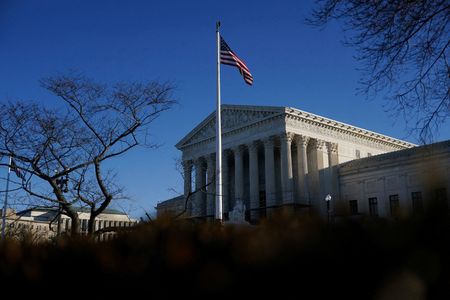

The U.S. Supreme Court delivered a major setback to President Donald Trump’s trade strategy on Friday, ruling that his extensive use of emergency powers to impose tariffs went beyond presidential authority in a 6-3 decision with far-reaching economic consequences.
Chief Justice John Roberts, writing for the conservative-led majority, determined that Trump’s application of the 1977 International Emergency Economic Powers Act (IEEPA) overstepped constitutional boundaries. The court concluded that this emergency law did not provide Trump with the tariff authority he asserted.
“Our task today is to decide only whether the power to ‘regulate … importation,’ as granted to the president in IEEPA, embraces the power to impose tariffs. It does not,” Roberts stated in the decision, referencing the statutory language Trump’s administration used to defend the widespread import taxes.
The White House declined to provide immediate reaction to the court’s ruling. However, Democratic leaders and business organizations praised the outcome.
Several justices in the majority also determined that Trump’s interpretation would encroach upon congressional authority and breach the “major questions” doctrine. This legal principle, favored by conservative justices, mandates that executive branch actions with “vast economic and political significance” must receive explicit congressional approval. The court previously applied this doctrine to block several key initiatives from former Democratic President Joe Biden.
Roberts referenced earlier Supreme Court precedent, writing that “the president must ‘point to clear congressional authorization’ to justify his extraordinary assertion of the power to impose tariffs,” concluding: “He cannot.”
The Chief Justice explained that had Congress intended IEEPA to grant presidents “the distinct and extraordinary power to impose tariffs, it would have done so expressly — as it consistently has in other tariff statutes.”
Trump has made tariffs — essentially taxes on foreign goods — a cornerstone of his economic and diplomatic approach. These trade measures have been fundamental to a worldwide trade conflict Trump launched during his second presidency, straining relationships with trading partners, disrupting financial markets and creating global economic instability.
The high court reached this verdict following a legal challenge brought by affected businesses and twelve U.S. states, predominantly under Democratic leadership, contesting Trump’s unprecedented application of emergency law to unilaterally establish import taxes.
Conservative Justices Clarence Thomas, Samuel Alito and Brett Kavanaugh formed the dissenting minority. Roberts was joined by conservative Justices Neil Gorsuch and Amy Coney Barrett, both Trump appointees from his first presidency, alongside liberal Justices Sonia Sotomayor, Elena Kagan and Ketanji Brown Jackson.
The liberal justices did not endorse the portion of the ruling citing the major questions doctrine.
The Supreme Court, maintaining a 6-3 conservative composition, had previously supported Trump in multiple emergency decisions since his return to office in January 2025 after lower courts blocked his policies.
Economic projections suggested Trump’s tariffs would produce trillions in revenue over the coming decade for the United States, which maintains the world’s largest economy.
Trump’s administration has withheld tariff collection figures since December 14. However, Penn-Wharton Budget Model researchers estimated Friday that collections from Trump’s IEEPA-based tariffs exceeded $175 billion. This substantial sum would likely require refunding following the Supreme Court’s adverse ruling on IEEPA-based tariffs.
CONGRESSIONAL AUTHORITY
The Constitution assigns Congress, rather than the president, responsibility for taxation and tariff authority. However, Trump bypassed this by utilizing IEEPA’s statutory powers to establish tariffs on virtually all U.S. trading partners without congressional consent. Trump implemented additional tariffs under separate laws not challenged in this case. Government data from October through mid-December indicates these represent approximately one-third of Trump-imposed tariff revenue.
IEEPA permits presidential regulation of commerce during national emergencies. Trump became the first president to employ IEEPA for tariff implementation, representing one of numerous ways he has aggressively expanded executive power since returning to office across diverse areas including immigration enforcement, federal official dismissals, domestic military deployment and overseas military actions.
Kavanaugh, also a Trump first-term appointee, authored a dissenting opinion arguing that IEEPA’s language, historical context and previous Supreme Court decisions supported the Trump administration’s stance.
“Like quotas and embargoes, tariffs are a traditional and common tool to regulate importation,” Kavanaugh wrote in his dissent, joined by Thomas and Alito.
“The tariffs at issue here may or may not be wise policy,” Kavanaugh continued. “But as a matter of text, history, and precedent, they are clearly lawful. I respectfully dissent.”
Kavanaugh also warned the decision might affect existing trade agreements.
“Because IEEPA tariffs have helped facilitate trade deals worth trillions of dollars—including with foreign nations from China to the United Kingdom to Japan, the Court’s decision could generate uncertainty regarding various trade agreements,” Kavanaugh explained.
Trump characterized the tariffs as essential for U.S. economic security, warning the nation would face vulnerability and ruin without them. Speaking to reporters in November, Trump stated that without his tariffs “the rest of the world would laugh at us because they’ve used tariffs against us for years and took advantage of us.” Trump claimed the United States suffered exploitation by other nations including China, the world’s second-largest economy.
Candace Laing, president and CEO of the Canadian Chamber of Commerce, characterized the decision as a legal determination rather than a trade policy revision.
“Canada should prepare for new, blunter mechanisms to be used to reassert trade pressure, potentially with broader and more disruptive effects,” Laing stated.
Following Supreme Court arguments in November, Trump indicated he would explore alternatives if the court ruled against his tariff authority, telling reporters “we’ll have to develop a ‘game two’ plan.”
Treasury Secretary Scott Bessent and other administration officials announced the United States would pursue alternative legal justifications to maintain as many Trump tariffs as possible. These alternatives include statutory provisions allowing tariffs on imports threatening U.S. national security and another permitting retaliatory measures including tariffs against trading partners the U.S. Trade Representative determines have employed unfair trade practices against American exporters.
These alternatives lack the flexibility and immediate impact that IEEPA provided Trump, and may not replicate his tariffs’ full scope quickly.
Senate Democratic Leader Chuck Schumer hailed the decision as a “victory for the wallets of every American consumer,” adding: “Trump’s illegal tariff tax just collapsed. He tried to govern by decree and stuck families with the bill. Enough chaos. End the trade war.”
Democratic Senator Elizabeth Warren said the ruling left numerous questions unresolved.
“The Court has struck down these destructive tariffs, but there is no legal mechanism for consumers and many small businesses to recoup the money they have already paid. Instead, giant corporations with their armies of lawyers and lobbyists can sue for tariff refunds, then just pocket the money for themselves,” Warren stated.
ENHANCED NEGOTIATING POSITION
Trump’s capability to immediately impose tariffs on any trading partner’s products under declared national emergency status increased his negotiating leverage with other nations. This brought world leaders rushing to Washington seeking trade agreements that frequently included commitments for billions in investments or enhanced market access for U.S. companies.
However, Trump’s use of tariffs as a foreign policy weapon has successfully alienated numerous countries, including those traditionally considered America’s closest allies.
IEEPA had historically been employed for imposing sanctions on adversaries or freezing their assets, not establishing tariffs. The law contains no specific mention of tariffs. Trump’s Justice Department argued that IEEPA permits tariffs by authorizing presidential authority to “regulate” imports during emergencies.
The Congressional Budget Office estimated that maintaining all current tariffs, including IEEPA-based duties, would generate approximately $300 billion annually over the next decade.
Total U.S. net customs duty receipts reached a record $195 billion in fiscal 2025, ending September 30, according to Treasury Department data.
On April 2, designated by Trump as “Liberation Day,” the president announced “reciprocal” tariffs on goods from most U.S. trading partners, invoking IEEPA to address what he termed a national emergency related to U.S. trade deficits, despite America running trade deficits for decades.
In February and March 2025, Trump invoked IEEPA to impose tariffs on China, Canada and Mexico, citing fentanyl trafficking and illegal drug smuggling into the United States as constituting a national emergency.
SECURING CONCESSIONS
Trump has employed his tariffs to secure concessions and renegotiate trade agreements, and as punishment for countries that anger him on non-trade political issues. These have included Brazil’s prosecution of former president Jair Bolsonaro, India’s Russian oil purchases that fund Russia’s Ukraine war, and an anti-tariffs advertisement by Canada’s Ontario province.
IEEPA was enacted by Congress and signed by Democratic President Jimmy Carter. In creating the measure, Congress imposed additional presidential authority restrictions compared to predecessor legislation.
The tariff cases before the justices involved three separate lawsuits.
The Washington-based U.S. Court of Appeals for the Federal Circuit supported five small importing businesses in one challenge, and the states of Arizona, Colorado, Connecticut, Delaware, Illinois, Maine, Minnesota, Nevada, New Mexico, New York, Oregon and Vermont in another.
Additionally, a Washington-based federal judge supported a family-owned toy company called Learning Resources.