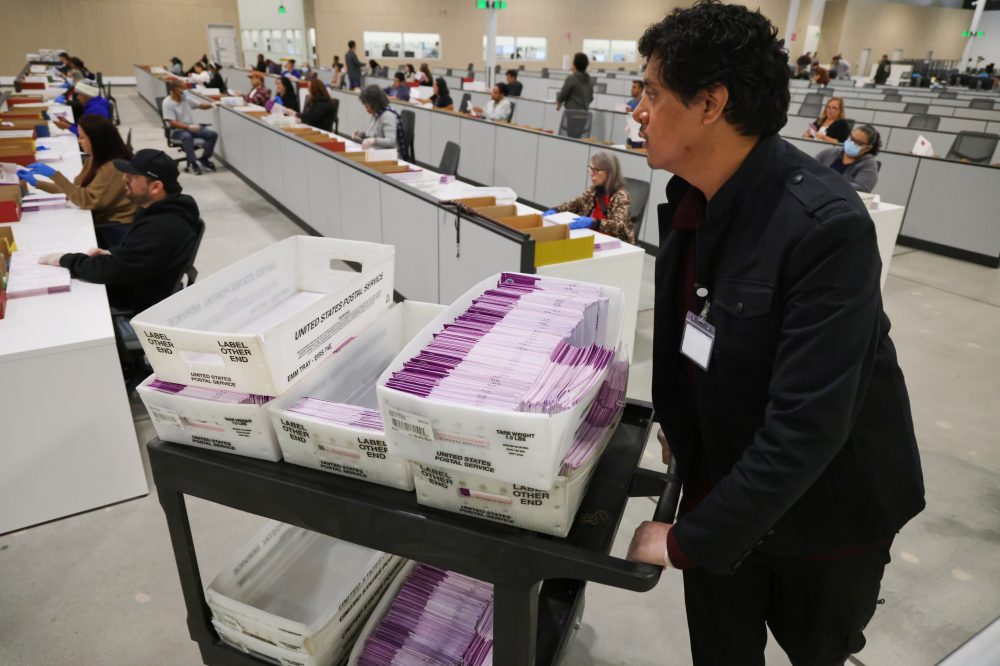

Following Monday’s Supreme Court arguments about mail ballot deadlines, Nevada’s top election official Cisco Aguilar immediately contacted his team with urgent instructions: prepare contingency plans for November’s midterm elections in case the justices alter current rules when they announce their decision this June.
“The challenge is educating voters shortly before the election how the election is going to work,” stated Aguilar, a Democrat. “That doesn’t happen overnight. The election planning happens long before.”
Officials across Nevada and 13 additional states that currently accept regular mail ballots arriving after Election Day closely monitored Monday’s oral arguments, where conservative justices seemed doubtful about existing grace periods. Another 15 states maintain similar extensions exclusively for military and overseas ballots.
Absentee ballots have become a target of unfounded conspiracy theories from former President Donald Trump, who falsely attributes his 2020 defeat to mail voting irregularities. The current Supreme Court case stems from a lawsuit by the Republican National Committee and Libertarian Party challenging Mississippi’s policy of counting mail ballots postmarked by Election Day that arrive within five additional days.
During nearly two hours of legal arguments, Justice Brett Kavanaugh, part of the court’s six-member conservative majority, questioned RNC lawyer Paul Clement about whether a June ruling might violate judicial precedent against disrupting imminent elections.
Clement responded that “June would give them plenty of time” for election administrators to adapt to November voting requirements.
However, Tammy Patrick, former Arizona election administrator and current chief programs officer at the National Association of Elections Officials’ Election Center, disputes this timeline. She explained that most election departments have already produced informational materials, signage, and ballot envelopes featuring existing deadlines for November use. These materials, typically prepared months or years ahead to reduce costs, would require expensive emergency reprinting.
“Nobody has put in their budget to reprint all of their educational material for the midterms,” Patrick explained. “That’s the hard spot election administrators are in.”
The Supreme Court case affects only a small percentage of ballots cast during election cycles.
Nevada statistics show 98% of mail ballots arrive before Election Day, with 95% of remaining ballots arriving the following day. In Illinois, another state permitting late arrivals, 106,000 ballots came during the state’s 14-day extension period in 2024, representing less than 2% of 5.5 million total votes.
Illinois State Board of Elections spokesman Matt Dietrich identified voter education as the primary obstacle if mail ballot deadlines change, saying his agency would collaborate with local election offices to communicate new requirements.
Alaska’s vast geography and remote communities accessible only by aircraft make the state’s 10-day grace period essential for many residents.
Michelle Sparck from Get Out the Native Vote expressed alarm about potential changes: “The thought that the outcome of Watson v. RNC could reshape elections as soon as June is horrifying to me, and for thousands of Alaskans who will have to rethink the way they approach voting by Election Day.”
Massachusetts faces particular scheduling constraints with its September 1st primary date, preventing earlier general election ballot distribution, according to secretary of state office spokeswoman Debra O’Malley.
“You can’t turn these things around on a dime,” O’Malley warned, expressing concern about inflexible timelines if the Supreme Court demands rapid changes.
Patrick noted that election administrators increasingly struggle with sudden voting law modifications following Trump’s election challenges. Texas alone introduced 3,000 election-related legislative proposals last year, requiring officials to prepare for potential changes months beforehand.
This situation relates to the Supreme Court’s “Purcell principle,” established in a 2006 Arizona case where justices reversed a decision striking down voter ID requirements close to election time, ruling that courts shouldn’t modify procedures near voting dates.
Patrick worked in Arizona’s Maricopa County elections office during that period.
“When the rules of engagement change too close to the election, you don’t have sufficient time to notify the electorate and make clear that policy change,” she observed.
She worries that sudden rule changes could disproportionately affect rural voters who experience slower mail delivery, creating the highest disenfranchisement risk.
While Aguilar expects Nevada officials will adapt to whatever decision emerges, he remains troubled by potential disruption.
“To change the rules of the game in the middle of the competition does not do anyone any good,” he concluded.