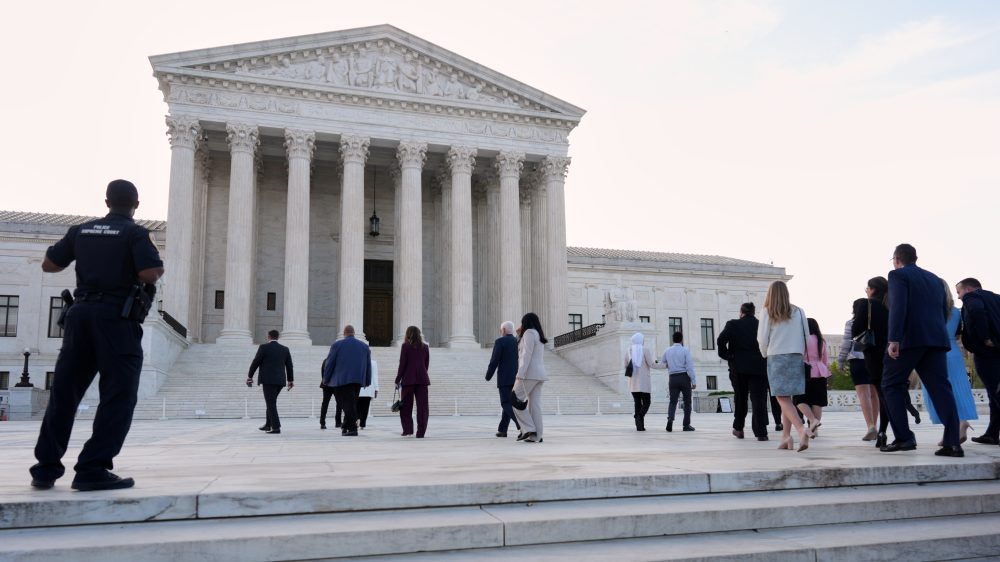

WASHINGTON — The nation’s highest court convened at 10 a.m. today to consider whether President Donald Trump’s executive directive eliminating birthright citizenship violates the Constitution.
Trump issued the controversial directive on January 20, 2025, his first day back in office, targeting children born on U.S. soil to parents who are in the country without legal status or on temporary visas. The measure represents a cornerstone of his administration’s sweeping immigration enforcement agenda.
Making history, Trump became the first sitting president ever to observe oral arguments at the Supreme Court. His attendance breaks with longstanding tradition, as presidents typically avoid the courtroom to preserve the separation of powers and prevent any appearance of attempting to influence the independent judiciary.
Federal courts nationwide have unanimously blocked the order from being implemented, declaring it unconstitutional. The Supreme Court’s final decision, anticipated by early summer, will definitively settle the matter.
UCLA constitutional law professor Adam Winkler told The Associated Press that Trump’s decision to attend demonstrates the case’s critical importance to his presidency. However, Winkler noted that the president’s presence “is unlikely to sway the justices,” explaining that Supreme Court justices “pride themselves in their independence, even if some agree with much of Trump’s agenda.”
Winkler added that “Trump’s presence will make the atmosphere a little bit more circus-like” for the justices during proceedings.
Solicitor General D. John Sauer, who previously clerked for Justice Antonin Scalia, will present the administration’s case in his ninth Supreme Court appearance. His most notable victory came in securing the presidential immunity ruling that protected Trump from prosecution related to January 6th election challenges.
Representing the opposition, ACLU legal director Cecillia Wang, daughter of Chinese immigrants, will make her second Supreme Court argument. During Trump’s previous presidency, she lost a 5-4 immigration case before the conservative-majority court.
The proceedings included ceremonial elements, with Trump and First Lady Melania Trump participating in traditional rituals for new justices. This ceremony had been postponed for Justice Amy Coney Barrett due to the COVID-19 pandemic.
Justice Clarence Thomas, at 77 the court’s senior member, continues to ask initial questions before general questioning begins, a pandemic-era accommodation that has continued. The court routinely extends beyond scheduled time limits since resuming in-person sessions.