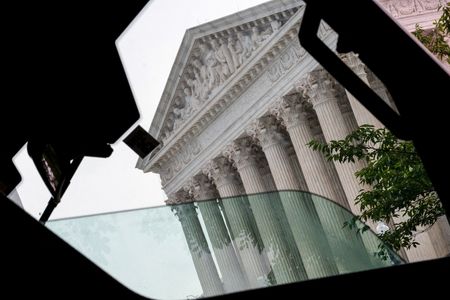

WASHINGTON — In a landmark ruling that legal scholars are calling a historic shift in American governance, the U.S. Supreme Court on Monday handed President Donald Trump sweeping authority to remove the heads of federal regulatory agencies, capping what experts describe as a decades-long conservative effort to tighten presidential control over the executive branch.
The 6-3 decision, driven by the court’s conservative majority, established that a president has the authority to remove agency officials who exercise executive power. Among those affected was Democratic Federal Trade Commission member Rebecca Slaughter, whose termination was upheld by the court even though federal law had provided her with protections against removal.
The court did draw one notable line, signaling that its ruling should not be interpreted as threatening the independence of the Federal Reserve. The justices described the nation’s central bank as having a unique historical standing, and in a separate case decided the same day, refused to allow Trump to remove Federal Reserve Governor Lisa Cook.
Legal experts said the FTC ruling delivered a devastating blow to what is commonly called the “administrative state” — the vast web of federal agencies that oversee critical areas of American life, including financial markets, air travel safety, and labor relations, which had until now largely operated free from direct presidential control.
The ruling is also being viewed as the high point of the “unitary executive” theory — a conservative legal doctrine that gained traction during the presidency of Republican Ronald Reagan in the 1980s. That theory holds that the president has sole authority over the entire executive branch of the federal government, including the power to hire and fire agency leaders at will.
University of North Carolina School of Law professor Michael Gerhardt described Monday’s FTC ruling as “the most significant decision expanding presidential power in decades.”
“This is definitely the biggest win yet for the unitary theory of the executive,” Gerhardt said, calling it “the culmination of years of planning by conservative groups.”
“The administrative state,” Gerhardt added, “just shrank to nearly a nullity.”
John Yoo, a professor at the University of California, Berkeley School of Law, noted that the ruling gives the president control over an administrative structure that was largely built and expanded by Democratic former Presidents Franklin Roosevelt, Lyndon Johnson, and Barack Obama.
“The presidency just gained the most constitutional power, at any one time, in Slaughter than in any other single case in Supreme Court history,” Yoo said, referring to the case by its name, Trump v. Slaughter. “There is no more independent administrative state.”
Slaughter, who was appointed by Democratic former President Joe Biden, was one of two Democratic FTC commissioners Trump moved to dismiss in March 2025 from the consumer protection and antitrust agency. Her term had been set to run through 2029.
In her legal challenge, Slaughter pointed to a 1914 law that only permitted a president to remove FTC commissioners for specific reasons — such as inefficiency, neglect of duty, or misconduct — not simply over policy disagreements. Comparable protections had shielded officials at more than two dozen other independent agencies, including the National Labor Relations Board and the Merit Systems Protection Board.
Lower courts had sided with Slaughter, upholding those job protections under a 1935 Supreme Court ruling in a case known as Humphrey’s Executor v. United States. That earlier decision had recognized Congress’s authority to shield leaders of certain regulatory agencies from being removed by the president at will.
In the Humphrey’s Executor ruling, the court had blocked President Roosevelt’s attempt to fire an FTC member over policy differences, reasoning that the FTC performed functions more similar to legislative and judicial work than purely executive duties. The Trump administration argued, however, that the modern FTC had grown far more powerful in the decades since that 1935 ruling, effectively making it obsolete.
The Supreme Court agreed Monday, overturning Humphrey’s Executor. The court’s three liberal justices dissented.
Christine Chabot, a professor at Marquette University Law School in Wisconsin, said, “The court’s decision to overrule Humphrey’s Executor is the biggest win to date for the ‘unitary executive’ theory.”
Erwin Chemerinsky, dean of the University of California, Berkeley Law School, predicted the ruling will lead to greater politicization of federal regulatory agencies that Congress had intended to be run by nonpartisan experts.
“I think agency independence is now gone,” Chemerinsky said. “Agencies, like cabinet departments, will need to do what the president wants.”
Analysts say the practical result may be wider swings in regulatory policy each time a presidential administration from one party replaces the other.
University of Illinois Chicago law professor Steve Schwinn, who was critical of the decision, said he expects it will produce the “hyper-politicization of previously independent federal agencies.”
“I fear that we as a people won’t fully appreciate the impacts for years or decades,” Schwinn said.