
CONCORD, N.H. (AP) — Back in the 1970s during her high school years, Lori Guess would eagerly pack her oboe each summer for music camp in Sidney, Maine. She was drawn to the peaceful lakeside setting with its haunting loon calls and the opportunity to bond with fellow musicians.
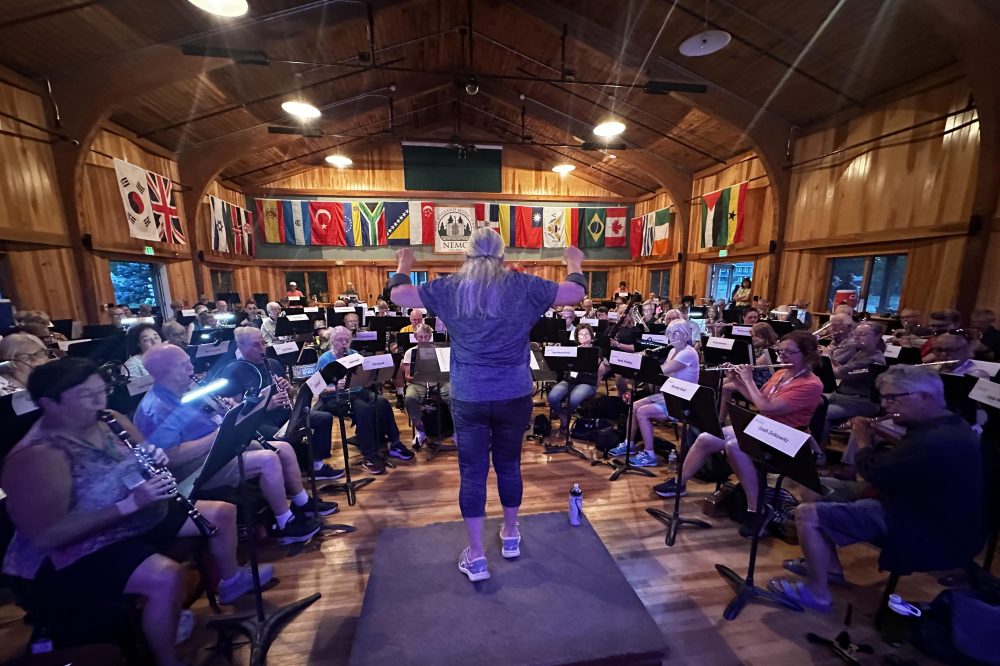
Now, more than five decades later, Guess continues returning to that same location. When an adult band program launched there in 2013, she enthusiastically joined and even picked up a new instrument — the trumpet.
“I was thrilled because I love this place,” said Guess, 71, of Baltimore, a retired lawyer for the U.S. Department of Defense who plans to return to the New England Adult Music Camp in August. “It is serene, beautiful, a perfect setting. And it’s not all that different from what it was 50-some years ago.”
Across America, adults seeking to reconnect with old friends, sharpen their musical abilities, or simply enjoy personal time after years of supporting their children’s activities can choose from numerous summer music programs. These camps span genres from electronic and folk to rock, jazz, chamber music, and opera.
Many participants find these camps provide a pathway to recapture the memorable musical moments of their younger days while building fresh friendships.
“Emotionally, making music is good for the soul,” said Carole Lieberman, a California-based forensic psychiatrist who has played multiple instruments herself. “It makes you feel creative, allows you to provide the music you like for yourself and can boost your spirits.”
“Cognitively, research demonstrates that learning to play a musical instrument and playing it helps your brain make better neurological connections,” she added. “It can help to ward off dementia.”
For Guess, creating music means entering “that zone” alongside fellow musicians.
“When you’re playing music together, you rise above all the pettiness of life,” she said. “And it’s just the most spiritual thing I can think of.”
These programs accommodate musicians of all skill levels. Camp directories published by organizations like Musical America Worldwide and The Instrumentalist feature listings that clearly indicate beginner, intermediate, and advanced options.
Michigan’s Interlochen Center for the Arts, where Guess participated in band camp during middle school, has expanded to provide various adult summer music programs, including an August weeklong Symphonic Band Camp designed for seasoned players.
Since starting in 1983, the Midsummer Musical Retreat in Walla Walla, Washington, has expanded to feature numerous performance ensembles of different sizes accommodating various skill levels.
Pennsylvania’s Susquehanna University in Selinsgrove hosts the Band Camp for Adult Musicians, where intermediate and advanced players receive instruction from former military musicians and university faculty.
The Pennsylvania camp’s creator drew inspiration from his children’s band camp experiences, according to director Leigh Hurtz.
Currently in its 37th year, the program attracts many retirees who have participated together for decades. Some bring their children and grandchildren along.
“They were lawyers or doctors, or working full-time, mothers,” Hurtz said. “There are also people who sold their tuba for a couch in college so they could have a couch, and 20 years later, it’s like, ‘I need a tuba again!’”
Beyond performances, these camps develop unique customs. Pennsylvania’s program kicks off with a group family dinner. Walla Walla features camper-produced comedy skits. New England organizes campfire gatherings and lobster feasts. Participants typically enjoy additional activities like kayaking, yoga, social hours, or open mic performances either solo or with small groups of fellow campers.
Many camps feature specialized workshops focusing on particular styles or instruments including jazz, percussion circles, klezmer, German band music, and ukulele, plus educational sessions covering performance anxiety and music theory.
Linda Haller, 70, of Laconia, New Hampshire, discovered a local adult community band promoting “music for life” a few years after retiring from her career as an obstetrician-gynecologist. This motivated her to return to clarinet, which she hadn’t touched since high school.
“It hasn’t all come back, but I’m getting to the point where I think I’m playing almost as good as I did back then,” she said. Haller, who also plays piano, said the rhythms and counting came right back to her.
She participated in the Sidney, Maine camp for two summers, advancing from the beginner ensemble to intermediate level. She particularly valued the fellowship with other musicians.
“Returning to an instrument learned in childhood is powerful because it combines memory, discipline and renewed growth,” said Jonathan Alpert, a psychotherapist based in New York.
“It strengthens attention, fine motor coordination, and memory pathways while reducing stress and improving mood,” Alpert said. “But equally important is the emotional experience of reengaging with something that once required patience and repetition.”
Haller’s community ensemble connects to the New Horizons International Music Association, a nonprofit organization that creates musical opportunities for adults, including those with zero previous experience. Since 1991, this organization has established over 200 bands, orchestras, and choruses globally serving 10,000 adult musicians.
The group’s guiding principle, embraced by other adult music programs, states “Your best is good enough.”
New Horizons operates its own camps, including an “American Music Abroad” journey to the Czech Republic, Austria, and Hungary in June, plus another near Cincinnati, Ohio, in July.
These programs enjoy strong popularity, according to Russ Grazier of Portsmouth, New Hampshire, who instructs at New Horizons camps and serves as artistic director for the New England Adult Music Camp.
He observes that ensemble participation among adults over 60 has grown from roughly 150 to 300 people at a regional music and arts center under his leadership. He believes social connection drives this growth.
“And that’s something missing from a lot of people’s lives these days,” Grazier said. “So any time we have an opportunity to have a space outside of the home where we’re connecting with new people and sharing a common interest, it has remarkable benefits for our health and our aging.”