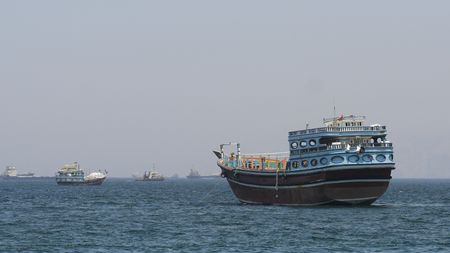

Commercial vessel movement through the strategically important Strait of Hormuz remained virtually nonexistent Monday, despite President Donald Trump’s announcement that American forces would work to restore shipping access through the waterway.
Maritime tracking data from MarineTraffic revealed only minimal activity on Monday, with just one sanctioned liquefied petroleum gas tanker of modest size making the passage, accompanied by several cargo vessels and one cable-laying ship entering the Gulf of Oman.
No commercial tankers or other merchant vessels were observed waiting to make the transit, and major German shipping company Hapag-Lloyd reported that passage for their fleet remained unfeasible due to unclear security protocols.
The US Central Command announced Monday it would initiate operations to help reestablish safe navigation through the strait while maintaining its blockade of Iranian ports.
However, the shipping industry has not received any operational guidance about the American initiative or its objectives, with overall security conditions remaining unchanged, according to the Baltic and International Maritime Council, which issues safety advisories for the maritime sector.
“Without consent from Iran to let commercial ships transit safely through the Strait of Hormuz, it is currently not clear whether the Iranian threat to ships can be degraded or suppressed,” stated Jakob Larsen, the organization’s chief safety and security officer.
The International Maritime Organization reports that hundreds of commercial ships and as many as 20,000 sailors have been prevented from using the waterway due to the ongoing conflict with Iran.
The US-led Joint Maritime Information Center maintained that the maritime security threat level in the strait remained at “critical” status, recommending that mariners consider alternative routes through Omani territorial waters south of established shipping lanes.
Central Command characterized American missions as “defensive” operations that would blend diplomatic initiatives with military coordination.
Iran responded by warning US naval forces to avoid the Strait of Hormuz and declaring that commercial ships would need to coordinate any transit with Iranian military forces. Tehran also released a new chart showing what it claims as its area of control.
Pakistan announced that all 22 crew members from the Iranian-flagged container vessel Touska, which was seized by US forces last month, had been evacuated to Pakistan and would be sent home.
The ship will also be returned to its owners following repairs, Pakistan’s foreign ministry stated, describing the action as a “confidence-building measure.”
The US naval blockade established at Iranian ports on April 13 has also reduced Tehran’s petroleum exports.