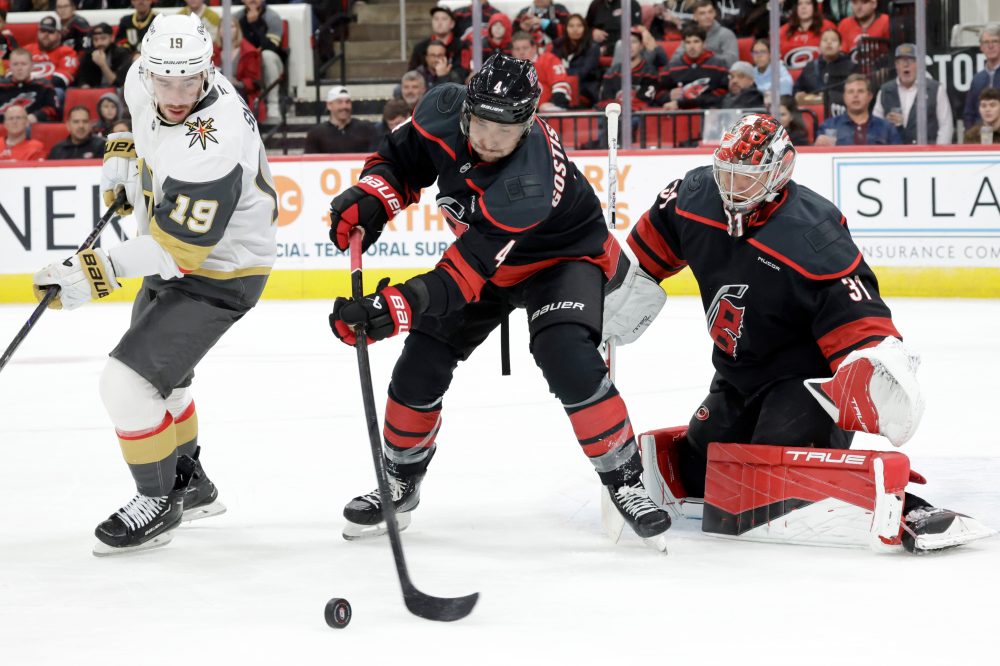

RALEIGH, N.C. — The championship series between the Vegas Golden Knights and Carolina Hurricanes appears remarkably balanced, leaving little room for mistakes.
The Golden Knights have captured 12 victories in 16 playoff contests, including a complete sweep of Colorado in the Western Conference final, while the Hurricanes have secured 12 wins in 13 games. Both teams rank among the top three in fewest goals allowed, with each squad averaging more than three goals per contest.
What factor will tip the scales in this matchup between two NHL elite teams? The answer lies in special teams performance.
The Hurricanes boast an impressive penalty kill operating at 92.5% effectiveness, surrendering just four goals while netting one short-handed score.
“Carolina’s been an elite penalty-killing team for years now and that’s part of their identity and that comes from their puck pressure and their sticks, their discipline — all that kind of stuff,” said goaltender-turned-NHL Network analyst Cory Schneider. “Vegas will have its work cut out for itself.”
The Golden Knights have demonstrated their own excellence in this area. Vegas has surrendered only six power-play goals across three playoff rounds while recording four short-handed tallies.
Defenseman Brayden McNabb, a veteran since the franchise’s first season in 2017-18, has anchored this effort, accumulating over 45 total minutes on penalty kill duty. Three additional crucial contributors are players that general manager Kelly McCrimmon acquired during the season.
Netminder Carter Hart, despite facing scrutiny regarding his role, has turned aside 64 of 70 shots during opposing power plays. Defenseman Rasmus Andersson, obtained before the Olympic break, and center Nic Dowd, added just before the trade deadline, have joined McNabb as primary penalty killers.
This has become a dependable strength for the Hurricanes, with stay-at-home defenseman Jaccob Slavin logging over 56 minutes of short-handed ice time. Coach Rod Brind’Amour’s squad employs consistent structural play throughout games, reaching peak effectiveness in penalty kill situations when the three or four skaters protecting goalie Frederik Andersen work in unison.
The Golden Knights’ power play has converted 11 times in 46 chances, producing a 24% success rate. Captain Mark Stone and winger Pavel Dorofeyev have contributed four goals each, while centers Jack Eichel and Tomas Hertl have recorded six power-play assists apiece.
“I find the Vegas power play to be more threatening,” Schneider noted. “Can Carolina quiet Vegas’ power play and force them 5 on 5 in order to beat them?”
The more pressing question concerns whether Carolina’s power play can match that production. The Hurricanes have scored 7 times in 56 opportunities, a 12.5% conversion rate that proved sufficient against Ottawa, Philadelphia and Montreal.
However, Vegas represents “a different animal,” as Brind’Amour acknowledged.
“Carolina’s got a good power play, don’t get me wrong, but I think that could be a bit of a wash and Carolina’s going to have to try to generate more 5-on-5 offense than rely on their power play like Vegas should,” Schneider explained.
Considering both teams’ ability to score during even-strength play, maintaining discipline becomes crucial. Avoiding penalties and playing 5-on-5 hockey favors neither side significantly, as the Golden Knights have tallied 34 even-strength goals compared to the Hurricanes’ 30.
Vegas has averaged slightly under four minor penalties per game compared to Carolina’s five infractions. This disparity makes each power-play opportunity more critical, with games becoming battles between two squads led by demanding coaches who emphasize attention to detail.
“They play the right way,” Slavin observed. “They play a very similar style to us. It’s going to be who can do it better and who can stay on it longer? But it’s going to be an awesome series.”