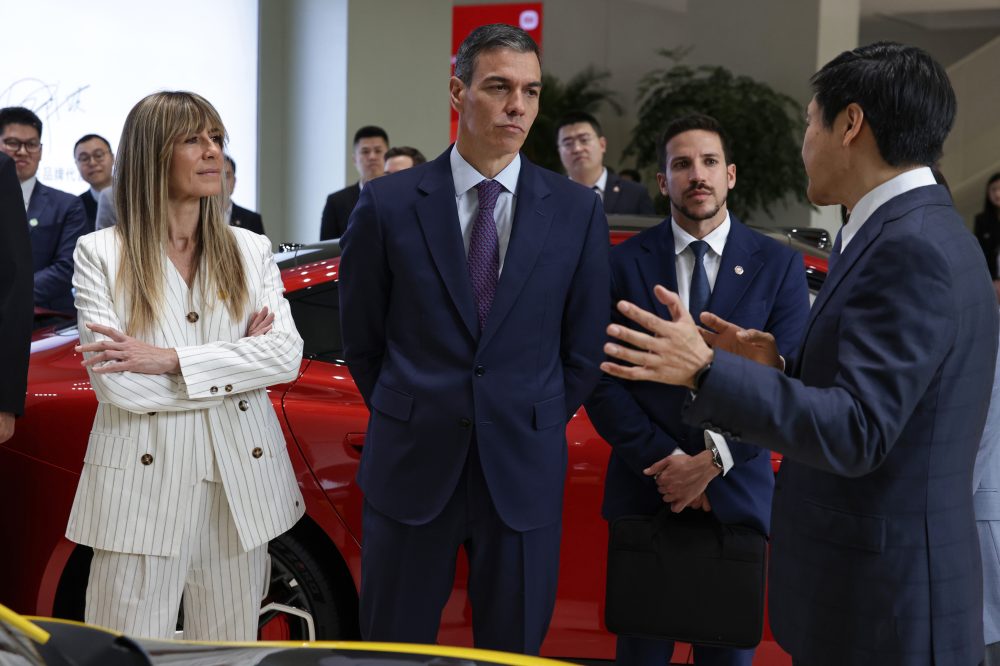

Spanish Prime Minister Pedro Sánchez has arrived in China this week for his fourth visit in four years to the globe’s second-largest economy, as Spain works to build stronger political and economic relationships with Beijing.
The visit occurs during a complicated international period, with European leaders attempting to help end the U.S.-Israeli conflict in Iran. Spain’s relationship with the United States has become tense, particularly because of Sánchez’s strong criticism of the U.S.-Israeli military actions in Iran.
Speaking at Beijing’s Tsinghua University on Monday, Sánchez called on China to take a larger leadership role in a multipolar world, one day before his scheduled meeting with Chinese President Xi Jinping.
“For example, by demanding … that international law be respected and that the conflicts in Lebanon, Iran, Gaza and the West Bank and Ukraine cease,” Sánchez said.
Spain has stated its goal to expand political relationships with major global powers, including Beijing.
Spanish government officials have indicated they want to increase Chinese investment and boost exports to China, despite the fact that trade negotiations are handled by the European Union on behalf of all 27 member nations, including Spain.
The southern European country, which produces more than half of its electricity through renewable energy sources, requires Chinese essential raw materials, solar panels and clean energy technologies — much like other European nations moving away from fossil fuels.
From a political standpoint, this visit happens as Spain has emerged as Europe’s most outspoken opponent of U.S. and Israeli military operations in the Middle East, with Sánchez’s administration recently closing Spanish airspace to U.S. aircraft being used in Iran and denying the U.S. access to jointly operated military facilities in southern Spain.
“Given the increased frictions with the U.S. administration, these annual meetings have taken on an increased importance,” said Eric Sigmon, a Madrid-based political analyst and a former U.S. national security adviser, about Sánchez’s latest trip to China.
Sánchez’s visit to China runs from April 13-15, and will include meetings Tuesday with Xi, Premier Li Qiang and China’s top lawmaker, Zhao Leji, who ranks third in the ruling Communist Party leadership.
Spain, which has the eurozone’s fourth-largest economy, has maintained a less confrontational approach toward China compared to other EU nations in recent years. The country has worked to restructure trade relationships with China, whose exports to Spain significantly exceed those from the Iberian nation of 49 million people to China, which has over 1.4 billion residents.
According to the American Enterprise Institute think tank’s China Global Investment Tracker, while Chinese investment in major EU economies like France and Germany has declined over the past five years, it has increased in Spain since 2019, though investment levels remain lower than several other European countries.
As a medium-sized political power, Spain under Sánchez has expressed its desire to develop stronger bilateral relationships with major global powers and economies, including China and increasingly India, alongside its U.S. relationship.
In November, Spain’s King Felipe VI also conducted an official visit to China, marking the first time in 18 years that a Spanish monarch had done so, highlighting the nation’s commitment to strengthening connections with Beijing.
“The economic and commercial part of the relationship is the most important part. Spain needs foreign capital and it needs investment and it likely sees China as a potential source for that,” said Sigmon.
For China, Spain represents “a more friendly and conciliatory partner in Western Europe,” he noted, adding that the unequal nature of the relationship may make it challenging for Spain to persuade Chinese negotiators to make concessions regarding technology or other areas the Spanish government has shown interest in.