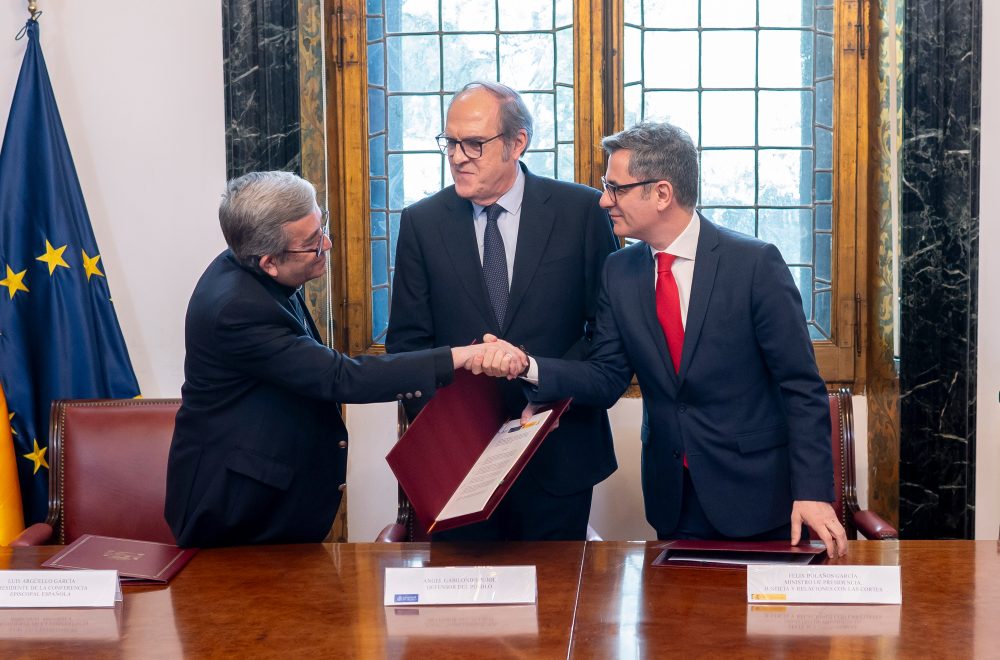

MADRID (AP) — Catholic Church leaders and government officials in Spain finalized paperwork Monday establishing a new compensation framework for individuals sexually abused by clergy members who have since died or whose alleged crimes fall outside prosecution time limits.
Back in January, Spain’s Catholic bishops agreed to allow the nation’s ombudsman to make final decisions regarding church compensation for such victims.
This arrangement, which provides a 12-month period for filing claims, represents an uncommon compromise from Catholic leadership. The framework aims to settle disputes between Spain’s left-leaning administration and church officials regarding victim compensation after survivors criticized the church’s initial internal reparations proposal.
Monday’s signing ceremony formalized the operational details of this collaborative church-government compensation program.
Spanish Episcopal Conference President Archbishop Luis Argüello announced the system will launch April 15th. He noted the documentation deliberately omits specific dollar amounts for potential victim compensation.
“We intentionally avoided including payment scales and specific sums; that wasn’t our focus,” Argüello explained. “We’ve arranged for working groups to develop implementation procedures, but the agreement doesn’t establish payment ranges or fixed amounts.”
Although church leaders across numerous Western European nations have established victim compensation programs — whether church-administered or overseen by independent experts — Spain’s approach stands out due to direct government participation in the process.
Justice Minister Félix Bolaños stated Monday that the program will assess compensation individually, considering elements such as abuse severity, victim age, and frequency of incidents.
“Standards have been established to determine appropriate compensation, which shouldn’t be based on a uniform payment,” Bolaños explained.
In recent years, Spain — historically a deeply Catholic nation — has started confronting decades of priestly abuse and episcopal cover-ups, largely prompted by initial investigative coverage from El País newspaper.
Spain’s parliament assigned the national ombudsman to conduct an investigation, and in 2023 the ombudsman released a comprehensive 800-page assessment examining 487 documented abuse cases and including survey data suggesting potential victims could number in the hundreds of thousands.
Spanish bishops disputed this figure, stating their internal review identified 728 sexual abusers within church ranks since 1945. They reported most incidents occurred before 1990, with 60% of perpetrators now deceased.
The new framework allows victims to submit initial requests to Spain’s Justice Ministry. The ministry forwards these to the ombudsman for review and compensation recommendations, which the church’s committee then evaluates.
When agreements cannot be reached between the church and victims, cases advance to a joint panel including church representatives, ombudsman staff, and victim advocacy groups. If this panel reaches no consensus, the ombudsman’s determination becomes final, according to Bolaños’ January statements.
Monday, Bolaños described the agreement as globally unprecedented, where “the state maintains final authority while the church provides compensation owed to each victim.”