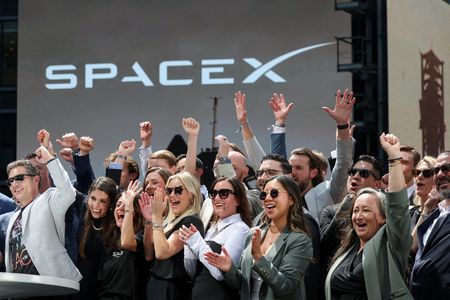

The recent stock market debut of Elon Musk’s SpaceX is creating a headache for the companies that manage major stock indexes, forcing them to weigh two goals that don’t always line up: follow their established rules for adding new stocks, or update those rules to better reflect today’s market landscape.
Financial advisers and asset managers say both approaches can serve investors well — but the tension between them requires careful thinking about how much risk and price swings investors are actually signing up for, even when index funds are often sold as a straightforward, one-size-fits-all solution.
“The IPO is the headline, but the real story is about index methodology,” said Dina Ting, head of global index portfolio management at Franklin Templeton. “Investors should pay attention … because what you actually own depends on whether you’re buying this index versus that index.”
The wave of massive IPOs — starting with SpaceX and potentially followed by AI companies Anthropic and OpenAI — may push investors and index providers alike to take a closer look at which indexes best match the level of risk they’re comfortable with.
For now, Nasdaq’s decision to fast-track SpaceX into its flagship Nasdaq 100 index, while S&P Dow Jones Indices chose not to immediately include it in the S&P 500, is likely to reinforce the Nasdaq’s image as the go-to choice for investors willing to accept bigger price swings in exchange for potentially higher returns.
“You’re going to get very different experiences because all of the indexes made a bunch of active decisions about which stocks to include, when to include them, how much weight to give them,” said Joel Schneider, deputy head of portfolio management at Dimensional Fund Advisors, an investment firm that describes its approach as “going beyond indexing.”
Schneider added that the surge of major IPOs “is causing advisers and investors to start to pay more attention to some of these decisions and how they are made and what they mean.”
Before its listing, SpaceX had been working to speed up its entry into major indexes, including the S&P 500 — the most widely followed U.S. stock index — and the Nasdaq 100, which has long been a showcase for top American technology companies.
Many everyday investors gain exposure to these indexes through mutual funds and ETFs, such as the Invesco QQQ ETF for the Nasdaq 100 and the State Street SPDR S&P 500 ETF.
“I think the most aggressive investors have for years been shifting their focus to the QQQs rather than the SPY. The decision by the different index providers will further that trend,” said Eric Kuby, chief investment officer at North Star Investment Management Corp.
By changing its rules to bring SpaceX in within a month of its listing, Nasdaq is returning to its tradition of embracing high-growth companies that haven’t always shown strong financial results. If Anthropic and OpenAI were also to list on the Nasdaq, it could spotlight a valuation gap in U.S. markets not seen since the technology collapse of 2000.
The stakes are enormous. S&P 500 index funds hold trillions of dollars in assets, and those funds would have been required to purchase SpaceX shares had the rules been changed to allow it in. The three largest ETFs tracking the S&P 500, from Vanguard, Invesco, and State Street, hold $3.2 trillion in assets under management, compared to roughly $600 billion in the largest Nasdaq 100 funds.
The S&P 500’s decision to hold off on SpaceX and similar companies could cause the performance of major indexes to drift further apart, putting investors in a tough spot — attracted by the excitement of AI-related offerings but uncertain about the risk tied to trillion-dollar-plus IPO valuations.
“In general, if you’re sort of more risk-on, if you would, then obviously the QQQ has the ability to include companies that are not profitable,” said King Lip, chief strategist at BakerAvenue Wealth Management in San Francisco. “Risk-off market, you’re going to have the S&P probably going to do better from an overall perspective.”
Schneider also pointed to research published this month in the scholarly Review of Asset Pricing Studies showing that IPOs added to indexes on a fast-track basis outperform non-fast-tracked ones by 5 percentage points up until the date they’re officially added — but that those gains are more than cut in half within two weeks of inclusion.
It’s worth noting that S&P 500-linked funds still carry significant exposure to technology stocks and AI-related trends, which have helped fuel market gains but could also make them more vulnerable.
“Obviously, the early inclusion of some of these companies into the indices is a change, so people that have been investing passively are going to find themselves arguably with riskier portfolios than they were historically,” said short-seller Jim Chanos, who has cautioned that the SpaceX offering is driven by “hopes and dreams” that don’t justify its price tag. “And the AI bull market — to the extent there’s anything systemic, it’s just that equity portfolios have gotten a lot riskier.”