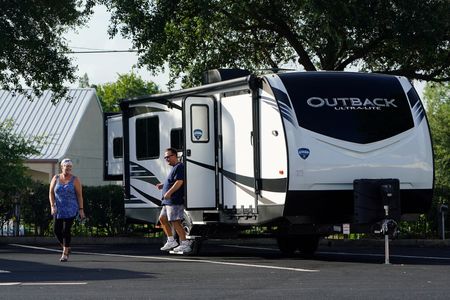

When spring sales failed to materialize as expected, Coley Brady made a tough call at the end of March — scaling back production from five days a week to four on most of the assembly lines at his five recreational vehicle factories in Elkhart, Indiana.
The timing wasn’t coincidental. The U.S.-Israeli war on Iran was only about a month underway at that point, but the ripple effects on global energy markets had already driven American gasoline prices up 33% and diesel prices up 43%.
“Clearly the war and higher gas prices are the easiest things to point to,” said Brady, who co-founded Alliance RV, a company that manufactures high-end fifth-wheel trailers and motorhomes.
The RV industry, which builds more than 80% of the recreational vehicles sold across the country right there in northern Indiana, is often viewed as a barometer for the broader U.S. economy. Commerce Department figures show that inflation-adjusted consumer spending on recreational goods and vehicles dropped for a fifth consecutive month in April — the longest stretch of declining real spending in that category since the depths of the Great Recession back in 2008.
Recreational vehicles are costly, optional purchases that consumers tend to delay when the economic picture looks uncertain. The University of Michigan’s Surveys of Consumers found that U.S. consumer sentiment hit a record low in May, recovering only slightly in early June. Inflation running at its highest rate in three years continues to squeeze household budgets, and elevated interest rates aren’t helping matters. Most RV buyers take out loans to finance their purchase, and according to LendingTree, the average interest rate on those loans currently sits at 7.53%.
Jeff Hirsch, CEO of Campers Inn — a chain of 50 RV dealerships operating across 22 states — said wealthier baby boomers are still making purchases, but many budget-conscious shoppers “just don’t feel this is the right time to make an investment.”
Spring is typically when RV sales get a boost, as families map out summer road trips to national parks and other destinations. But consumer RV registrations — a closely watched industry indicator — have been falling since last summer, according to Statistical Surveys Inc. That includes a nearly 22% plunge in March and a nearly 17% drop in April when compared to the same months a year ago.
The RV Industry Association reports that manufacturers shipped 13.5% fewer units to dealers during the first four months of this year versus the same period last year. On June 1, the association trimmed its full-year shipment forecast to between 300,000 and 328,100 units — well short of last year’s total of 342,200 units.
“Economic headwinds and tightening household budgets are weighing on consumer demand and contributing to a more cautious outlook for RV shipments in 2026,” said Craig Kirby, the association’s president, in a statement accompanying the revised projection.
The industry has faced a rough stretch in recent years. During the early days of the COVID-19 pandemic, demand exploded as people looked for ways to travel while avoiding airplanes and hotels. Shipments set a record of just over 600,000 units in 2021. But once the pandemic boom faded, sales cratered and manufacturers were left sitting on enormous excess inventory that took years to clear out.
Gregg Fore, a former RV components manufacturer who now consults for the industry, said the war and elevated fuel costs “killed whatever speed there was” in the market heading into this spring. Many manufacturers are now running reduced production schedules, and some are consolidating their factory operations.
Despite the challenges, Alliance RV’s Brady believes business will rebound later in the year — perhaps even by summer if the conflict in Iran comes to an end. Analysts, however, caution that gasoline prices are likely to remain elevated for some time even if hostilities wind down.
“The stock market is strong, and I think that’ll ultimately be good for business,” Brady said. He also pointed to factors that could steer consumers back toward RV travel: skyrocketing airfares, ongoing safety concerns related to cartels and violence in Mexico, and cruise lines dealing with illness outbreaks. “You’d think all of that would guide back to RV use,” he said.
Alliance built 8,200 RVs last year and expects to exceed that figure this year, though Brady acknowledged it “depends on the market.” He estimates the production cutbacks since March have reduced his output by roughly 10%. “We’re scheduled through July, but if the summer goes well, we have the ability to go higher (with production) in August,” he said.
Michael Hicks, an economist at Ball State University who follows the RV sector, said the industry does have some things going for it. He noted that most RV buyers are in their 50s and 60s, many of them with solid retirement savings. “They’ve lived through high gas prices before, they’ve bought homes at higher interest rates,” he said. “Those are the ones that the industry really counts on.”
Michael Provost fits that description. The 69-year-old retiree from Rhode Island has owned three RVs over the past two decades and has no plans to change his routine of heading to Cape Cod in the summer and Florida in the winter with his wife Cheryl. As for the spike in gas prices, he’s not losing sleep over it. “This year, we went to Florida and when we came back, it was a dollar more (a gallon),” he said. “You kind of take it in stride.”