
War-displaced civilians who sought safety in a remote South Sudan village have been cut off from critical humanitarian assistance by their own government, despite mounting casualties, according to witnesses and relief organizations.
The Associated Press interviewed individuals who recently escaped to Nyatim, a community surrounded by marshland. They reported severe food shortages and contaminated water sources in such an isolated location that satellite internet was their only means of requesting emergency help.
However, when humanitarian workers contacted South Sudan’s leadership requesting permission to provide emergency supplies, officials refused. Even reports indicating dozens had perished, some apparently from hunger, failed to change their decision.
“It was a ‘no’ from local and national authorities and from the military,” said Yashovardhan, the head of mission for Doctors Without Borders in South Sudan, who goes by one name. “Meanwhile, people are eating leaves and roots to survive.”
The U.N. World Food Program, typically cautious about addressing this ongoing issue in South Sudan, confirmed to the AP that authorities had prevented their assistance despite “numerous engagements with both national and local authorities,” according to the agency’s country director, Adham Effendi.
This pattern has repeated throughout South Sudan’s history, where citizens battled for independence from Sudan before civil conflict erupted internally. Whichever faction controls relief supplies stands accused of preventing the opposition from accessing them, leaving ordinary people to bear the consequences.
Current violence has escalated since Riek Machar, President Salva Kiir’s longtime political adversary, was removed from his position as first vice president and placed under house detention for alleged conspiracy last year. These leaders commanded rival armies during a brutal civil conflict that claimed approximately 400,000 lives before a 2018 peace accord established their unstable coalition government.
Last December, opposition troops supporting Machar captured military installations in Jonglei state. Government armies retaliated the next month.
On February 7, government soldiers approached Lankien town’s perimeter, where days before an air assault had targeted a Doctors Without Borders medical facility. Local residents described heavy weapons fire before troops invaded the settlement using armored vehicles.
Thomas Nim was among the evacuees. Accompanied by his expecting wife, three young children, and elderly mother, they navigated through wetlands, praying soldiers wouldn’t pursue them.
They joined many others who eventually reached Nyatim, roughly one day’s journey on foot.
“Some of the most vulnerable, like the elderly and children, ended up in Nyatim because they couldn’t make it any farther,” said Nim, a 43-year-old pharmacist.
As time went on and fatalities began occurring due to hunger and contaminated water, he requested assistance. Yet no help arrived.
Gatkhor Dual, an opposition representative managing relief efforts in Jonglei state, pointed to county commissioner James Bol Makuei for preventing humanitarian access. Makuei refuses aid to reach individuals who “support the opposition,” Dual explained, particularly when they’re located near government-controlled territories.
Makuei confirmed that entry to Nyatim had been limited but argued that population estimates of displaced persons — 30,000 according to Doctors Without Borders — were inflated. He charged South Sudan’s primary opposition movement, identified by its acronym SPLM-IO, with keeping civilians in Nyatim to draw aid and establish a strategic position near the county’s government center.
Nim, the pharmacist, insisted no opposition fighters were present in the region.
Worries about aid misappropriation have historical basis. Armed factions in South Sudan, including government forces, have extensively redirected humanitarian resources for military use. During recent Jonglei fighting, combatants ransacked more than two dozen humanitarian-operated medical centers, the U.N. reported.
Doctors Without Borders indicated it initially contacted authorities about Nyatim on February 22. The organization made another appeal on March 3 after receiving death reports. By March’s end, the medical organization released a public statement highlighting their efforts.
Providing assistance in South Sudan presents constant challenges. Transportation networks are inadequate. Water-based transport, when possible, faces attack risks. Official authorization remains mandatory.
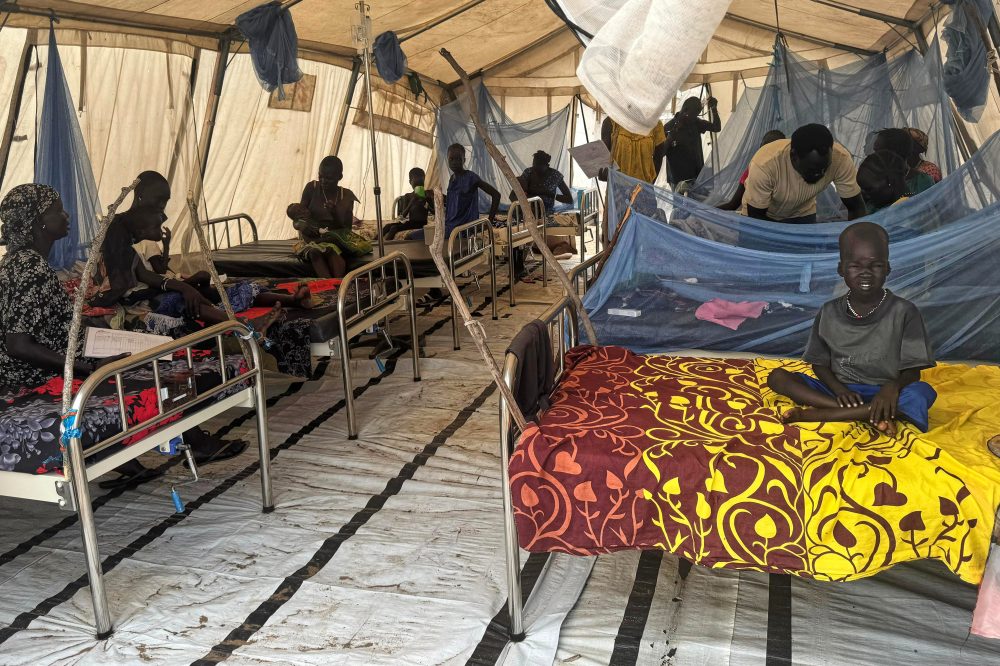
The humanitarian emergency has worsened significantly. In March, more than half of over 1,000 children examined by Doctors Without Borders in Chuil, where South Sudan’s government has permitted humanitarian entry, showed severe malnutrition.
Relief workers face overwhelming demands. During February, Doctors Without Borders expanded a four-bed clinic to 60 beds, then 80. The facility is now expanding to accommodate 100 patients.
Meanwhile, some people are abandoning isolated Nyatim and returning to destroyed homes.
“People are returning to their homes,” said one of them, Koang Pajok. “There was no food and shelter.”
Unable to access the region through ground or water routes, the World Food Program has conducted airdrops of 415 metric tons of food supplies to Chuil since March, country director Effendi reported.
However, as civilians arrive seeking help, armed young men carrying assault rifles also appear. Some residents fear this could make Chuil a military target.
During an April morning, an aircraft circling above created nervous spectators.
“It’s a surveillance plane,” said Gal Wai Tut, who had reached the area days earlier with his wife and infant child. He remembered observing a similar aircraft over Lankien on the day he claimed a December bombing killed at least 11 civilians.
An elderly man warned against clustering together, explaining that groups are more vulnerable to attack.