
SEOUL, South Korea — Two of South Korea’s largest technology companies, Samsung Electronics and SK Hynix, announced Monday a combined investment of 800 trillion won — equivalent to approximately $518 billion — to construct a major new computer chip manufacturing hub in the nation’s southwestern region, aiming to capitalize on explosive demand fueled by artificial intelligence.
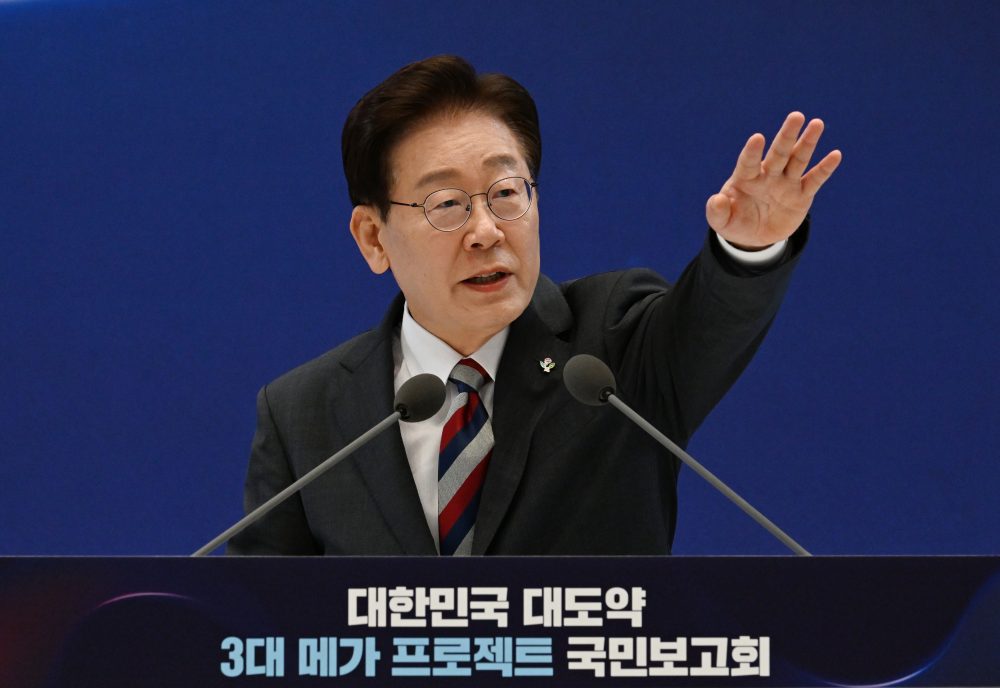
President Lee Jae Myung stood alongside the chairmen of both companies at Monday’s announcement, which aligns with the government’s broader strategy to spread economic investment beyond the greater Seoul metropolitan area — currently the country’s economic and semiconductor industry center.
The southwestern region has historically lagged behind in economic development and lacks major industrial hubs. It has also long served as a political stronghold for President Lee’s liberal Democratic Party.
Samsung and SK Hynix together account for roughly two-thirds of the world’s memory chip production. Both companies announced plans to each build two fabrication plants in the southwest, expanding beyond their current manufacturing facilities in Gyeonggi Province, located south of Seoul.
Samsung Chairman Lee Jae-yong said the company’s new chip factories will be constructed in the southwestern city of Gwangju. Experts have identified several potential sites there, including land currently occupied by a military air base that is scheduled to be relocated.
Neither company provided a specific timeline for when the new southwestern facilities would be completed. SK Hynix Chairman Chey Tae-won described the undertaking as a massive and complex project, saying it would require “vast sites, along with sufficient power, water and skilled workers.” He noted that it took SK Hynix nine years to establish its major manufacturing cluster in Gyeonggi Province, but stressed that significant expansion is necessary to keep pace with worldwide demand.
Government officials pushed back on concerns about whether the southwestern region has adequate power and water supplies to support large-scale chip manufacturing. They argued that the region’s existing strength in renewable energy would actually give the chipmakers a competitive advantage as global pressure mounts to shift toward cleaner electricity sources.
Both Samsung and SK Hynix have posted record profits in recent months, driven by surging global investment in data centers and artificial intelligence infrastructure — all of which requires large quantities of memory chips. Government and business leaders expect AI-related demand to keep climbing as the technology expands into areas like AI-powered industrial robots and self-driving vehicles. Officials warn that the companies’ existing facilities in Gyeonggi Province could reach full capacity sooner than previously anticipated.
At Monday’s event, government officials also outlined a broader vision for a nationwide semiconductor ecosystem. Under the plan, existing manufacturing hubs in the southeast would ramp up production of chip components and materials, the central Chungcheong region would specialize in chip packaging, and data centers would be developed throughout the country.
President Lee emphasized the urgency of the effort, stating: “We must establish the core building blocks of artificial intelligence faster than any other country. Semiconductors, physical AI and AI data centers are the three pillars of our next great leap forward.”