
Samsung Electronics and SK Hynix are placing one of the largest bets in tech history on the continued surge in artificial intelligence, committing hundreds of billions of dollars to expand chip manufacturing — a move that has both excited investors and alarmed industry analysts.
The two companies, which together dominate global memory chip production, pledged a combined 3,200 trillion won, equivalent to roughly $2.07 trillion, toward expanding their operations. The package includes a brand-new chip manufacturing cluster in South Korea’s southwestern region valued at 800 trillion won, along with a collection of previously announced projects.
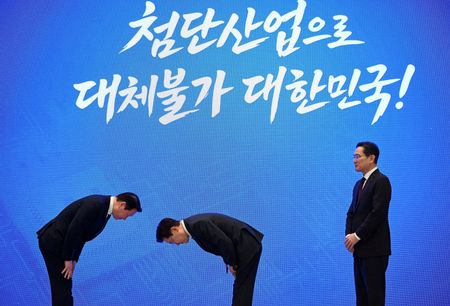
South Korean President Lee Jae Myung praised the chipmakers — reportedly offering a deep bow — after they threw their support behind the government’s semiconductor expansion agenda. The government’s goal is to double South Korea’s memory chip production capacity within five years.
Part of the plan calls for speeding up construction at the Yongin semiconductor cluster, cutting what had been projected as a 7-to-12-year timeline and bringing new manufacturing capacity online sooner.
South Korea has become a major beneficiary of the global AI investment wave, largely due to Samsung and SK Hynix’s strong foothold in high-bandwidth memory chips — a critical component in advanced AI processors. Demand from AI data center operators and consumer electronics companies, including Apple, has created a global shortage and driven chip prices sharply higher.
But analysts caution that chip factories take years to build and fully operate, meaning most of this new capacity won’t be available until well into the next decade.
Morningstar analyst Jing Jie Yu offered a measured take on the announcement. “We see memory pricing remaining a function of demand and supply, and accelerating capex over the next decade further increases the risk of an oversupply longer term,” he said, adding that the memory boom depends heavily on whether AI data center operators continue expanding at their current pace.
Lee Jong-ho, a professor in the Department of Electrical and Computer Engineering at Seoul National University, questioned whether the investment decisions were made too hastily. “It is the kind of investment that could determine a company’s future,” he said. “No one knows what the situation will look like three years from now. We need to respond quickly while demand is strong, but after that, demand is uncertain and decisions should be made cautiously.”
The current profitability of both companies’ memory divisions is a relatively new development, fueled by the AI boom and a chip shortage that nearly doubled prices in just the first quarter. The industry has a turbulent history — past downturns pushed SK Hynix close to bankruptcy in 2001 and caused both firms to post significant losses in 2023.
The push to build factories in the southwest has political undertones as well. In recent months, ruling party lawmakers and government officials began advocating for relocating some chip production to that region, which had largely been left out of South Korea’s industrial development. As recently as two months ago, SK Hynix Chairman Chey Tae-won expressed doubt about the idea when a lawmaker raised it. “I’m not sure semiconductors are necessarily the field you have to go into,” he said at the time. Neither company has explained what changed their position.
Both Samsung and SK Hynix said the government’s pledge to accelerate regulatory approvals made it possible to speed up construction at Yongin. Nomura analyst CW Chung suggested the southwest expansion may also serve as a hedge. “Investing in other regions could be a way of hedging the uncertainty surrounding the Yongin semiconductor cluster,” he said.
Analysts believe the companies will draw on lessons from previous industry downturns. CLSA senior analyst Sanjeev Rana acknowledged that “a downturn in the memory industry is clearly a risk to the plan,” but noted that “memory producers retain the flexibility to adjust their investment pace if signs of excess capacity emerge.”
Samsung’s portion of the plan calls for 2,100 trillion won in chip production investment through 2040, with the company noting that spending levels could be adjusted based on market conditions. The company previously halted construction of a chip plant in Pyeongtaek for nearly two years during a market slump before resuming work late last year.
During a Monday presentation attended by President Lee, SK Hynix Chairman Chey said the company would keep a close eye on demand as it determines the appropriate scale of investment, while noting that supply is still struggling to keep up with current demand.
South Korean presidential chief of staff Kang Hoon-sik said Monday that the government would fast-track approvals and aim to complete the new chip cluster before President Lee’s term concludes in 2030.
Koh Taebong, head of research at iM Securities, expressed confidence in the direction of the investment. “Yesterday’s message was that South Korea is serious about becoming one of the world’s top three AI powers. This isn’t just rhetoric — the government is committing to spending real money to make it happen,” he said.