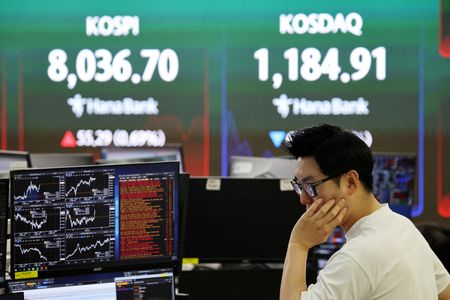

A Seoul resident’s investment story illustrates the mounting risks facing South Korea’s stock market as individual investors increasingly use borrowed funds to chase soaring share prices.
Laura Byun, who typically favored American mutual funds over domestic Korean stocks, changed her strategy when the KOSPI index’s dramatic surge made it the world’s top-performing benchmark. Not wanting to miss out on the rally, she borrowed approximately 15 million won ($9,687) through a bank overdraft to purchase a leveraged fund focused on the electronics giant, initially seeing returns of around 20%.
However, her fortunes quickly reversed. Following a technology sector selloff on Wall Street, the KOSPI dropped more than 8%, sending her investment position to negative 17% by Monday morning. The leveraged fund connected to the chip manufacturer plummeted as expectations of a Federal Reserve interest rate increase ended a nine-week winning streak on Wall Street.
“I’m not gonna do anything. I don’t know, I’m gonna wait for a rebound, unless like it halves or something,” Byun said.
Byun’s situation reflects a growing concern in South Korean financial markets, where retail investors known as “ants” are using increasing amounts of borrowed money to participate in a runaway stock rally, causing worry among regulators about heightened volatility and potential sharp corrections.
Data from the central bank released Thursday revealed that leveraged equity investments by individual investors reached an unprecedented 60 trillion won ($39.06 billion) at the end of May, coinciding with the KOSPI more than doubling over six months to claim the title of world’s best-performing index.
Contributing to this debt surge was the May 27 launch of South Korea’s inaugural single-stock leveraged funds tied to semiconductor companies whose earnings have skyrocketed alongside the artificial intelligence boom. These products offer investors double the daily returns of the underlying stocks.
Interest was so intense that the training website required for retail investors crashed on the first day, according to applicants including Byun. More than 350,000 individuals have since completed the mandatory course, the financial investment association reported.
However, leverage amplifies losses just as much as gains. The funds double both positive and negative movements within South Korea’s limit of twice a stock’s daily fluctuation – a characteristic regulators believe many newcomers may not fully understand.
“Investors should be cautious of amplified market volatility during potential downturns, particularly if late comers to the market increasingly rely on leverage to chase stock surges out of FOMO (Fear Of Missing Out),” the central bank warned, noting that margin loans are heavily concentrated in chip stocks.
The finance minister also expressed concerns last week about rising leveraged stock investments, promising to address risks associated with “excessive herd-like behaviour.”
A financial services official, speaking anonymously, said the commission monitors leverage levels and maintains regular contact with brokerages, though no immediate plans exist for additional restrictions beyond current training requirements.
The two major semiconductor companies now represent more than half the index’s market value, and daily swings of 5% to 10% on the KOSPI have become routine.
This leverage trend is part of a broader initiative to attract Korean investors back from U.S. markets, where many had shifted their focus since the pandemic began.
The strategy has succeeded – perhaps excessively so – as ants have shown enormous appetite upon returning to domestic markets. Margin-based equity investment surged 72.5% in 2025 alone, significantly exceeding growth rates of 36.3% in the United States, 36% in China, and 21% in Japan, according to central bank figures.
Daily trading volume reached a record 106.2 trillion won in May, nearly 60% higher than January through April averages and approximately four times the 2025 average.
Brokerage surveys showed investors in their 40s were the largest buyers, representing 28.9% of total inflows into single-stock leveraged funds linked to the chipmakers between May 27 and June 1. Those in their 50s comprised 28.7%, while people in their 30s accounted for 22.2%.
“I used to trade U.S. equities, but I bought SK Hynix just before the war broke out,” said a 40-year-old Seoul housewife who requested anonymity.
“Everyone is talking about the leveraged ETFs. SK Hynix had run up too high to buy outright, so I bought the double-leveraged ETF instead. But the volatility is extreme, and it makes me anxious. I’ll probably sell soon.”