
SEOUL, South Korea — Following a devastating stroke that left the right side of his body paralyzed in 2012, South Korean pianist Lee Hun initially focused solely on whether he’d regain the ability to walk. The thought of returning to music seemed impossible.
His journey back to the piano began only when a former teacher informed him about the extensive collection of compositions written specifically for left-hand performance.
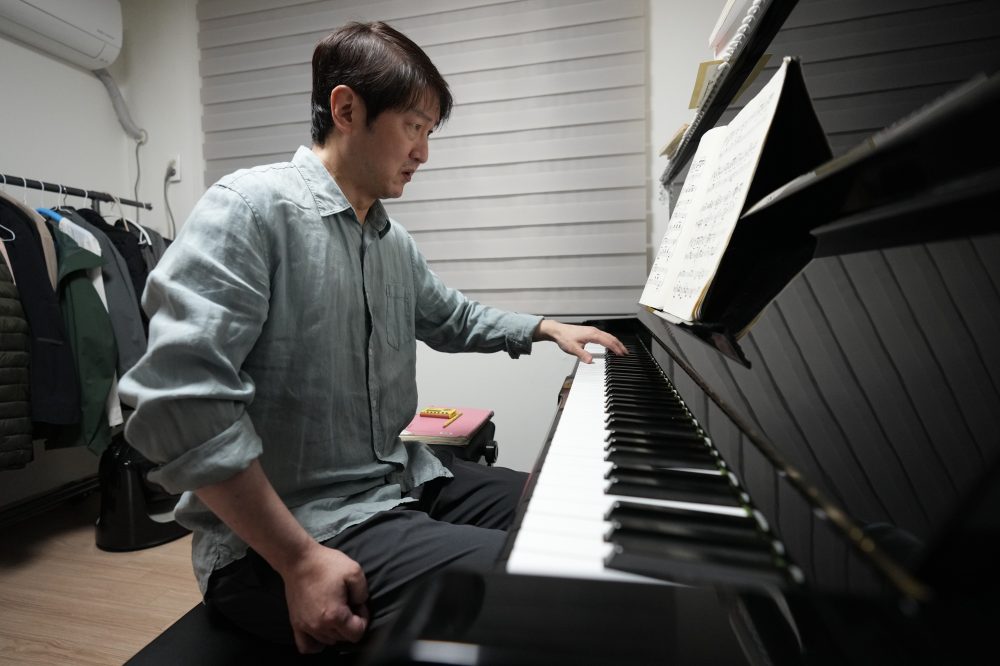
Through intensive training and determination, Lee made his return to performing as South Korea’s sole recognized professional pianist who plays exclusively with his left hand.
Now, the 54-year-old musician faces his biggest challenge yet: performing alongside an orchestra at an international music festival scheduled for next month.
“I’m so, so nervous I could die,” Lee shared with a smile during a recent interview with The Associated Press at his Seoul residence. “It’s just one concerto but working with an orchestra has its own difficulties.”
The medical emergency struck in August 2012 while Lee was pursuing his doctoral studies at the University of Cincinnati’s music program. He suddenly collapsed at his residence.
Emergency surgery saved his life, but the stroke affected approximately 60% of his brain’s left hemisphere. The damage left him unable to move his right arm and leg, and he temporarily lost his ability to speak.
Lee returned to South Korea requiring a wheelchair. His father, Lee Hae Chang, who achieved legendary status in South Korean baseball, revealed that his son couldn’t even recognize him when he arrived home.
“After the stroke, I didn’t even imagine paying the piano. I only thought about whether I could stand on my feet again,” Lee Hun explained.
The situation proved challenging for his entire family, who became his daily caregivers. His mother, Poong Ok Hee, remembered frequent conflicts with her son due to his emotional instability. He frequently rejected her guidance and help.
A turning point came during a 2013 dinner with his former instructor, Chun Yung Hae. Chun motivated him to return to piano performance, explaining that over 1,000 compositions exist for left-hand solo performance. This conversation reignited his musical passion, and Lee started practicing that very evening.
Lee’s official return as a single-handed pianist occurred in 2016 at Seoul St. Mary’s Hospital, the facility where he underwent treatment and recovery. Following his performance of Camille Saint-Saens’ “6 Etudes for the Left Hand Alone,” Lee joined Chun for “Amazing Grace,” with Lee playing left-hand parts while Chun handled the right-hand melody. The emotional performance moved at least one audience member to tears.
“He is a pianist so he must play the piano. He was completely hopeless and in despair, so I tried to give him some hope. But I didn’t expect him to play as well as this,” explained Chun, who previously served as dean of the College of Music at Seoul’s Kyung Hee University.
Since his comeback, Lee has maintained a regular performance schedule, made television appearances, and published his autobiography. He now moves independently and communicates effectively in Korean.
Korean media outlets have nicknamed him “Korea’s Paul Wittgenstein,” referencing the celebrated Austrian pianist who pioneered one-handed piano performance. Wittgenstein lost his right arm during World War I and commissioned left-hand compositions from renowned composers including Ravel, Strauss, Prokofiev, and Britten. His sibling was the famous philosopher Ludwig Wittgenstein.
Lee’s upcoming performance on May 2 at the annual Icheon Young-Artist International Music Festival in South Korea will feature him with the festival orchestra. Their program includes Ravel’s “Piano Concerto for the Left Hand,” another piece originally commissioned by Wittgenstein.
While acknowledging the composition’s extreme difficulty, Lee expressed his long-standing desire to perform this particular work.
Chung Eun-hyon, who heads Lee’s representation at Tool Music, noted that Lee has shared his dream of performing this concerto. Chung described feeling deeply moved while helping “make his dream come true.”
Lee’s artistic approach has evolved since becoming a one-handed performer. Previously, he concentrated on technical perfection to impress audiences. Currently, he focuses on communicating his emotional connection and musical interpretation to listeners.
“He plays a sort of music that truly touches the heart of people and it’s not about finger dexterity,” observed Lee Eungkwang, who directs the cultural foundation organizing the Icheon festival.
“I’m really curious what it was like when he played with both hands,” Lee added.
Lee Hun maintains hope for eventually returning to two-handed performance, noting that he managed to press a single piano key with his right hand during a November 2024 concert.
However, Dr. Koo Jaseong from St. Mary’s Hospital, who treats Lee, believes the medical outlook for regaining right-hand function and returning to two-handed performance remains unlikely.
“I still would like to give him a round of applause to his efforts. Though rare, there have been reports of miraculous recoveries too,” Koo stated.