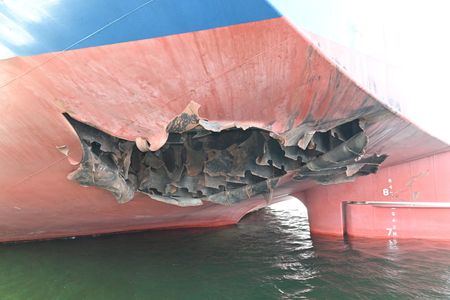

South Korea’s Foreign Ministry announced Wednesday that investigators believe an Iranian anti-ship missile was responsible for striking a cargo vessel operated by local shipping company HMM in the Strait of Hormuz earlier this month.
Officials from the Iranian embassy in Seoul have not yet responded to requests for comment regarding the allegations.
The ministry revealed their findings during a briefing where they disclosed results from a government investigation examining the May 4 strike on the bulk carrier. The incident resulted in a fire and damage to the vessel’s lower stern hull.
Investigators examined debris from unknown objects discovered inside the ship following the strike on the vessel.
The examination revealed that the ship, called Namu, was struck twice, with the first warhead failing to detonate while a second one exploded.
Materials found in the debris suggested the objects were manufactured in Iran, according to ministry officials.
“Their engines were similar to turbojet engines made in Iran,” stated First Vice Foreign Minister Park Yoon-joo, who noted that one piece contained markings that seemed to be from an Iranian manufacturer.
The explosive devices were similar to those found in Iranian anti-ship missiles, specifically the Noor or Qader models, Park explained.
South Korea plans to call in the Iranian ambassador to present the investigation findings and lodge a formal complaint, he announced.
Seoul will also require Iran to implement responsible actions to ensure such incidents don’t happen again, Park stated.
U.S. President Donald Trump declared shortly after the incident that Iran had attacked the South Korean ship, and called on Seoul to participate in U.S.-led initiatives to protect shipping routes through the strait.
Tehran has previously rejected any involvement in the attack.