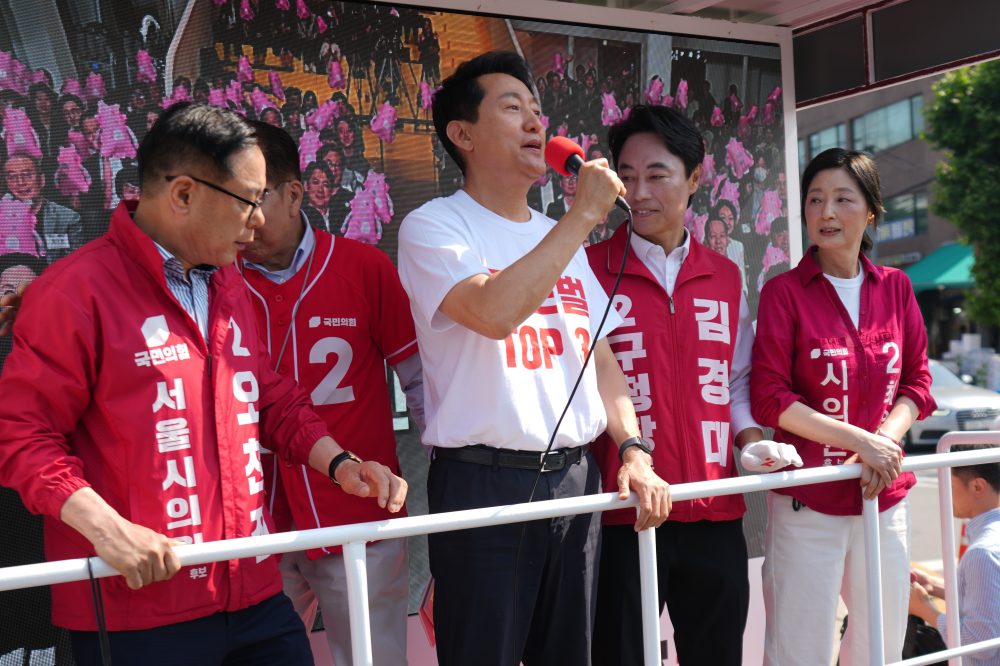

Citizens across South Korea headed to polling stations Wednesday for mayoral and local elections that political observers are watching as a key indicator of how much backing President Lee Jae Myung has after completing his first year leading the nation’s liberal administration.
Polling data indicates Lee’s Democratic Party is positioned to capture more victories than the conservative opposition People Power Party, which continues to struggle with internal divisions roughly 18 months following former conservative President Yoon Suk Yeol’s controversial martial law declaration.
Political analysts say that with such favorable conditions, the DP needs to achieve an overwhelming win and secure critical contests like the Seoul mayoral race to provide Lee with significant momentum.
“The conservatives’ support base has been fractured and weakened in the wake of Yoon’s impeachment, while the liberals’ support base has grown stronger. Considering that, results of the elections will determine whether their dominance would prolong for a considerable time,” said Jeong Han-Wool, director of the Korean People Research Institute.
Voters are selecting candidates for 16 mayoral and provincial gubernatorial positions on Wednesday, with the PPP currently holding 12 of those seats. Additionally, 14 new lawmakers will be elected to the 300-seat National Assembly through special elections.
Voting began at 6 a.m. local time at approximately 14,300 locations nationwide and will conclude at 6 p.m. The election commission reports that roughly 44.6 million people are eligible to participate.
Initial polling suggested the DP could secure as many as 15 of the 16 available positions. However, more recent surveys indicate that opposition or independent contenders have narrowed the margin with their DP opponents or even moved ahead in five to seven contests.
The DP benefits from continuing public anger over Yoon’s December 2024 martial law decision that triggered a major political upheaval. Additionally, the relatively new Lee administration may still enjoy voter goodwill rather than facing attempts to limit its authority, according to Choi Jin, director of the Seoul-based Institute of Presidential Leadership.
Choi explained that a decisive DP triumph would mean capturing at least 12 races. He emphasized that the party must also secure the highly competitive Seoul mayoral contest or the Lee administration would face “a tremendous blow.”
The Seoul competition features the DP’s Chong Won-o, a former Seoul district head whose political profile grew after Lee commended his leadership last October, running against incumbent mayor and prominent political figure Oh Se-hoon from the PPP.
“A Seoul mayor isn’t a post that someone whose campaign solely relies on the president’s coattails can afford,” Oh told reporters Tuesday. “Our country would be safer when the rival forces keep each other in check than one side controlling every things. Please, leave Seoul, the last stronghold, in our hands.”
During a Tuesday press briefing, Chong stated he anticipated Seoul residents would issue “a stern verdict” on Oh regarding what he characterized as the mayor’s incompetent and irresponsible leadership approach.
Lee will mark his first anniversary in office Thursday, maintaining approval ratings above 60%. He secured victory in a special election held after the Constitutional Court decided to remove Yoon from office due to his martial law implementation. A Seoul district court found Yoon guilty of rebellion in February and imposed a life sentence.
Yoon’s removal created significant internal conflict within the PPP between reform-minded members who supported the DP-led impeachment effort and Yoon supporters who tried to defend the former leader.
Han Dong-hoon, who leads the reform faction and was ultimately kicked out of the PPP, is among those seeking one of the 14 parliamentary seats in the special elections. Polling shows Han with a narrow advantage over the DP’s Ha Jung-woo, a former Lee adviser on AI, in a Busan race in the nation’s second-largest city in the southeast.
Jeong noted that a Han win might enable anti-Yoon reformers to reorganize and become a new conservative movement in South Korea. However, Choi suggested Han’s victory could deepen conservative divisions as Yoon supporters might feel threatened and become more unified in response.