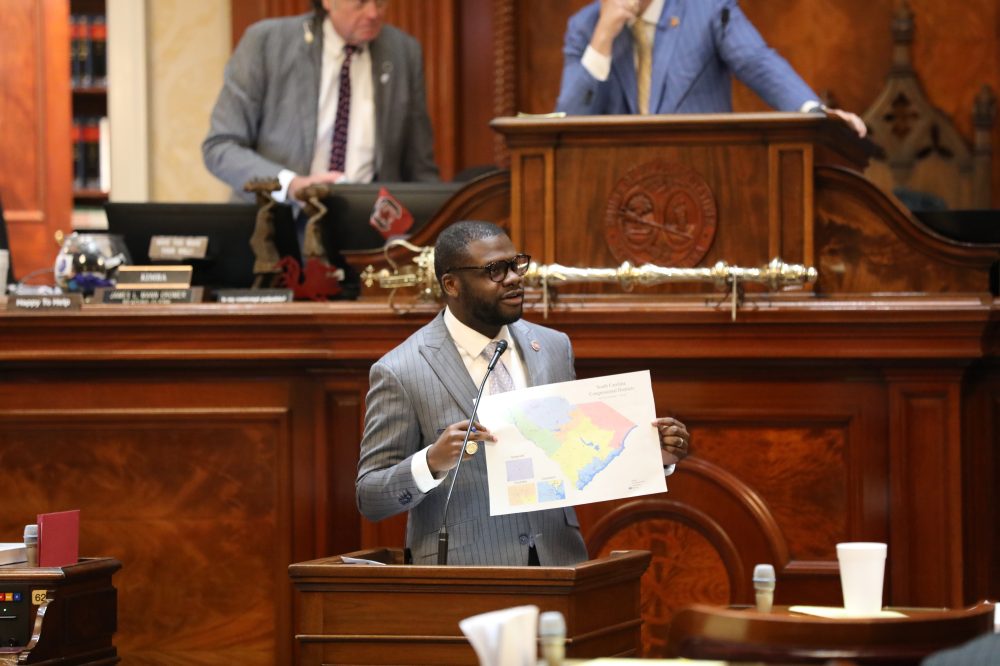

Republican lawmakers in South Carolina’s House chamber dismissed Democratic opposition Tuesday while advancing toward a crucial vote on congressional redistricting that could help the GOP secure another seat in November’s midterm elections.
The redistricting proposal, backed by President Donald Trump, would reconfigure the state’s sole Democratic-controlled U.S. House district to benefit Republicans as part of a wider national strategy to preserve the party’s narrow House majority in the midterms.
To allow time for implementing the proposed new map, the South Carolina measure would pull U.S. House contests from the state’s June 9 primaries and establish a special August primary to choose nominees for the state’s seven congressional seats. Already submitted absentee and military overseas ballots for congressional races would be discarded.
Throughout Tuesday’s proceedings, Democrats raised repeated objections while Republicans consistently voted down their proposed changes.
“What you all are doing is wrong,” Democratic state Rep. JA Moore declared, continuing: “You can justify it, rationalize it, but it’s wrong.”
Several other Southern states are pursuing similar tactics as they rush to redraw U.S. House boundaries following a recent U.S. Supreme Court ruling that eliminated a majority-Black district in Louisiana for being an unlawful racial gerrymander and substantially reduced Voting Rights Act safeguards for minority districts.
Louisiana’s congressional primaries, originally set for last Saturday, were delayed until later this summer by Republican Gov. Jeff Landry to provide time for creating new districts.
Alabama conducted primary voting Tuesday, but the state intends to invalidate results in four of its seven U.S. House districts and conduct special primaries August 11 for those districts using different boundaries. The redrawn districts could assist Republicans in gaining another seat come November.
Overall, Republicans believe they could capture up to 15 additional seats through revised U.S. House districts across seven states, while Democrats anticipate gaining as many as six seats from new House districts in two states. However, this count may shift as court battles continue in multiple states. Voters will ultimately determine if these predictions prove accurate.
The consequences could reach beyond government and politics.
The NAACP announced Tuesday it was urging Black athletes and fans to boycott athletic programs at public universities in states that “have moved to limit, weaken or erase Black voting representation.” The initiative specifically targets Alabama, Florida, Georgia, Louisiana, Mississippi, South Carolina and Texas — although new voting districts haven’t been implemented in all these locations yet.
In South Carolina, Democratic state House members spent hours Monday debating the proposed modifications. This prompted the Republican-majority chamber to alter Tuesday’s rules by restricting members to just one amendment and imposing time constraints on speeches.
Democratic state Rep. Beth Bernstein urged lawmakers to support a voter education initiative, noting that elections would appear dramatically different in 2026. She worried that some voters might avoid the polls altogether. However, her amendment was defeated.
“When confusion becomes a barrier, a barrier becomes silence, and silence becomes a vote that was never cast,” Bernstein stated.
Democratic Rep. Lonnie Hosey suggested prohibiting the drawing of districts solely to benefit one party. But Republicans quickly defeated his amendment as well.
“I love you and I believe you love me. But sometimes that doesn’t show,” said Hosey, who has served in the House for 27 years.
Republican legislators are working against approaching deadlines. Early voting is scheduled to begin May 26 for the June 9 primaries.