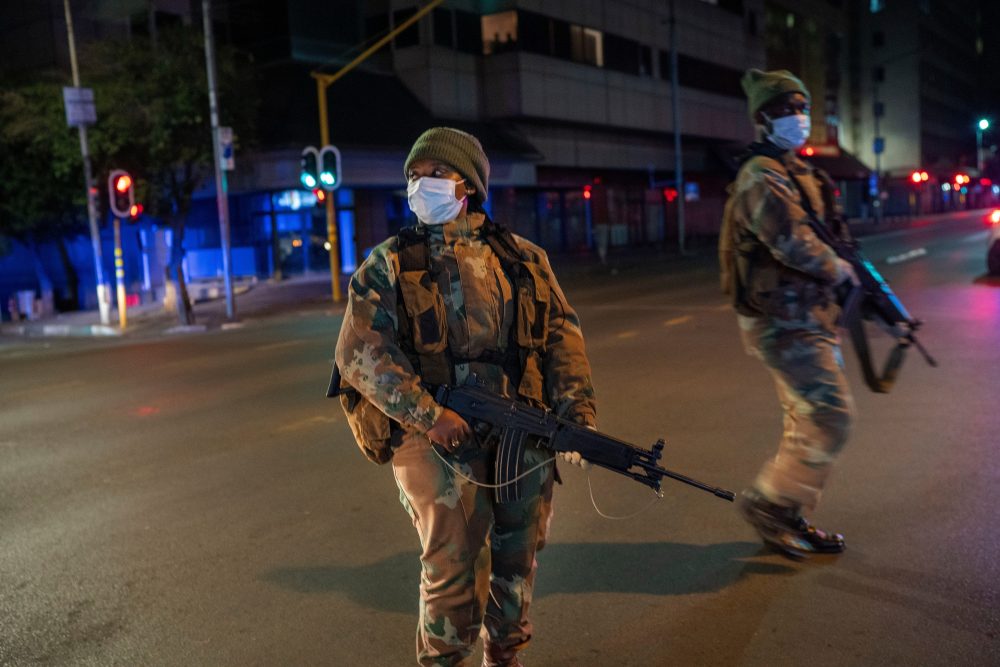

JOHANNESBURG — In a rare move for Africa’s most established democracy, South African President Cyril Ramaphosa has announced plans to send military forces into areas experiencing extreme criminal activity, targeting organized crime syndicates, gang warfare, and unlawful mining operations.
Ramaphosa declared that military personnel would be stationed in regions experiencing some of the globe’s most severe violent crime rates, addressing what he called the “most immediate threat” to South Africa’s democratic system and economic progress.
The president indicated that three of the nation’s nine provinces would receive military support, though he provided no specific timeline. Opposition voices argue that bringing in the military may signal that Ramaphosa’s administration is failing in its fight against crime.
Cape Town, home to approximately 3.8 million residents, stands as South Africa’s second-largest metropolitan area and a major tourism destination known for its scenic beauty.
However, the surrounding areas called the Cape Flats have gained infamy for lethal gang conflicts.
Criminal organizations with names like the Americans, the Hard Livings and the Terrible Josters have spent years fighting over illegal narcotics territory while engaging in extortion schemes, prostitution rings, and murder-for-hire operations.
Innocent civilians, including young people, frequently become casualties in gang shootouts. Recent crime data shows that South Africa’s three most dangerous police districts are all located in or near Cape Town.
Ramaphosa announced that military units would be sent to the Western Cape province, home to Cape Town, where statistics indicate approximately 90% of the nation’s gang-related murders occur.
He also named two additional provinces for troop deployment: Gauteng, which contains Johannesburg, the country’s largest city, and the Eastern Cape province.
Areas surrounding Johannesburg and throughout Gauteng province contain numerous deserted mining sites, where officials have struggled for years with unauthorized gold extraction.
Officials report that mining criminal groups, called zama zamas, operate under heavily armed crime organizations that violently defend their territories. These syndicates recruit “informal miners” from impoverished communities to descend into mine shafts seeking remaining valuable materials.
These criminal networks frequently connect to serious violent incidents, including a 2022 case that horrified South Africa when approximately 80 suspected illegal miners faced charges for the gang rape of eight women filming a music video at a defunct mine site.
In the previous year, a confrontation between law enforcement and unauthorized miners in an abandoned mine resulted in at least 87 miner deaths after police adopted aggressive tactics and blocked food deliveries to force them to surface.
Security analysts note that illegal miners often participate in additional crimes within surrounding neighborhoods, and territorial disputes between competing groups have displaced residents who flee seeking safer locations.
Government officials estimate that roughly 30,000 unauthorized miners operate throughout South Africa’s approximately 6,000 abandoned mining sites.
The administration has documented rising illegal mining activity, calculating that criminal organizations steal over $4 billion worth of gold annually.
Authorities believe the trade operates primarily under the control of migrants from nearby Lesotho, Zimbabwe, and Mozambique, creating resentment within South African communities toward both crime leaders and foreign residents in local areas.
Ramaphosa recognizes that South Africans who lived through the apartheid era of enforced racial separation, which concluded in 1994, may remember images of soldiers deployed to crush democracy movements.
Acknowledging this difficult history, he emphasized the importance of not deploying military forces “without a good reason.”
However, he stated it has now “become necessary due to a surge in violent organized crime that threatens the safety of our people and the authority of the state.”
Ramaphosa attempted to address concerns by explaining that military forces would function under police supervision.
South African troops have been deployed in other recent situations. In 2023, soldiers patrolled streets following a series of truck attacks that raised fears about broader civil unrest. Additionally, approximately 25,000 troops were deployed in 2021 to suppress violent demonstrations triggered by former President Jacob Zuma’s incarceration.
South Africa also utilized military personnel to implement strict lockdown measures during the initial phase of the COVID-19 pandemic in 2020.
Crime specialists have voiced concerns regarding Ramaphosa’s recent deployment strategy, arguing that military intervention cannot provide lasting solutions to criminal activity and that soldiers lack expertise in civilian law enforcement.
Firoz Cachalia, the nation’s police minister, has supported Ramaphosa and emphasized that military forces will assist police “their operations in particular locations.”
He described the deployment as temporary and designed to stabilize regions “where people are losing their lives” daily.