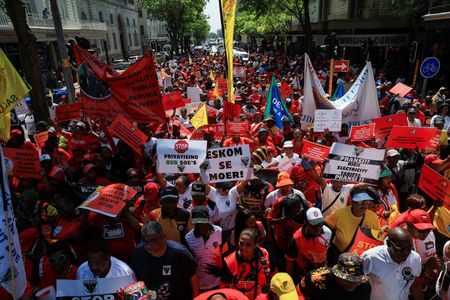

JOHANNESBURG — South Africa’s most powerful labor unions are telling workers to stay on the job and avoid anti-immigrant demonstrations that have been spreading across the country, warning that those who miss work to take part in the protests could put their jobs at risk.
Tension is building across South Africa as June 30 approaches — a deadline set by anti-immigrant groups demanding that all undocumented foreigners leave the nation. Weeks of sometimes violent xenophobic attacks have already occurred, and further unrest is anticipated around that date.
Four major unions, including the Congress of South African Trade Unions (COSATU) — which represents roughly 2 million workers — issued a joint statement making clear that employees would have no protection if they fail to show up for work on June 30.
“We urge workers to report for duty and not place their employment at risk,” the unions stated.
The unions also backed a call made the previous day by President Cyril Ramaphosa, who urged South Africans not to blame migrants for the country’s difficulties.
“Removing foreign nationals from workplaces, communities or public spaces will not reopen factories, repair municipalities, strengthen public healthcare or create sustainable jobs,” said the unions COSATU, FEDUSA, SAFTU, and NACTU in their joint statement.
As the continent’s largest economy, South Africa has historically drawn significant numbers of foreign workers seeking opportunities unavailable in other parts of Africa. In recent months, some politicians have used immigration as a political issue, pointing to migrants as the cause of widespread poverty and crime.
South African news outlets reported Wednesday that clashes broke out between police and thousands of Malawian nationals waiting to be sent home in the coastal city of Durban. According to News24, officers deployed stun grenades and teargas after the crowd grew agitated.
Earlier in the week, Malawi announced that approximately 10,000 of its citizens were in distress and seeking to return home from South Africa. The Malawian government has been organizing buses to transport them back, and even issued a public appeal for donations to help fund the effort.
“Government is resolute in its commitment to bring home every Malawian who wishes to return from South Africa,” the Malawian government said, adding that “the scale and urgency of the operation have created unprecedented financial, logistical, and humanitarian demands.”
Several other nations — including Ghana, Nigeria, and Mozambique — have also been working to bring their citizens home due to safety concerns in South Africa.