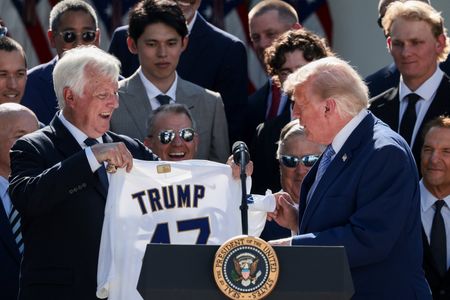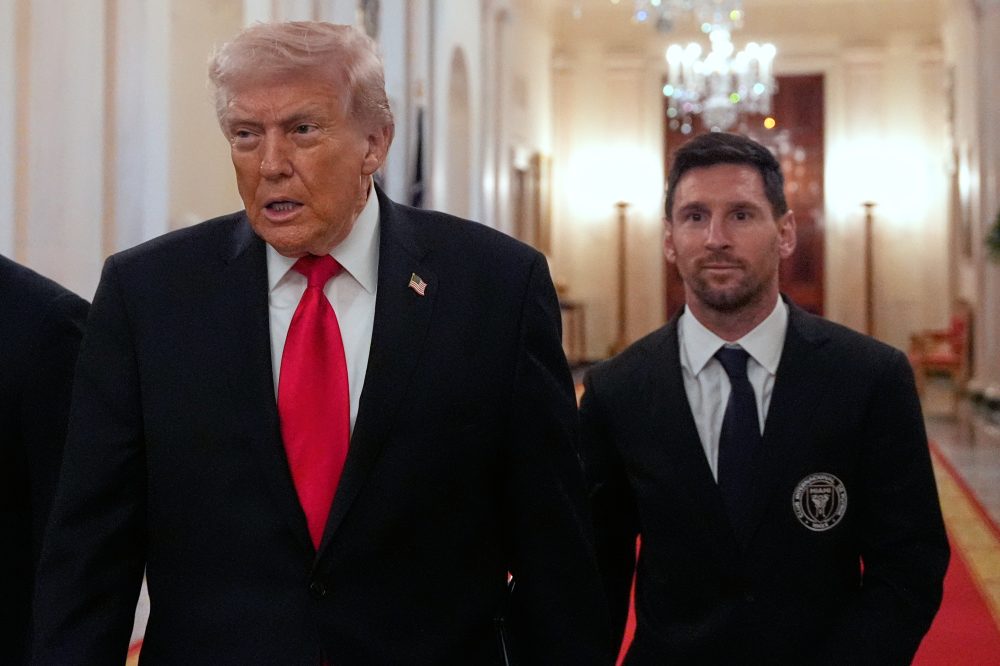

BUENOS AIRES, Argentina — Soccer legend Lionel Messi broke his longstanding tradition of avoiding political appearances when he visited President Donald Trump at the White House this week, presenting him with a sparkling pink soccer ball during Inter Miami’s championship celebration.
The global soccer icon has historically been as skilled at avoiding political figures as he is at evading defenders on the pitch, particularly when it comes to leaders from his native Argentina. Many questioned whether Messi would even participate in Inter Miami’s White House visit following their MLS Cup victory.
When the ceremony began, Messi was notably absent from the team’s initial gathering. Instead, he made his entrance walking beside President Trump and team owner Jorge Mas Santos, later gifting the president the glittery ball.
Though Messi remained quiet during the event, his mere presence appeared significant for an athlete whose political views have remained largely unknown throughout his career.
Following Argentina’s 2022 World Cup triumph under Messi’s leadership, the team chose not to visit then-President Alberto Fernández at Argentina’s Casa Rosada. Argentina’s current leader, Javier Milei, who maintains ties with Trump, has publicly praised Messi but hasn’t managed to secure a meeting or photograph with the star. Last year, Messi was unable to attend a ceremony where former President Joe Biden would have presented him with the Presidential Medal of Freedom due to scheduling conflicts.
The White House visit generated shock and disappointment in Argentina, especially among fans who had respected the national team captain for staying out of political matters — a quality that set him apart from predecessor Diego Maradona. However, some believe his appearance could benefit Argentina as the country prepares for World Cup matches on U.S. soil.
Kirk Bowman, a Georgia Tech professor at the Sam Nunn School of International Affairs who researches soccer and politics in Latin America, wasn’t caught off guard by Messi’s decision.
“He is very ‘long-termism’ in his career, both as a player but also as someone who has a very strong team building long-term wealth,” Bowman explained, referencing Messi’s numerous business ventures, including his ownership stake in Inter Miami.
“He’s also embedded very strongly in Miami as a community, which is far more conservative as a soccer community than other parts of the United States,” Bowman noted.
During the event, Messi stood beside Trump as the president made remarks about Iran, Cuba and Venezuela, offering applause at the conclusion. Supporters have defended Messi by pointing to his limited English proficiency, which Bowman describes as providing “an extra layer of brand protection.”
Neither Inter Miami nor Messi’s representatives responded to Associated Press inquiries about the visit. However, Inter Miami head coach Javier Mascherano addressed questions during a Friday media session.
“I thought we would talk about football but I guess I’m not lucky. We were following the protocol that is practically a tradition for a team to visit the White House when it becomes champion,” Mascherano stated.
He explained that the team spent several hours at the White House and that their “contact with Trump was what you saw on TV and not much more than that.”
The photograph of Messi alongside Trump prompted some supporters to recall the anti-American positions of the late Maradona, Argentina’s other football legend. The captain of Argentina’s 1986 World Cup-winning squad actively supported figures like Fidel Castro and Hugo Chávez, even getting revolutionary Ernesto “Che” Guevara tattooed on his arm.
In contrast, Messi has maintained silence on political issues across all countries where he’s resided, including Argentina, Spain, France and the United States. During his time at FC Barcelona from his teenage years until 2021, he navigated a politically turbulent period when Catalonia’s independence movement threatened to separate the region from Spain. Despite the movement dividing Catalonia’s 5 million residents, Messi avoided taking any stance on the separatist cause.
He skillfully maintained his status as a beloved figure among Barcelona’s politically divided fanbase by focusing on scoring goals and winning championships. While he could be heard shouting “Visca Barça y visca Catalunya!” (“Long live Barça and long live Catalonia”) during celebrations, this chant was standard among players and carried minimal political significance.
Though Messi never learned Catalan, he consistently spoke positively about Barcelona, the city he moved to at age 13. In a 2024 interview with Catalan television channel Tv3, Messi said his “children are Catalans” and that “I feel like I am from Barcelona.”
Some hints of his political perspectives emerged in 2011 and 2020 interviews with La Garganta Poderosa, a left-leaning Argentine publication. In the earlier interview, Messi expressed admiration for Guevara, and in the more recent conversation during the coronavirus pandemic, he identified inequality as one of society’s most urgent challenges.
Despite this rare political appearance, Bowman believes Messi is unlikely to become more politically active.
“I don’t think he’s really comfortable being political, but he’s not uncomfortable being used in politics as long as the net benefit is positive,” he observed.
Bowman referenced Messi’s promotional agreement with Saudi Arabia’s tourism authority and the accompanying “sportswashing” criticisms, comparing Messi’s strategy to the kingdom’s standard “tarnish clause.”
“I think Messi is seen in the same way,” Bowman concluded. “He will participate in things as long as it doesn’t tarnish Brand Messi.”