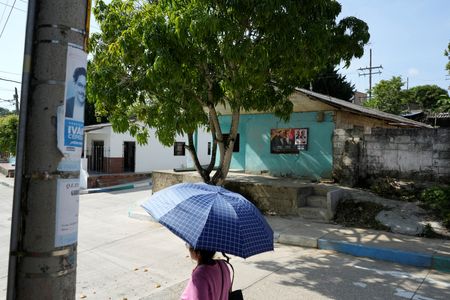

TUBARA/JUAN DE ACOSTA, COLOMBIA — At first look, these two side-by-side towns along Colombia’s hot and humid Caribbean coast seem nearly identical. Single-story houses with rocking chairs on their porches surround town plazas, and locals plan their errands to dodge the brutal midday sun. Mango trees shade the streets where children meander home from school.
Yet Tubara and Juan de Acosta — both located near the port city of Barranquilla — are sharply split when it comes to Sunday’s presidential election, which places two very different visions for Colombia’s future head to head.
In Juan de Acosta, where murders and extortion have surged alongside rising drug trafficking activity along its coastline, right-wing candidate Abelardo De La Espriella earned 55% of the vote in the first round. He has promised a firm hand against armed groups and criminal organizations.
Just next door, Tubara threw its support behind leftist senator Ivan Cepeda, giving him just under 60% of their votes. His message centered on expanding social programs, including reforms to healthcare, pensions, and education.
De La Espriella, a 47-year-old lawyer and businessman with no prior experience in politics, has leaned heavily into military-style imagery and language throughout his campaign. He calls himself “the Tiger,” labels his political movement “Defenders of the Homeland,” and salutes at campaign rallies and in promotional materials — despite never having served in the armed forces.
His tough-on-crime stance gave him a lead of several percentage points over Cepeda in the first round, and more recent polling shows him eight points ahead heading into the runoff.
For residents of Juan de Acosta, the rise in violence feels foreign to their community. Nicanor Alba, who was trimming and bagging pork ribs for customers at his butcher stand near the town plaza, described the toll extortion has taken.
“You set up your business and tomorrow they come and say ‘if you don’t give us 50,000, 30,000 or 40,000 (pesos), it’s over,’” said Alba, whose own brother was killed five years ago.
He said multiple friends and neighbors have been targeted by extortion on more than one occasion, and that recent homicide numbers left him stunned.
“That had never been seen before in Juan de Acosta, it’s a bunch of people,” said the butcher, who intends to cast his vote for De La Espriella.
The town’s location — with road access to Colombia’s interior and a stretch of coastline — has turned it into what authorities describe as a “strategic point” for drug smugglers, according to Colonel Eddy Sanchez, the police commander for Atlantico province.
Two criminal organizations — Los Pepes and Los Costenos — have long been active in the area, including in drug sales, Sanchez said. More recently, the country’s largest criminal gang, the Clan del Golfo, has also moved in.
“The Clan del Golfo uses this municipality as a platform to reach maritime areas and, using speedboats, ship drugs abroad,” Sanchez said.
“Of course, that leads to issues of violence,” he added, though he noted that murders have dropped from 15 in 2025 to just 2 so far in 2026, returning to the town’s historical average. Police have classified 14 of last year’s killings as contract murders.
Tubara, meanwhile, recorded no murders in 2025 and only one so far in 2026, Sanchez said.
“It’s a territorial dispute, where some gangs are trying to enter the municipality while others are trying to push them out to fully control local drug trafficking,” said Oscar Andres Arteta, Juan de Acosta’s interior secretary, adding that local government and police are working together to combat extortion.
Juan Gabriel Coronel, 42, who sells meat, ice cream, and dry goods at a small shop in Juan de Acosta, also plans to vote for De La Espriella in hopes of curbing crime — but he has personal health concerns weighing on him as well.
“I had a liver transplant 17 years ago and have never been denied my medication in that time,” said Coronel, who is a client of a healthcare provider the government took over in 2024 due to alleged care failures. For the past six months, he said, he has been paying for his medication out of his own pocket.
On the other side of the ballot, Cepeda, 63 and the son of a murdered communist leader, swept all but one Caribbean province in the first round among a field of 13 candidates.
To win the runoff, he will need to grow his numbers in those coastal provinces and in the capital, Bogota, according to Luis Fernando Trejos, a political science professor at the Universidad del Norte. Trejos estimates Cepeda needs between 2.5 million and 3 million additional votes to pull off a victory.
De La Espriella, who outpaced Cepeda by roughly 700,000 votes in the first round, will also need to expand his support. More than 41 million Colombians are eligible to cast ballots, but fewer than 24 million participated in the first round.
Both candidates have lined up backing from influential political figures along the coast, Trejos noted. De La Espriella has made a point of highlighting that he grew up in the inland Caribbean city of Monteria. His campaign billboards show his tiger persona wearing a Barranquilla soccer jersey with the message: “Abelardo is coastal like you. … Coastal votes coastal.”
He has also accused Cepeda’s campaign of planning a large-scale vote-buying effort on the coast — a claim Cepeda’s team has firmly rejected.
In Tubara, Cepeda supporters have been actively working to drive up voter turnout. Clara Algarin, a clinical psychologist and former city councilor, told Reuters she has been coordinating transportation for voters who were unable to reach polling stations during the first round.
Algarin expressed admiration for the current leftist president’s expansion of free public university education and a 230,000 peso (about $66) monthly state pension he created for people who were unable to save for retirement — including her own mother.
“My mother worked as a domestic servant from the age of 16. She never had the possibility of being paid a pension before,” Algarin said.
Her husband, Javier Gomez, operates a bakery — its porch decorated with a bright Cepeda campaign banner. He said he was glad to pay his employee the 23% minimum wage increase for this year that the current president put in place.
“The work that (the employee) does deserves the payment of a living wage,” Gomez said while taking a break from packaging fresh bread.