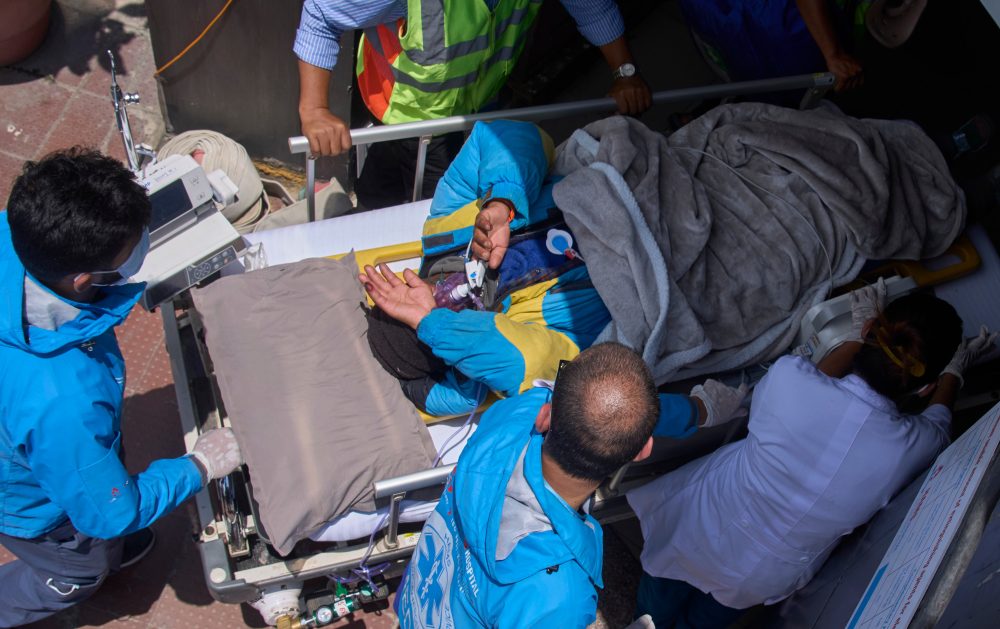

KATHMANDU, Nepal — A mountaineering guide who endured seven days on Mount Everest’s dangerous terrain was receiving medical care at a Nepal hospital on Friday, as his relatives pursued legal remedies over what they called delayed rescue operations.
The 57-year-old Dawa Sherpa was discovered Thursday moving through snow near the Khumbu Icefall area, located just beyond Everest’s base camp, seven days following his disappearance. He was transported by aircraft to Kathmandu where he rejoined his relatives. Medical staff at HAMS Hospital reported he was receiving care for frostbite, dehydration and leg injuries, though his condition remained stable during recovery.
Relatives expressed frustration over the delayed start to search operations and initiated legal proceedings against Dawa’s employer, Himalayan Traverse company based in Kathmandu, while also lodging a formal complaint with the Department of Tourism, the agency overseeing Nepal’s mountaineering activities.
“Action needs to be taken by the mountaineering department. It was negligence of the company that resulted in so much delay in starting rescue,” stated Karma Gelje Sherpa, Dawa’s nephew. “If he had been a foreign climber, rescue would definitely have been organized much faster and prompt, but he happened to be an old Nepali.”
Representatives from Himalayan Traverse were unavailable for immediate response on Friday.
Dawa was last observed around May 29 making his way down the peak, though he failed to return to base camp despite two international climbers who accompanied him successfully completing their descent. These climbers were among the final group on the mountain as the seasonal climbing period concluded and equipment was being removed.
His final known position was at Yellow Band, situated above Camp 3 at an elevation of 7,200 meters (23,622 feet). Base camp sits at 5,300 meters (17,388 feet).
Dawa had been climbing alongside British mountaineer Chris Thrall and a Polish climber whom local news outlets identified as Mariusz Chmielewski. In a social media post, Thrall explained he needed to assist the Polish climber during descent due to his deteriorating condition and frostbite injuries.
“He (Dawa) had been in death zone for 19 hours and at that point, a decision was made that we needed to descent through the Icefall,” Thrall wrote earlier this week, describing his reasoning for not ascending to search for Dawa.
Helicopter search missions dispatched to locate him proved unsuccessful.
Officials have not explained why the climbing party remained on the mountain after authorities had already removed route ladders on May 29.
Dawa’s relatives had abandoned hope for his survival and were conducting their second day of funeral ceremonies, which traditionally continue for multiple days.
The group that located him belonged to the Sagarmatha Pollution Control Committee, an organization responsible for installing ladders and ropes at the beginning of each climbing season before removing equipment and conducting cleanup operations after climbers depart.