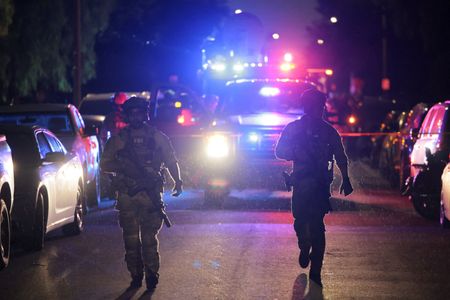

WASHINGTON – Federal law enforcement agencies are conducting a comprehensive review of security protocols following a shooting incident that occurred near Saturday night’s White House Correspondents’ Association dinner, where President Donald Trump and other high-ranking officials were in attendance.
According to five sources including former Secret Service personnel and senior federal officials who spoke with Reuters, agents successfully executed their protective strategy by preventing the armed suspect from reaching the Washington Hilton’s basement area where the president was scheduled to deliver remarks.
However, the incident has exposed potential security weaknesses, particularly given that dinner attendees could hear gunshots fired at a Secret Service agent. This concern comes despite enhanced security measures already implemented following two previous assassination attempts on Trump during his 2024 campaign.
The Secret Service has not yet responded to requests for comment regarding the incident.
Former law enforcement officials suggest the primary takeaway from Saturday’s events is the need to establish larger protective zones around the president during major public gatherings, even if such measures create inconvenience for the public.
Several federal officials pointed out that security perimeters at Trump’s campaign rallies typically extend much further than what was implemented Saturday evening.
While attendees were required to pass through metal detection equipment before entering the ballroom, only a valid ticket was needed to access the hotel property. According to someone directly involved in event planning, multiple individuals attempted entry using outdated tickets from the previous year.
The alleged gunman, identified as a California resident, reportedly bypassed basic security measures by registering as a hotel guest several days before the event, then rushed past security personnel while carrying multiple weapons.
Bill Gage, a former six-year veteran of the Secret Service Counter Assault Team who currently serves as executive protection director for SafeHaven Security Group, anticipates that post-incident analysis will emphasize extending metal detector placement to create expanded outer security zones.
“The Secret Service is going to have to find a way to better secure large hotels that may inconvenience the hotel goers and the hotel,” Gage stated.
Gage also emphasized the need for improved coordination when evacuating other administration officials.
Multiple law enforcement agencies, including the U.S. Marshals and Diplomatic Security Service, removed attendees following the shooting, demonstrating how the complicated network of agencies responsible for protecting various VIPs can result in apparently uncoordinated emergency responses.
Analysis of video and audio evidence by Reuters shows that while Trump was removed from the stage within 30 seconds of the final gunshot, Health and Human Services Secretary Robert F. Kennedy Jr. required at least 100 seconds to exit the venue, while Secretary of State Marco Rubio and Pentagon chief Pete Hegseth needed approximately 150 seconds to leave.
Don Mihalek, a former senior Secret Service agent with experience securing previous correspondents’ dinners at the Washington Hilton, acknowledged the ongoing security challenges posed by the expansive facility.
“I’m sure the service is going to go back and re-look at the set-up there, and probably push out the perimeter some more now, because of what happened,” Mihalek explained.
During an unscheduled press conference Saturday night, Trump characterized the Washington Hilton as “not a particularly secure building.”
The incident recalls the first assassination attempt against Trump at a Butler, Pennsylvania campaign rally in July 2024, where law enforcement faced criticism for inadequate security perimeter establishment that allowed a gunman clear sight lines to the then-candidate, resulting in an ear injury.
The suspected shooter expressed criticism of the event’s security measures in a written statement first published by the New York Post.
“Like, I expected security cameras at every bend, bugged hotel rooms, armed agents every 10 feet, metal detectors out the wazoo,” the California man wrote. “What I got (who knows, maybe they’re pranking me!) is nothing.”
Conservative commentators and officials, including acting Attorney General Todd Blanche, used social media platforms to argue that the incident demonstrates the necessity of proceeding with a proposed White House ballroom construction project.
A federal judge halted the ballroom construction in late March, ruling the project illegal without congressional authorization, though a federal appeals court subsequently suspended that order.
One federal official indicated expectations for a comprehensive security review covering both the president and his cabinet members, with potential procedural changes. A second official noted that cabinet member security had already been enhanced when the Iran conflict began in February.