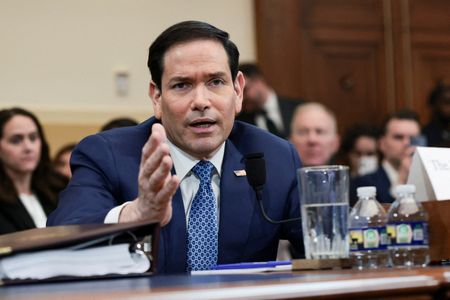

During Tuesday testimony before the Senate Foreign Relations Committee, US Secretary of State Marco Rubio revealed that Iran has demonstrated increased willingness to address nuclear program components that were previously considered untouchable in negotiations with Washington.
Speaking to lawmakers, Rubio indicated that recent conversations with Iran have encompassed topics that were once completely off the table.
“They have agreed to negotiate aspects of their nuclear program that just a month ago, just a year ago, they were refusing to even mention,” Rubio informed the committee, though he did not provide specific details about these discussions.
The secretary of state warned that advances in negotiations do not ensure a successful conclusion and noted that internal uncertainty among Iran’s leadership has made the diplomatic process more challenging.
“This is not a guarantee that ultimately it will lead to a deal that’s acceptable,” Rubio stated.
Rubio suggested that a significant development might occur in the near future, explaining: “There is the prospect before us, which could happen today, it could happen tomorrow, it could happen next week.”
The top diplomat emphasized that any easing of sanctions requested by Tehran would continue to be linked to limitations on its nuclear operations.
“Right now, everything that’s been discussed with them is that … any sanctions relief is condition-based, which means it has to be in return for the reason why those sanctions were put in place in the first place, which is their nuclear program,” he informed Congress.
Rubio noted that Iran would also need to reopen the Strait of Hormuz, a waterway that handles 20% of global oil and gas transportation.
“They have to announce very clearly ‘The straits are now open, we’re not charging a toll.’ We will help remove the mines that they put in there, and they will not fire on ships,” Rubio explained.
“The more they give, the more they would get,” he continued, later adding, “They’re not going to get it as a signing bonus.”
Regarding Lebanon peace negotiations, Rubio identified Hezbollah as the principal barrier to achieving an agreement.
“This is one of the most ironic situations in the world. The government of Lebanon and the government of Israel could sign a peace agreement tomorrow,” he observed.
“The obstacle in Lebanon is the fact that Hezbollah has embedded itself within the state, and it is the reason for all the suffering taking place there now and over the years,” Rubio declared.
He further characterized Hezbollah as “a complete and total proxy of Iran,” maintaining that the organization’s military strength relies on Iranian backing.