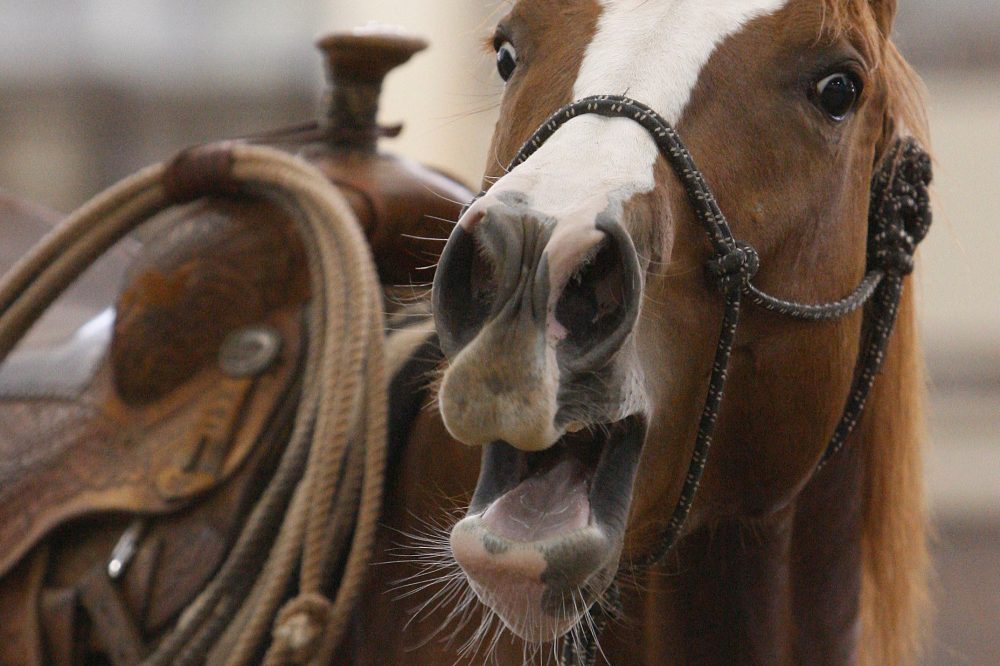

NEW YORK (AP) — When horses call out to locate companions, welcome familiar faces, or express excitement during meal times, they create one of nature’s most distinctive sounds.
For years, scientists have been puzzled by how horses create their characteristic whinny sound, which combines both deep and shrill tones simultaneously — resembling a mix of a growl and a shriek.
The deeper tones weren’t difficult to understand. These sounds result from air flowing across tissue bands within the larynx that create noise through vibration. This process mirrors how people produce speech and song.
However, the sharp, high-pitched element remained a puzzle. Generally speaking, bigger animals possess larger vocal systems and produce deeper sounds. So what allows horses to create these high notes?
A recent study reveals the answer: horses create whistles.
Scientists inserted tiny cameras through the nostrils of horses to record internal activity during whinnying and nickering, the gentler sound horses make. They also performed comprehensive scans and forced air through voice boxes from deceased horses.
The study found that the whinny’s puzzling sharp tones result from a whistling mechanism originating in the larynx. Air causes tissue vibration in the voice box while a region directly above tightens, creating a narrow passage for the whistle sound to emerge.
This differs from human whistling, which occurs using our mouths.
“I’d never imagined that there was a whistling component. It’s really interesting, and I can hear that now,” said Jenifer Nadeau, who studies horses at the University of Connecticut. Nadeau was not involved with the study, which was published Monday in the journal Current Biology.
While some small mammals like rats and mice produce similar whistles, horses represent the first large mammal discovered with this ability. They’re also the only known animals capable of whistling through their larynx while simultaneously vocalizing.
“Knowing that a ‘whinny’ is not just a ‘whinny’ but that it is actually composed of two different fundamental frequencies that are created by two different mechanisms is exciting,” said Alisa Herbst with Rutgers University’s Equine Science Center, of the study in an email.
One major remaining question involves how horses developed these dual-toned calls. Wild Przewalski’s horses demonstrate similar abilities, as do elk. However, more distantly related species like donkeys and zebras cannot produce the sharp-pitched sounds.
The dual-toned whinnies might enable horses to communicate multiple messages simultaneously. The varying pitch levels may help them express a broader spectrum of emotions during social interactions, according to study author Elodie Mandel-Briefer with the University of Copenhagen.
“They can express emotions in these two dimensions,” Mandel-Briefer said.