
Newly released Justice Department files show Charles Schwab processed approximately $27.7 million in wire transfers for Jeffrey Epstein as the convicted sex offender attempted to buy an extravagant palace in Morocco during the 10 days leading up to his 2019 arrest.
The financial services company handled these transactions for Epstein over several months in 2019, even as the disgraced financier faced intense public attention following Miami Herald investigations in 2018. Schwab submitted a suspicious activity report to federal authorities on July 13, one week after Epstein’s arrest.
According to the documents, Schwab established three business accounts for Epstein’s companies in April 2019. One account belonged to Southern Trust, the entity seeking to purchase the lavish Bin Ennakhil palace in Marrakesh. The corporate account designated Richard Kahn, Epstein’s accountant, as an authorized individual, while Epstein served as Southern Trust’s president and sole beneficial owner.
From June 26 through July 9, 2019, Southern Trust directed Schwab to transfer roughly $12.7 million in euros for the property acquisition, then canceled that order. The brokerage subsequently received another wire request bearing Epstein’s signature and transferred $14.95 million for the same property, despite the account lacking adequate funds while awaiting the return of the initial payment.
When contacted by Reuters, Schwab refused to discuss account specifics, citing federal regulations, privacy laws, and company policies requiring confidentiality.
“An associate of Epstein opened accounts in April 2019. Shortly after, our Risk team began investigating the accounts and within 60 days of starting the review, we notified the client of our decision to close and terminate the relationship. We also referred the matter to federal law enforcement,” the company stated in an email response.
Schwab declined to specify when its risk team initiated its investigation.
Federal Bank Secrecy Act regulations require financial institutions to submit suspicious activity reports within 30 days of discovering concerning facts, along with reporting daily cash transactions exceeding $10,000 to help detect and prevent money laundering.
A FinCEN spokesperson informed Reuters that federal law prohibits confirming or denying the existence of any alleged suspicious activity report.
Kahn’s attorney did not respond to Reuters’ inquiries.
Marc Leon, the Marrakesh real estate agent, told Reuters via email that Epstein initially attempted to purchase Bin Ennakhil in 2011, with negotiations over terms and pricing continuing for years.
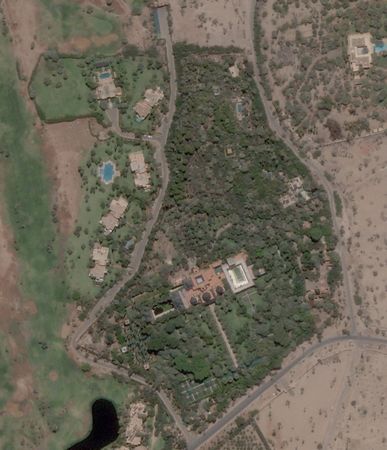
Property listings in the Justice Department files describe Bin Ennakhil as featuring gold-adorned walls, a hammam steam spa, 60 marble fountains, and an outdoor pool and jacuzzi across 4.6 hectares. The estate includes multiple gardens containing hundreds of olive trees and over 2,000 palm trees, covering an area larger than New York’s Washington Square Park or approximately six soccer fields.
Leon defended his involvement in facilitating Epstein’s property bid.
“Epstein had been convicted of sex crimes (in 2008) and had served his sentence. There was therefore nothing to prevent him from attempting to purchase property in Morocco. We had no way of knowing that he had continued his terrible crimes,” he explained.
Epstein died in jail in August 2019 while facing federal sex trafficking charges.
Epstein sought Schwab’s services in 2019 as Deutsche Bank closed accounts belonging to the convicted sex offender, who had pleaded guilty in 2008 to soliciting prostitution from a minor and served prison time.
The U.S. Virgin Islands subpoenaed Schwab along with at least six other financial firms in 2020, requesting documents related to Epstein’s estate co-executors. The subpoena did not name Schwab as a defendant or include any wrongdoing allegations against the brokerage.
Emails and wire transfer requests in the Justice Department documents indicate Epstein discussed the luxury Marrakesh property purchase with associates during spring 2019. Southern Trust, Epstein’s company, agreed to acquire the property through Leon in March 2019.
After evaluating various financial arrangements, Epstein instructed associates to transfer funds to Leon.
Schwab received Southern Trust’s order to wire 11.15 million euros, approximately $12.7 million at that time, to Leon on June 26, 2019, according to the suspicious activity report reviewed by Reuters.
The funds went to Leon’s Julius Baer account in Switzerland, where Leon was based at the time.
The following day, Schwab received a call from someone whose identity was redacted in the report, requesting the transfer’s cancellation. When asked why, the caller explained that real estate deal terms were not “agreeable.”
The caller also indicated another payment for a larger amount would be made to a different account.
Schwab successfully reversed the order, with funds scheduled to return on July 10.
Two days before Epstein’s arrest, Southern Trust instructed Schwab in a July 4 wire transfer request signed by Epstein and his co-signatory to send Leon $14.95 million.
Schwab transferred the funds to Leon’s Julius Baer account, despite Southern Trust’s account lacking sufficient funds because the earlier transfer had not yet been returned.
While Schwab could reasonably expect the payment would be transferred back to Epstein’s account, the bank faced risk until the funds returned.
Reuters could not determine when the $12.7 million ultimately returned to Epstein’s account, though the funds were scheduled to arrive July 10, according to the July 13 suspicious activity report.
When asked about its policy for processing international wire transfers from accounts with insufficient funds, Schwab declined to comment.
Reuters could not establish whether Julius Baer accepted the transfers. A Julius Baer spokesperson declined to comment.
Leon stated: “The anti-money laundering checks in force were carried out by the banking institutions involved in the future transaction, which ultimately never took place.”
Schwab canceled the second transfer on July 9, three days after Epstein’s arrest, at the request of an individual acting on Epstein’s behalf whose name was redacted.
An email in the Justice Department documents shows Epstein’s accountant Kahn requested the transfer cancellation on July 9.
House Oversight Committee member Robert Garcia announced in January that Kahn has been ordered to testify before Congress next week to answer questions about whether he helped facilitate Epstein’s crimes through managing the deceased sex offender’s financial affairs.
Reuters has no evidence of wrongdoing by Kahn.
In a post-arrest exchange with Schwab, an unidentified Epstein associate asked whether future Southern Trust account transfers would still require two signatures, as more money would be sent soon.
The Justice Department announced on July 8 that Epstein had been charged with sex trafficking of minors and remained in jail.
In its July 13 suspicious activity report to FinCEN, Schwab expressed “concerns with attempted wires for the purpose of real estate, in light of negative media surrounding Jeffrey Epstein” and worries about him being a potential flight risk before a bail hearing.
“This investigation is the result of an internal referral,” the document shows Schwab stating.
While Epstein’s deal collapsed, the Bin Ennakhil palace – meaning “amidst the palms” – in Marrakesh is no longer empty.
“The property has since been sold to another buyer,” Leon informed Reuters.