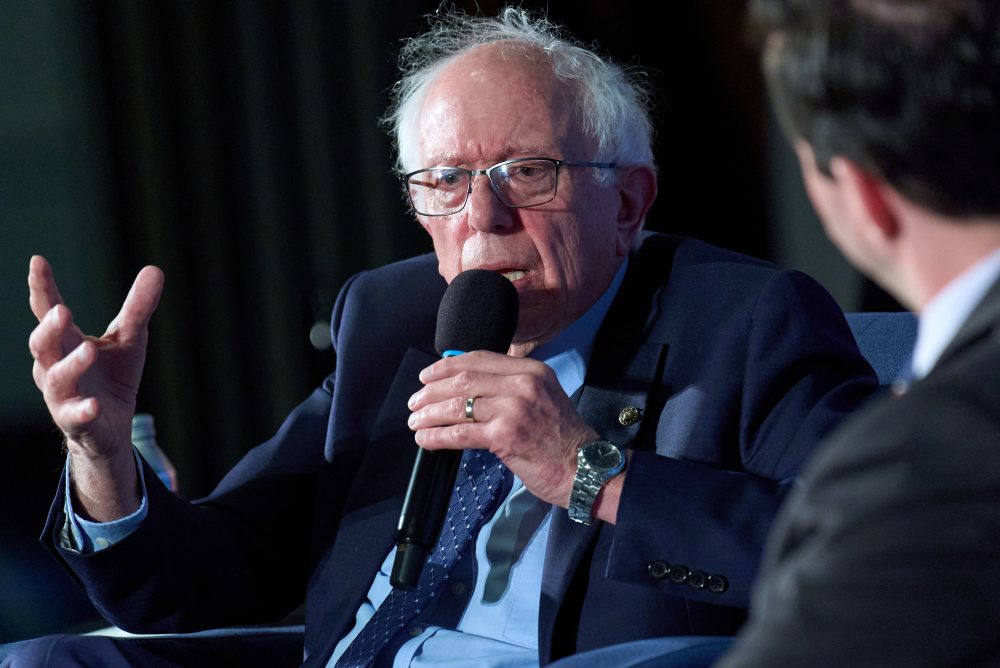

WASHINGTON — As artificial intelligence companies surge toward trillion-dollar valuations and reshape the broader economy, Vermont Sen. Bernie Sanders is pushing legislation that would transfer significant wealth and corporate power directly to the American public.
The bill, first shared with the Associated Press, would establish a sovereign wealth fund managed by an independent commission. It would be funded through a one-time 50% tax on the stock holdings of the largest AI companies — not a cash payment, but an actual transfer of shares. Sanders estimates that arrangement would create a fund worth nearly $7 trillion.
“The benefits cannot simply go to the handful of wealthy corporations. They will be shared by the American people,” the independent Vermont senator said in a Wednesday interview.
The tax would apply to AI companies that bring in at least $200 million in annual AI-related sales. Any future company that hits that threshold would also be subject to the same requirement.
A seven-member independent commission, nominated by the president and confirmed by the Senate, would oversee the fund. Its mandate would be to use its voting shares to “block decisions that hurt the American people and to push for policies that help them,” according to a summary of the bill obtained by the AP.
Sanders proposes that a 5% annual dividend from the fund would deliver direct payments of more than $1,000 to every American. As AI companies grow in value, those gains would be directed toward public programs covering education, housing, and health care.
“We’re not going to lose any money, even if there is a bust in the bubble,” Sanders said, arguing that taxpayers would not be on the hook if AI company valuations drop.
“The public has got to have a significant seat at the table to make sure that terrible things do not happen to ordinary people, and that in fact, AI benefits ordinary people, not hurts them,” he added.
The concept of giving the public a financial stake in AI development has drawn attention from across the political spectrum. President Donald Trump has mused about the government holding a stake in AI companies, describing it as “something very interesting” that could become “a partnership with the American public.” Trump recently signed an order allowing new AI models to be voluntarily reviewed by the government, and on Wednesday he attended an AI-focused session at the G7 summit in France alongside top industry figures.
OpenAI proposed in April to “create a public wealth fund that provides every citizen — including those not invested in financial markets — with a stake in AI-driven economic growth.” Anthropic, one of OpenAI’s leading competitors and recently valued at $965 billion, has also shown openness to similar ideas, with its CEO writing that “universal basic income could be financed through taxes on relevant companies.”
However, Sanders’ proposal is considerably more aggressive than any of these approaches. In a meeting between Sanders and OpenAI’s CEO, the two remained far apart on how large of a public stake would be appropriate, according to people present in the room.
“I think people like Sam Altman and Trump (who) may be sympathetic to this are saying: ‘Okay, look, we’re making zillions of dollars so we’re going to be nice guys and maybe we’ll buy off the public. We will give 5% of our profits back into the government,’” Sanders said. “That’s not what we’re talking about. What we’re talking about are two very different things.”
Sanders acknowledged the proposal is a starting point, not a final answer. “We think this is the best that we could do at the moment, and it’s certainly a major, major, major step forward from giving unilateral and total power to a handful of multi-billionaires,” he said.
Sanders plans to make AI ownership a central theme going forward. His “Fighting Oligarchy” tour drew large crowds across the country last year alongside high-profile lawmakers, including Rep. Alexandria Ocasio-Cortez, D-N.Y. When asked if AI wealth inequality would be part of that message, Sanders answered simply: “Absolutely.”
Other candidates are also leaning into the issue ahead of the midterm elections. A Michigan Democratic Senate candidate has unveiled a plan to “protect workers in the age of AI,” while a New York Democratic House candidate has also made AI regulation a campaign issue.
Public anxiety about the technology is widespread. Data center projects across the country have faced pushback from communities worried about electricity use, water consumption, and environmental effects. Some states that once aggressively courted those facilities, including Ohio and Virginia, have begun reconsidering the tax incentives they offered.
On college campuses, commencement speakers have been booed for mentioning artificial intelligence. A 2025 poll by the Institute of Politics at the Harvard Kennedy School found that roughly 70% of college students view AI as a threat to their job prospects.
“Workers will be thrown out of their jobs while billionaires, multi-billionaires become even richer,” Sanders said. “The American people are aware of that and don’t want to see it happen.”