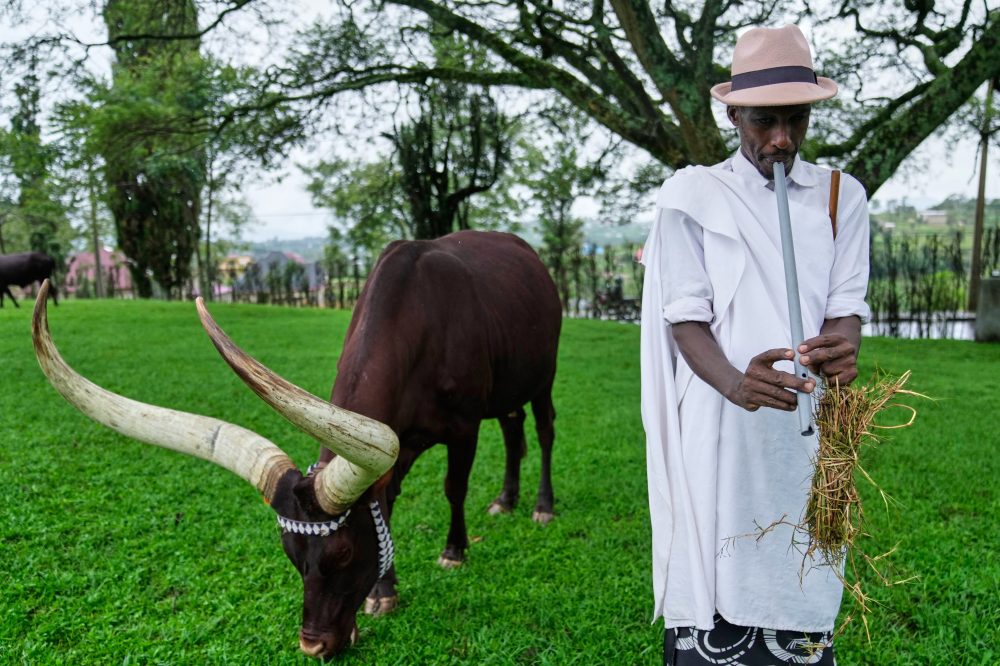

NYANZA, Rwanda — At the King’s Palace Museum in Nyanza, Rwanda, a flute plays softly and verses of poetry fill the air — all for the benefit of a herd of cattle.
These are no ordinary animals. The Inyambo cows, recognized by their long, crescent-shaped horns, are considered living symbols of Rwanda’s royal history. They graze at the museum and at the estates of some of the country’s wealthiest citizens, including President Paul Kagame.
The Inyambo are descended from the Ankole cattle breed of East Africa and can also be found in neighboring Uganda and Burundi. Historically, they were kept in royal courts where they represented wealth, power, and prestige.
“They’re not for milk, they’re not for meat. They were just used as decorations around the palaces,” said museum curator Bigira Junior.
Although Rwanda’s monarchy no longer exists, President Kagame has continued the age-old tradition of gifting these cattle to other leaders. A local publication, The New Times, once described this practice as “Inyambo diplomacy.”
As Rwanda works to grow its tourism industry, it has been investing significantly in sites like the King’s Palace Museum, where the Inyambo serve as the centerpiece attraction.
Caretakers recite melodious poetry to the animals, praising their appearance and addressing them by name. This practice is believed to soothe the cattle before major events or traditional ceremonies.
“You have beautiful horns. Move your head so that we can see your beautiful neck and body. You are the most beautiful cow among others,” one caretaker sings during the ritual.
The cattle are also regularly brushed, another calming technique used by their handlers.
“Remember, they are to be loved and cherished, and you can’t love something from afar. You have to get close to it,” Junior explained.
Across Rwanda and several other African nations, cattle carry deep social and economic meaning. The size and uniqueness of a person’s herd often determines their standing in the community. In 2004, South African President Cyril Ramaphosa purchased a special breed of Ankole cattle from Uganda’s Yoweri Museveni.
The Inyambo have also shaped Rwanda’s traditional dance culture. Women perform graceful movements, extending their arms to imitate the shape of the cattle’s distinctive horns.
“The dance is more or less a way to portray the beauty of the royal cows,” Junior said.
The Inyambo were reintroduced to the museum grounds in the early 2010s as part of a conservation effort, though the exact number remaining is not known. Caretakers oversee breeding programs aimed at preserving the animals’ signature traits — including their long horns and rich brown coloring, a shade associated with royalty, maturity, and stability.
For younger visitors encountering the breed for the first time, the Inyambo represent a direct connection to Rwanda’s past.
“We educate them to take this information to others and keep the culture alive,” Junior said.