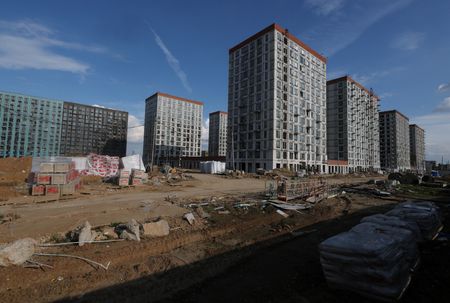

Plastic sheets cover empty window frames and balconies hang crookedly at the partially built Ostafyevo housing complex on the outskirts of Moscow, where frustrated apartment buyers say they have taken the developer to court.
Russia set a record for housing construction in 2023, driven largely by government-subsidized mortgages. But the withdrawal of those subsidies, combined with steep borrowing costs and an ongoing economic slowdown tied to the war in Ukraine, has since hammered the construction industry.
Figures from Russia’s state statistics agency show that the amount of residential space completed in the first quarter dropped 28% compared to the same period the previous year. Russia’s largest bank, Sberbank, warned that the entire construction sector had essentially stalled during that time.
Buyers at Ostafyevo say their expected move-in dates have been pushed back several times since March 2025. About 20 of them confronted the developer, Samolet, at a meeting held in May.
“Who is working there? Are they even working? Because … we have not seen any changes since January,” one buyer said at the meeting.
Another buyer showed Reuters footage filmed inside one of the half-finished units, revealing exposed breeze block walls with wiring dangling loose and a large water stain spreading across the ceiling.
In a written statement responding to media questions, Samolet said it understood the buyers’ frustration and was “making every possible effort” to speed up the move-in process. The company did not explain what caused the delays but noted that several contractors had been swapped out for what it called “reliable partners.”
The Ostafyevo development’s website promotes a large residential campus with landscaped grounds, schools, and shops — illustrated with a video of children playing on a sunny playground. Apartment prices begin at roughly 7.5 million rubles, or about $101,500.
Samolet said construction has wrapped up on three of the complex’s six phases, with residents already living there. Apartments in the fourth phase and some in the fifth are ready for occupancy, and the company said a gradual handover of remaining units would begin by September 30. “All obligations to clients will be fulfilled,” the company stated.
The financial strain on Samolet mirrors broader troubles across Russia’s real estate sector. After strong revenue gains in 2023 and 2024, the company reported a loss in 2025, partly due to high borrowing costs. Cut off from state subsidies, it restructured a portion of its debt in February. By the end of 2025, the company’s total debt exposure had reached 373 billion rubles, equivalent to roughly $5 billion.
The construction slowdown is adding further pressure to Russia’s economy, which shrank for the first time in roughly three years during the January-to-March period. Russia’s construction minister was quoted by the RIA news agency as saying that construction and related industries together made up 13% of the country’s gross domestic product in 2025.
Russia’s central bank noted in a June financial stability report that requests for loan restructuring from construction and real estate companies climbed 10% in the first quarter compared to the prior quarter. It described the difficulties facing some developers as “limited” and said they posed “no systemic risks.” The bank also pointed to a 37% year-over-year jump in new project launches during the first quarter as an encouraging sign, and said the number of delayed housing completions had declined after a moratorium — which had prevented buyers from seeking penalties for missed deadlines — expired in January.
Buyers at Ostafyevo said they moved quickly once they were able to take action. “Many have filed lawsuits, I have as well,” said Elena Skripnichenko, speaking alongside other buyers outside the Samolet office at the construction site.
She said some of the buyers had recently slipped past a fence to speak directly with workers on site, who told them they were not receiving their wages. At the May meeting, a Samolet representative acknowledged that workers were being paid, though “probably not the amount they want.” The company did not address questions about worker pay or the number of lawsuits filed in its written response.
A mid-May survey by Russia’s state housing agency found that nearly 75% of developers missed their first-quarter sales targets, and more than half expect conditions to get worse over the coming year — even as some report that severe labor shortages are beginning to ease slightly.
For some at Ostafyevo, hope is fading. Tatyana Lubentsova had planned to move her young family into their new apartment in March 2025. The family had left their hometown of Belgorod, a city near the Ukrainian border that has been repeatedly struck by drone and missile attacks. “Now we are in May 2026, and we still do not have any keys,” she said.