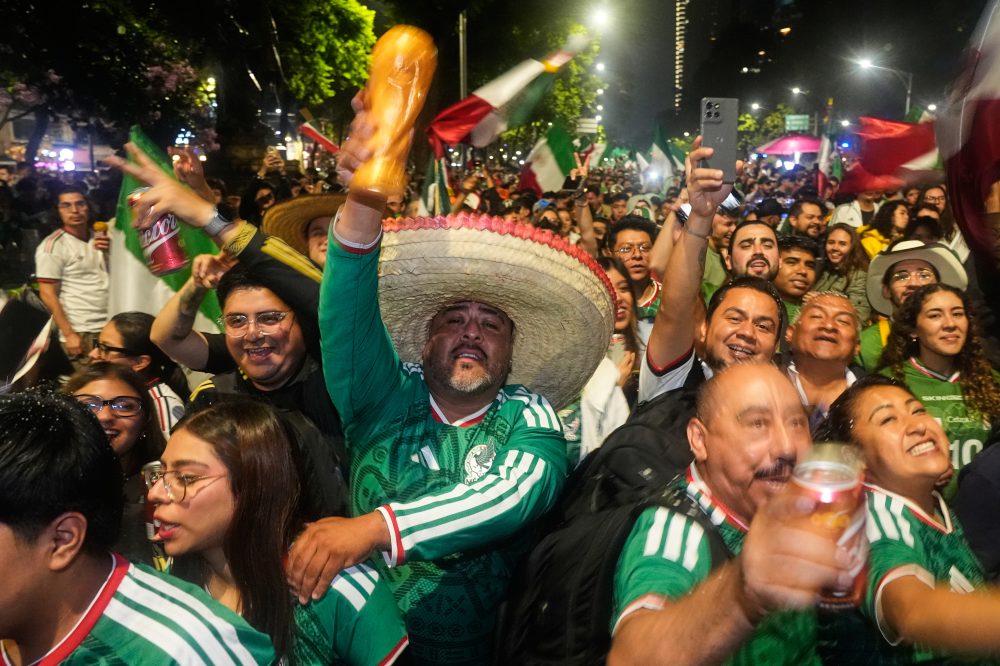

MEXICO CITY (AP) — The roar of “GOOOOOOOOOAL!” echoes through a working-class neighborhood in downtown Mexico City, where a crowd has gathered around a television balanced on plastic tables, surrounded by a maze of street vendors. Across Mexico, fans are watching their national team rack up victories in the FIFA World Cup on screens set up in public plazas, beneath highway overpasses, and inside taco stands.
Locked out by skyrocketing ticket prices for a tournament their own country is co-hosting with the U.S. and Canada, many Mexicans have decided to create their own version of the celebration — right in their own streets.
“Honestly, there’s nothing like going to the stadiums, but I prefer being here in the street. … For me it’s like watching the game from my living room,” said Esmeralda Serrato, who watched a street television alongside dozens of her neighbors. “I feel the blood rushing through my veins saying ‘This is the World Cup.’”
The excitement has been enormous, with hundreds of thousands of people pouring into mass watch parties in host cities including Mexico City, Guadalajara, and Monterrey following Mexico’s two straight wins.
But the festive atmosphere exists alongside months of growing anger at FIFA over what critics describe as outrageously high ticket prices. In a country where the typical worker brings home around $433 per month and soccer is widely seen as a sport that crosses class lines, the exclusivity of stadium access has struck a nerve.
That disconnect has stirred social tension and left many feeling like outsiders at their own party, according to Diego Merla, fiscal justice coordinator for Oxfam Mexico.
“The World Cup is built around the logic of squeezing as much value out of it as possible,” Merla said. “It’s about getting those who are willing and able to pay the absolute maximum. And that ends up excluding a lot of people.”
When tickets first went on sale earlier this year, prices ranged from $140 to $8,680. Since then, costs have climbed dramatically — with some tickets to the World Cup final now running around $32,970.
FIFA President Gianni Infantino has pushed back against the criticism, arguing that the prices reflect the American market.
“You cannot go to watch in the U.S. a college game, not even speaking about a top professional game of a certain level, for less than $300,” Infantino said. “And this is the World Cup.”
For fans like Guillermo Ramírez, the answer was simple: do it themselves.
Ramírez, 49, grew up in Tepito, a working-class Mexico City neighborhood known for its sprawling street markets, which are currently packed with pirated World Cup jerseys. Soccer carries deep meaning in Tepito — a symbol of community identity and resilience in an area often associated with crime. At the center of the neighborhood’s dense market streets sits a soccer field named after Bernardo Manolete Hernández, a celebrated Mexican soccer player who was born there.
Just a block from that field, Ramírez — dressed in a bright green and white Mexico jersey — set up a television and speakers on plastic tables in front of his home and small corner shop before Mexico’s match against South Korea. He recalls watching the 1986 Mexico World Cup as a boy, from TVs set up by neighbors who also couldn’t afford stadium tickets.
“There are a lot of us who simply can’t afford to go to the stadium,” Ramírez said. “Tepito is a soccer barrio, and when there’s a match on, everyone takes out their TVs to watch, especially now during the World Cup.”
Neighbors pack around his screen wearing green and red lucha libre masks, holding their children, and grabbing beers from Ramírez’s corner shop. When Mexico wins, the celebration spills into the broader city, with tens of thousands flooding the streets and heading to Mexico City’s central monument, the Angel de la Independencia.
Mexican President Claudia Sheinbaum has also voiced concern over the costs, saying last week that FIFA leadership should reconsider its pricing approach.
“Soccer has to be something else,” Sheinbaum said.
Sheinbaum has encouraged fans to attend free public watch parties organized by local governments and FIFA in Mexico City, Guadalajara, and Monterrey. Nearly 20 such venues have been set up across the capital, including in lower-income parts of the city. During one match, more than 200,000 Mexican and international fans filled the city’s main plaza, the Zocalo, in a sea of green jerseys.
Armando Soriano brought his wife and two children from the outskirts of the city to a smaller Fan Fest at a plaza about a mile from where Ramírez lives. Locals arrived on motorcycles, and vendors sold beer, tequila, and snacks from plastic tubs on rolling carts. To Soriano, that scene felt more genuinely Mexican than the central FIFA-organized event.
“I want (my family) to be swept up in the spirit — to feel, more than anything, what it means to be Mexican, and to experience the traditions that people here live and breathe,” Soriano said.