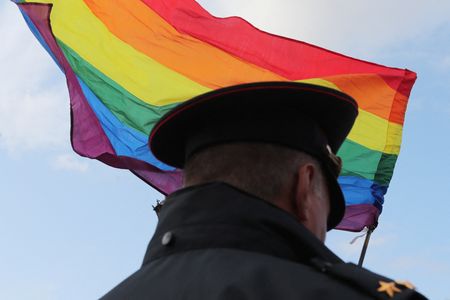

A Russian court has sentenced three people — the owner of an LGBT nightclub and two of its employees — to prison terms in what the court described as the first case prosecuted under Russia’s prohibition on what the government labels the “LGBT movement.”
The court announced Monday that the three individuals, arrested following a law enforcement raid on a club called “Pose” in the southwestern city of Orenburg two years ago, had organized and taken part in activities connected to what authorities classified as an “extremist organization.”
Club owner Vyacheslav Khasanov, 37, was sentenced to seven years in prison and ordered to pay a fine of 1 million roubles, equivalent to approximately $12,755. Club manager Diana Kamilyanova, 30, received a sentence of six years and three months, while art director Alexander Klimov, 23, was sentenced to two years and three months behind bars. All three maintained their innocence.
Under President Vladimir Putin, Russia has significantly restricted LGBT rights, framing them as a Western influence that undermines what the government describes as traditional Russian values rooted in family, national identity, and Orthodox Christian faith.
In 2023, Russia’s Supreme Court officially classified the “LGBT movement” as an extremist organization, and those who support it have been designated as terrorists. That ruling opened the door to serious criminal charges against LGBT individuals and those who advocate for them.
The crackdown has extended broadly — music platforms and online film services face routine fines for hosting LGBT-related content, and in April, employees of a Russian book publisher were questioned by authorities over potential “LGBT propaganda” found within its catalog.
The Pose club had been in operation since 2021, regularly hosting drag performances. As restrictions on LGBT expression grew, the venue began promoting itself as a “parody bar theatre,” according to Russian independent news outlet Mediazona.
In March 2024, the club was raided by Orenburg regional authorities alongside Russia’s National Guard. Video footage posted online by a far-right group captured patrons standing with their hands raised as masked individuals moved through the club’s neon-lit interior. Others were shown lying on the floor with their hands crossed over their heads.
In its ruling, the court stated that the three defendants had “under the guise of running a nightclub, organised events centred on the common theme of demonstrating affiliation with people of non-traditional sexual orientation for an unspecific group of the venue’s patrons.”
LGBT rights attorneys in Russia have stated that the Orenburg case will function as a legal precedent, enabling future prosecutions of LGBT people and their supporters, while also eliminating what they describe as remaining “safe havens” for LGBT individuals within the country.