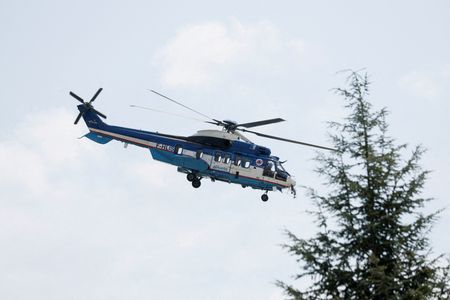

Rising oil prices may breathe new life into a helicopter model that faced serious safety concerns nearly a decade ago, according to the departing chief executive of the world’s largest civilian helicopter manufacturer.
Bruno Even, who is stepping down this week as CEO of Airbus Helicopters after eight years in the role, believes the H225 Super Puma could experience renewed demand as energy companies expand offshore drilling operations in response to higher oil prices.
The H225 faced a major crisis in 2016 when aviation authorities grounded the aircraft for half a year following a fatal accident off the Norwegian coast. In that incident, the helicopter’s main rotor blades broke apart, resulting in the deaths of 13 individuals who were returning from an offshore oil platform.
While operators in countries including Brazil, Nigeria, and various Asian nations have returned to using the redesigned H225, North Sea operators remain hesitant to employ the helicopter, which traces its design origins to the oil crisis of the 1970s.
“It is for clients to decide but I am convinced that in coming years it will continue to increase market share in the offshore market,” Even stated during an interview.
The executive pointed to recent developments in oil markets, noting that prices have climbed dramatically following U.S.-Israeli military actions against Iran that began in late February. This surge has put oil on pace for a record monthly increase, potentially making previously expensive offshore drilling sites more economically viable.
Even suggested that industry trends toward smaller helicopter models might reverse as companies seek aircraft capable of longer-distance missions, particularly as the competing Sikorsky S-92 approaches replacement age.
The H225 production line has remained operational largely due to strong orders for military versions of the aircraft, Even noted.
During Even’s tenure, the company has seen significant improvements in its supply chain reliability, with parts shortages reaching their lowest point in several years by 2025. However, challenges remain with certain suppliers, he acknowledged.
“We still have some suppliers with difficulties and we need to be able to address these,” Even said.
Under Even’s leadership, Airbus Helicopters doubled its order backlog. His successor, Matthieu Louvot, currently serves as Airbus’s strategy chief.
Even’s final years included the public unveiling of the company’s first entirely new aircraft design in ten years: the H140, which is intended to eventually succeed the H135 model commonly used by emergency response services. Both helicopter types will continue to be available, Even confirmed.
The company has also been working on classified development projects, including one previously known as X9 that may become a future replacement for the H145 model. In 2024, Airbus Helicopters purchased property adjacent to its German manufacturing facility where both the H135 and H145 are produced, citing “significant potential” for expansion in company documents.
When asked about secretive research initiatives, Even remained tight-lipped.
“If there are names beginning with X, it’s possibly because they are not meant to be commented on externally,” he remarked.
He emphasized that current demand for the H145 remains robust while acknowledging ongoing innovation efforts.
“That doesn’t mean that, like any self-respecting company, we aren’t working on innovation to be able to launch a programme when the market requires. That’s true for all our portfolio,” Even explained.
Research and development investment has increased since 2023 following an extended period of reduced spending, though the company remains cautious about not undermining sales of established models like the popular H125.
“There isn’t a single day in these eight years that I haven’t thought about the successor to each of our products,” Even reflected.
Regarding potential replacements for the H125, Even identified several key technological areas under consideration.
“It’s a mixture of engines, architecture and hybrid (power). That’s the segment most likely to introduce some electric solutions. I don’t think the conditions are there yet,” he concluded.