
PORT-AU-PRINCE, Haiti (AP) — A new international assessment released Thursday reveals that while Haiti’s hunger crisis may be stabilizing slightly, rising fuel costs tied to Middle Eastern conflicts could quickly undo any progress in the Caribbean nation.
The Integrated Food Security Phase Classification, a leading global authority on food crises, projects that more than 5.83 million Haitians will experience severe hunger between March and June — representing over half the nation’s population. This marks a modest decrease from the earlier projection of 5.91 million people.
The report also indicates that approximately 1.9 million individuals are anticipated to endure emergency-level food shortages, down slightly from the previously estimated 2 million.
The organization attributed the marginal improvement to several factors: inflation declining from 32% to 22%, generally favorable winter growing conditions, and better road accessibility in certain regions.
Despite these developments, the authority emphasized that these limited improvements are “insufficient” to counter the overall pattern of severe food insecurity plaguing the nation.
“The outbreak of the conflict in the Middle East and the blockade of the Strait of Hormuz have caused a major disruption to the global food system with direct implications for Haiti,” the report said.
The assessment also pointed to armed groups as contributors to the food emergency, noting that “violence continues to suffocate the Haitian economy and limit the transportation of goods and the movement of people, with many of the most vulnerable people forced to join armed actors in order to feed their families.”
Food insecurity is anticipated to deteriorate further after Haiti’s administration raised fuel prices in early April — increasing kerosene costs by 40%, diesel by 37%, and gasoline by 29% due to the continuing conflict.
The analysis emphasized that elevated fuel costs would affect transportation across the board and contribute to higher food prices.
The majority of those experiencing emergency hunger levels reside in Haiti’s northwest areas, including Artibonite, where criminal organizations have conducted devastating attacks over recent years, destroying communities and agricultural land.
“Fighting hunger is essential to restoring stability in Haiti. We cannot build peace if families cannot feed their children,” said Wanja Kaaria, World Food Program’s country director and representative in Haiti, who stressed the need for emergency food assistance and the rebuilding of local food systems.
Emergency-level hunger is also prevalent in impoverished areas of Haiti’s capital, which authorities say gangs now control 72% of, down from an estimated 90%.
The worsening food situation stems from gang violence that has forced a record 1.4 million people from their homes throughout Haiti. The assessment found that 70% of those living in displacement camps face high levels of food insecurity.
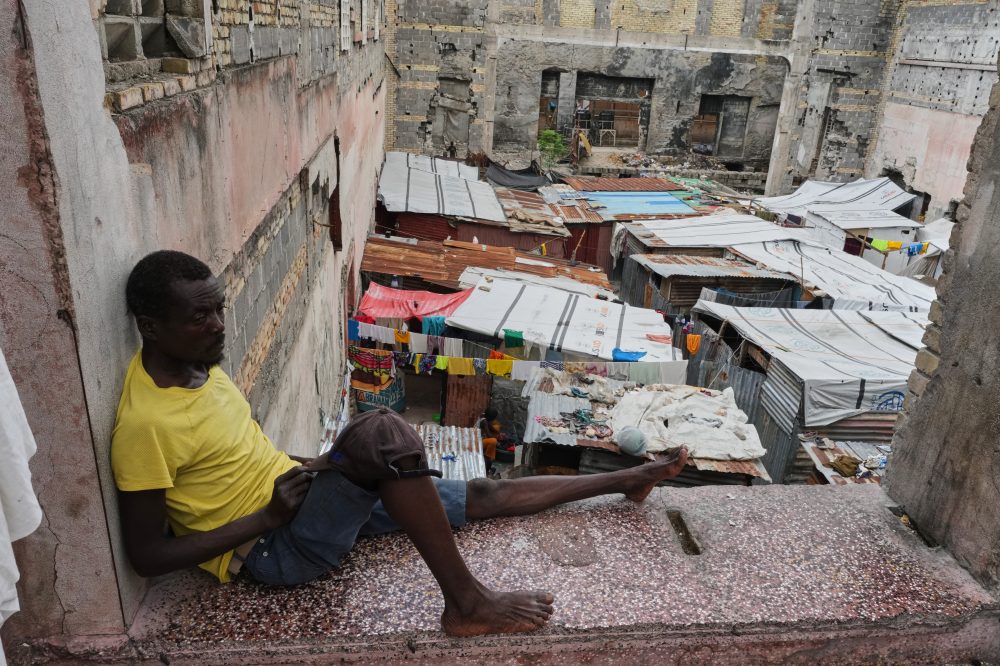
At an overcrowded and unsanitary shelter that formerly served as a school, 25-year-old Feguens Jean explained he would have little to eat Thursday due to poor weather conditions.
Jean makes money selling secondhand shoes to support himself and send money to his mother and sister in rural areas “for them to survive.” However, rainy conditions kept him from working.
“If I don’t sell, I don’t eat, which means today, what I have is very little to eat,” said Jean, who was studying to be a carpenter at a technical school but was forced to become a street vendor to support himself and his family.
Antony Joassainte, 40, lives among the hundreds of people in the overcrowded shelter with Jean. Though trained as a mason and plumber, he explained that employment is extremely difficult to find currently.
“Nobody is building anything,” said Joassainte, the father of two children, ages 11 and 13. “I find myself having to feed a family with nothing.”
He explained they depend primarily on bread.
“It’s cheaper,” he said. “We have one strong meal if we can; that might be rice and beans.”
Bernadette Toussaint, a 37-year-old mother of two boys, also worries about providing food.
She operates a small business selling rice, beans and chicken sauce, but with rising oil prices, she’s been forced to reduce her family’s meals.
“I cannot provide what I used to for my kids,” she said. “I don’t have a husband, and I have to depend on my business.”