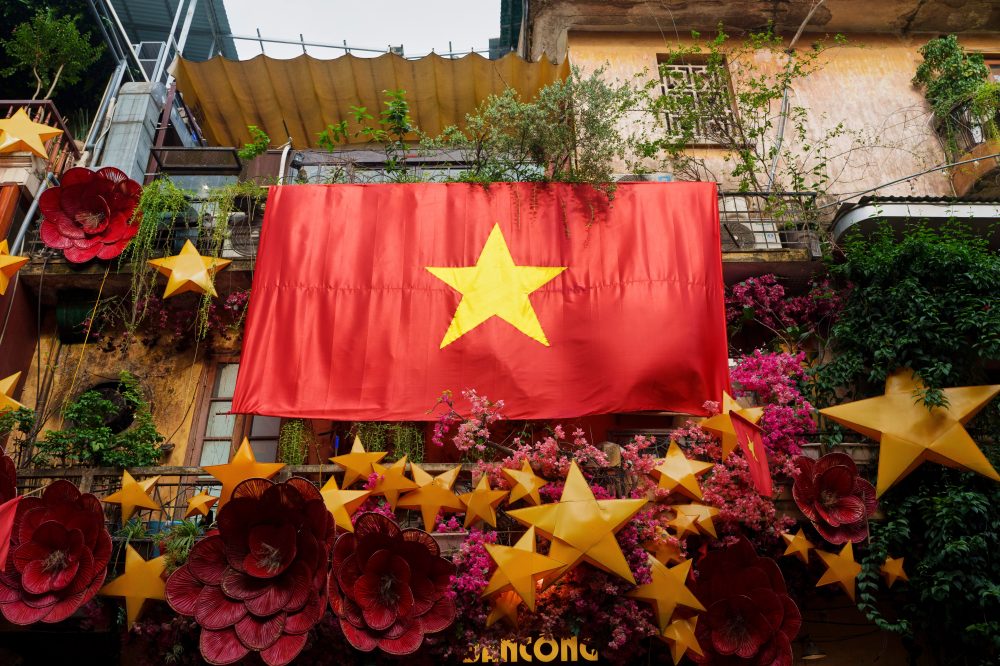

BANGKOK — A human rights organization is raising serious concerns about Vietnam’s growing use of broadly worded criminal laws to detain activists, critics, and others seen as threats to Communist Party rule, according to a new report released Monday.
The 88 Project, an organization focused on human rights conditions in Vietnam, recorded 56 politically motivated arrests in 2025 alone — the third year in a row that figure has climbed, and twice the number seen in 2022. Ben Swanton, co-director of the group, noted the report only counts cases where the arrested individual could be identified by name and the case monitored, meaning the true total is likely far greater.
The report describes Vietnam under leader To Lam as a government that “routinely weaponizes criminal law” to stamp out dissent. To Lam, who previously served as the country’s top security official, has held the position of general secretary of the Communist Party since 2024 and was also elected president earlier this year.
According to the report, much of the crackdown stems from the leadership’s fear of a popular uprising — the kind of so-called “color revolution” seen in Ukraine’s 2004 Orange Revolution or the Philippines’ 1986 Yellow Revolution.
That same fear is shared by Communist Party leadership in neighboring China, which has faced similar accusations of suppressing critics. Despite tensions over competing territorial claims in the South China Sea, Vietnam and China agreed earlier this year to jointly “prioritize political security and enhance efforts to prevent and resist color revolutions,” according to the Chinese state-run Xinhua News Agency.
“With the ascendancy of To Lam, the country has become a literal police state that tolerates no dissent,” Swanton said. “This represents a serious regression from the period of relative openness in the 2010s when some dissent was tolerated and civil society groups were able to engage in policy activism.”
Vietnam’s Foreign Ministry did not respond to requests for comment on the report’s findings.
The report highlights a growing reliance on Article 331 of Vietnam’s penal code, a law that makes it a criminal offense — carrying up to seven years in prison — to “abuse democratic freedoms to infringe upon the interests of the state.”
Once rarely enforced, New York-based Human Rights Watch wrote in a report last year that authorities have “enlarged the scope and application of Article 331 so that it reaches further into society, beyond human rights and democracy dissidents … to all those who voice any grievance with state or local Communist Party and government officials.”
Human Rights Watch also described the trend as “a little known facet of the government’s expanding crackdown on ordinary people who are seeking to use social media and other peaceful means to publicly raise important social issues, including religious freedom, land rights, rights of Indigenous people, and government and Communist Party corruption.”
Among those arrested under Article 331 last year were three men behind a YouTube channel called “Nguoi Da Tin” — translated as “The Messenger” — who were accused of uploading videos containing “distorted content” that violated the law, according to The 88 Project.
Other politically related arrests documented in the report include an activist representing the minority Montagnard community who was detained in Thailand and sent back to Vietnam, a writer accused of spreading “propaganda against the state,” and an individual who assisted residents of Ha Tinh province in filing complaints seeking fair payment for land seized to build a new highway.
“The Vietnamese government has dealt alarmingly severe punishments to longstanding targets like journalists and human rights activists, while displaying an increasing willingness to attack groups previously thought safe, such as political exiles and legal petitioners,” the report concluded.