
A single by-election in northern England on Thursday has the potential to reshape British politics at the highest level — and it may come down not to the winner’s popularity, but to a bitter feud tearing apart the populist right.
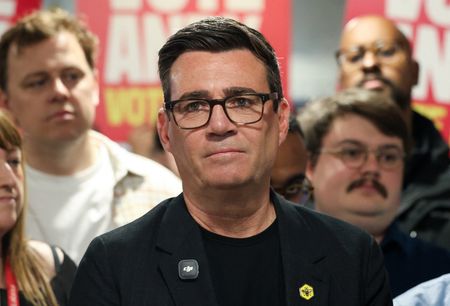
Andy Burnham, currently serving as the Labour Party’s mayor of Greater Manchester, is seeking to win the parliamentary seat of Makerfield. Under Labour Party rules, he must hold a seat in parliament before he can mount a challenge to Prime Minister Keir Starmer for the party’s leadership.
The roughly 77,000 registered voters in Makerfield, a constituency in northern England, could effectively be choosing the next leader of a country of nearly 70 million people.
Opinion surveys show Burnham with a lead of between five and 12 percentage points over the right-wing Reform UK party — a margin that analysts say exists largely because the right-wing vote is being split between two parties whose leaders were once allies. Nigel Farage’s Reform UK and Rupert Lowe’s Restore Britain, born from an ugly falling-out between the two men last year, are both competing for the same pool of voters.
Peter Thompson, a 78-year-old record shop owner in Ashton-in-Makerfield, said he plans to vote for Reform but worries that Restore’s presence in the race could cost the right-wing bloc the seat. “All my voting in life there’s only been two parties that have run this country, Labour and Conservatives. Look around you, it’s a mess,” he said.
“If it was a straightforward fight, I think Reform may well edge it but because there’s that many parties that you can vote for now, I think it will swing it to Labour’s advantage, unfortunately,” Thompson added.
Both Reform and Restore position themselves as anti-establishment parties with hardline stances on immigration — Restore going so far as to advocate mass deportations. Polling shows Restore pulling in around 7% to 8% support in the constituency, a figure that is seen as seriously damaging Reform’s chances.
Farage warned last week that the race is effectively a two-horse contest, arguing that supporting Restore risks electing “perhaps the most left-wing prime minister of modern times.”
Burnham’s campaign is built around themes of economic abandonment, pointing to the decline of the region’s mining and manufacturing industries. “It all adds up to 40 years of neoliberalism that have not been kind to the North of England. Forty years of trickle-down economics that did not again trickle down very much at all,” he said at the start of his campaign last month.
Official statistics offer a more complicated picture. Makerfield falls roughly in the middle of national rankings when it comes to income deprivation, and performs relatively well on employment and health measures. Its weakest scores come in housing access and services — areas that sit at the center of Burnham’s political vision, which he calls “Manchesterism” and describes as “business friendly socialism.”
Rob Ford, a professor of politics at the University of Manchester, described the seat in an interview with independent consultancy Blonde Money as one of aspirational middle-class commuters rather than a traditional working-class stronghold. “It is ‘Red Wall’ in its heritage and identity, it is not Red Wall in terms of the kind of people who live here,” Ford said, referencing the traditionally Labour-held northern seats that briefly shifted to the Conservatives in 2019 and are now key Reform targets.
The political landscape in the area has already shifted dramatically. Reform swept 24 of 25 Wigan Borough Council seats — which includes the Makerfield area — during local elections on May 7, leaving Labour’s hopes resting heavily on Burnham’s personal name recognition.
On the ground, placards backing Reform outnumber Labour signs in many neighborhoods, particularly in more working-class areas like the Stubshaw Cross estate. Labour has responded by pouring significant resources into the race, with cabinet ministers and prominent lawmakers showing up to campaign and help distribute leaflets.
While Burnham built his reputation as mayor on openness and accessibility, his return to national-level politics is being tightly managed by party operatives based in London — a reflection of just how much is riding on the outcome.
For all the high-level political maneuvering, the final result will come down to individual voters like Neil Price, a 41-year-old bricklayer from the area. “I’m going to be voting for Andy Burnham. I know he does a lot for the community round here. He does well with everything he talks about … so yeah, he’s the one I’m going to be voting for,” Price said.