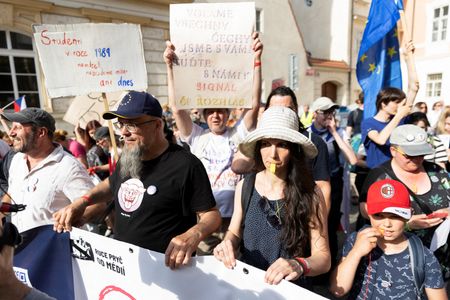

PRAGUE — The Czech government has approved what is being called its most sweeping overhaul of public media in decades, agreeing to eliminate license fees and replace them with state budget funding — a decision that has drawn sharp criticism from press freedom groups and opposition politicians who say it threatens the independence of public broadcasters.
The government, which is led by the populist ANO party under Prime Minister Andrej Babis and also includes far-right and eurosceptic parties, has frequently clashed with both public and privately owned independent media outlets, accusing them of bias.
If the proposal clears parliament, funding for public broadcasters would shift away from fees currently paid by households and businesses and instead come directly from the state budget. That new level of funding would be approximately 15% less than what the broadcasters currently receive through the fee system.
Opponents of the plan warn that tying broadcaster funding to the state budget creates an opening for political influence over editorial decisions.
Babis, a billionaire businessman and a self-described admirer of U.S. President Donald Trump, has framed the change as a cost-saving measure that would also fulfill a campaign promise to relieve citizens of paying the combined monthly fee of 205 crowns — roughly $9.87.
At a news conference, Babis pushed back against accusations that the plan was designed to undermine journalistic independence. “We have never threatened the independence of Czech Television… nor will we,” he said.
Czech Television and Czech Radio both enjoy strong public trust — each earned the confidence of 59% of Czech citizens in a 2025 Reuters Institute survey, the highest marks of any media outlets included in that poll.
Pavol Szalai, the Prague bureau chief for Reporters Without Borders, said the government had effectively institutionalized financial pressure on public media. He added that the move appeared to conflict with European Union guidelines on how public media should be funded.
Babis has maintained that the Czech approach mirrors funding models already in use in other European nations.
Under the specifics of the proposal, Czech Television — the larger of the two public broadcasters — would see its budget allocation drop by approximately 1 billion crowns, bringing it down to 5.74 billion crowns. The station also generates additional revenue through content licensing and advertising.
Czech Television’s director Hynek Chudarek said the financial cuts would likely force the station to lay off between 300 and 500 employees out of its current workforce of 2,900.