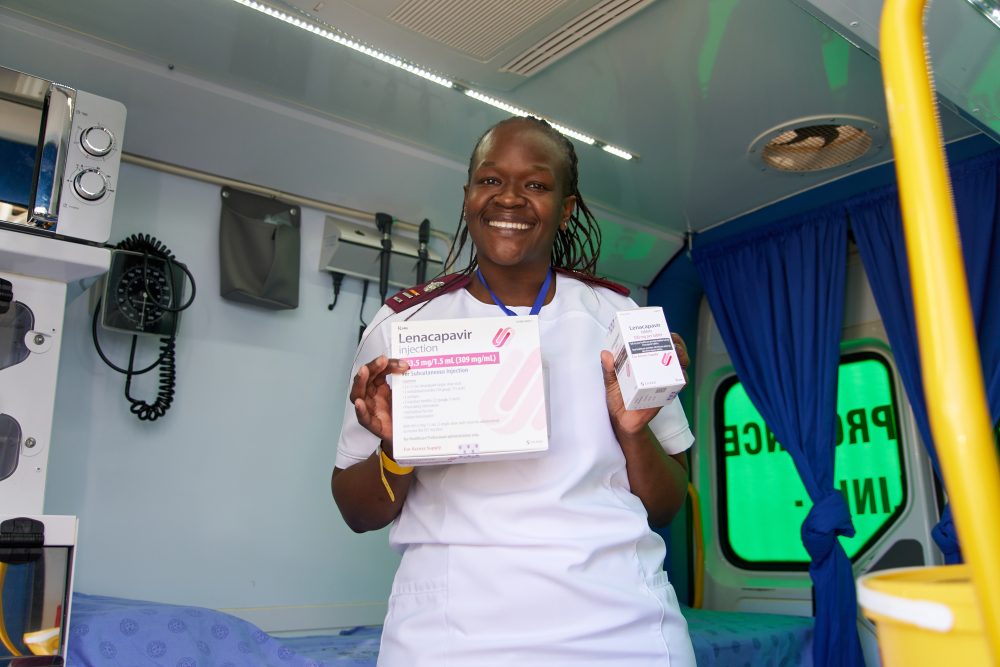

SECUNDA, South Africa — Witnessing HIV’s destructive impact on her family and neighbors motivated 19-year-old Olwam Plaatjie to begin taking preventive HIV medication three years ago.
“Sometimes they’d lose weight, they would get sick and have to go to the clinic, and I didn’t want that for me,” she told The Associated Press. “I’d see the people I live with taking (antiretroviral) pills for HIV every day, and I knew I wouldn’t be able to handle that life.”
Plaatjie joined thousands of South Africans participating in clinical studies for lenacapavir, a groundbreaking injectable drug administered twice yearly that overcomes the challenges associated with taking daily oral prevention medication.
Even though she experienced night sweats and other adverse reactions, she continues taking the treatment after South Africa launched the program this month, making it among the first nations worldwide to offer the drug.
At a stadium event announcing the medication’s introduction, President Cyril Ramaphosa described lenacapavir as a “turning point” for South Africa, the nation with the globe’s largest HIV population.
However, health advocates argue the country should receive significantly more doses given South Africa’s essential contributions to the research that made this breakthrough medication available worldwide.
More than 8 million South Africans are infected with the virus. Officials hope lenacapavir will reduce annual new infections, which currently number between 140,000 and 170,000.
“If South Africa can deliver it equitably and at scale, it could make a meaningful contribution to reducing new HIV infections,” said Leila Mansoor, a senior scientist at the University of KwaZulu-Natal’s Center for the AIDS Program of Research in South Africa.
Researchers in South Africa and Uganda tested lenacapavir’s effectiveness in clinical studies. The drug was created by Gilead Sciences. A pivotal trial conducted in Johannesburg found the six-month injection provided complete protection against HIV infection.
“It was a groundbreaking finding,” said Dr. Nkosi Ndlovu, senior clinician at the research institute Wits RHI.
South Africa’s government has obtained enough doses to treat 456,000 individuals for one year, supported by a $29 million Global Fund grant. Following this period, Health Minister Aaron Motsoaledi stated South Africa plans to finance its own program with donor assistance.
Several South African advocacy groups criticize the distribution strategy as insufficient, arguing that at least 2 million annual doses are needed to substantially impact new infection numbers.
While Ramaphosa has promised to reach 3 million South Africans within three years, he hasn’t provided specific implementation details.
Questions remain about South African access to the drug despite the nation’s vital role in making lenacapavir available, according to Tian Johnson, health strategist for the Johannesburg-based health advocacy group African Alliance.
“Our communities participated in the research, our clinics hosted the trials and our scientists helped produce the data,” Johnson said. “Yet we are still waiting for Gilead to determine how much of the product we receive, when it arrives and how quickly access can expand.”
The health minister reported that Gilead agreed to provide a voluntary manufacturing license to a South African company after granting six licenses to other nations last year. This arrangement enables production of less expensive generic versions for lower-middle-income countries at $40 per person yearly, compared to the initial $28,000 cost.
Manufacturing will begin in South Africa once a committee selects the appropriate company, he explained.
The initial shipment of 37,920 doses is being delivered to 360 healthcare facilities across six provinces with elevated HIV rates.
South Africa is initially targeting high-risk populations, including people who inject drugs, sex workers, transgender individuals, young women between 15 and 24, and pregnant or breastfeeding women.
Reaching these groups presents challenges. Extensive U.S. funding reductions by the Trump administration resulted in closure of many specialized facilities these populations preferred for HIV treatment.
“Key populations, sex workers, people who use drugs, they don’t normally use public clinics” because of challenges like long lines and staff attitudes, said Bellinda Thibela, international policy and advocacy coordinator for the Health Global Access Project.
“So it means that we’re going to lose them unless the government acts fast and ensures that they put the resources to reach those people,” Thibela said.
South Africa’s health minister explained that patients from the 12 closed U.S.-funded clinics were moved to existing government facilities, with ongoing efforts to train personnel and establish private consultation areas.
“What we have lost is that confidentiality, where they were going to these clinics that are very special to them, where they feel very safe,” Motsoaledi said. “So we are trying to train our doctors to take over.”