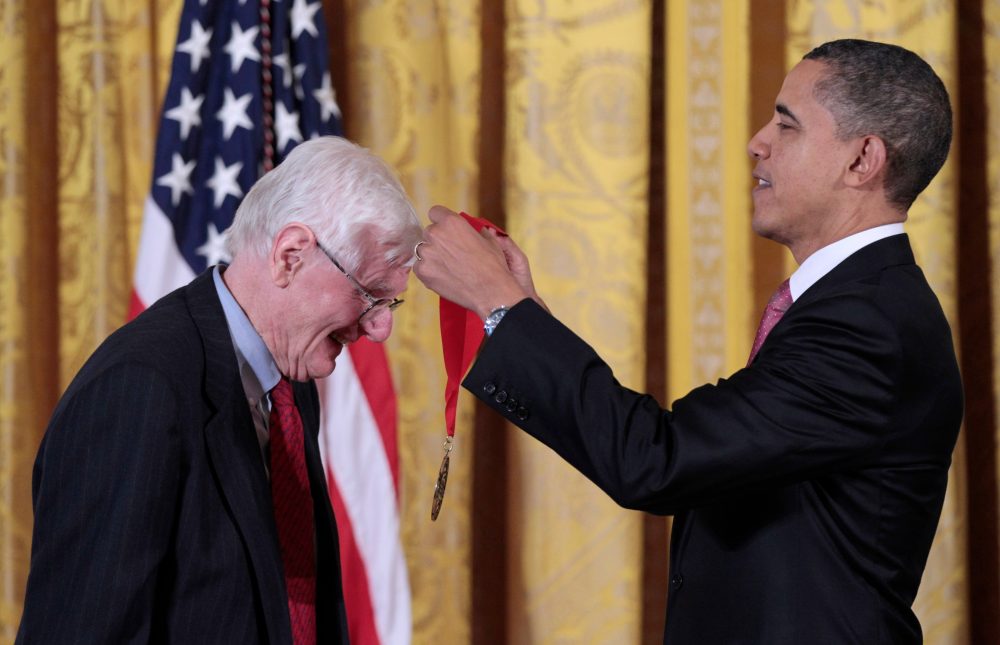

A distinguished historian whose scholarship shaped how Americans understand their nation’s founding has died at age 92. Gordon Wood, professor emeritus at Brown University, passed away Sunday following a tragic accident in which he was struck by a vehicle in a supermarket parking lot in East Providence, Rhode Island, according to local police.
Wood authored numerous books and scholarly articles that became essential reading for understanding America’s early independence period. While he never achieved the widespread popularity of historians such as David McCullough and Doris Kearns Goodwin, his research became foundational material for academic discussions about the nation’s formation and revolutionary legacy. Colleagues viewed the white-haired, gentle-appearing Wood as the quintessential scholarly historian, one who prioritized factual evidence over ideological interpretation.
President Barack Obama honored him in 2011 with a National Humanities Medal “for scholarship that provides insight into the founding of the nation and the drafting of the U.S. Constitution.”
However, recent years brought increasing criticism from younger scholars who argued that Wood represented outdated academic approaches that overlooked the experiences of enslaved people, women, and Indigenous populations. John L. Brooke, a history professor at Ohio State University, criticized him for “a distinct avoidance of interpretative paradox and complexity,” while still acknowledging Wood’s “scale and scholarly enterprise.”
Wood’s academic impact began early and endured throughout his career. His debut work, “The Creation of the American Republic,” earned the Bancroft Prize in 1970 and influenced countless students who grappled with Wood’s argument that the Constitution was accidentally revolutionary—a document created by elite leaders that ultimately led to “the destruction of the very social world they had sought to maintain.”
“The Radicalism of the American Revolution” earned him the Pulitzer Prize in 1993, while his comprehensive work “Empire of Liberty” received finalist recognition in 2009.
Wood demonstrated openness to some scholarly developments, particularly embracing Annette Gordon-Reed’s “persuasive contextual case” regarding the relationship between enslaved Sally Hemings and Thomas Jefferson. In “Empire of Liberty,” which examined the period from 1789 to 1815, he devoted substantial attention to slavery, describing it as a cancer “eating away at the message of liberty and equality.”
However, Wood also fiercely opposed certain contemporary historical interpretations. He became a vocal opponent of The New York Times’ Pulitzer Prize-winning 1619 Project and its assertion—which was later modified—that preserving slavery motivated the American Revolution. He claimed the project promoted feelings of “victimhood” and being “aggrieved,” despite admitting he had not read most of the material. Wood maintained that the founders, including plantation owners like Jefferson and James Madison, incorrectly believed slavery would naturally disappear, and argued that the revolution actually strengthened American abolitionist efforts.
“We all want justice, but not at the expense of truth,” he wrote in 2019, adding the controversial statement, “I don’t know of any colonist who said that they wanted independence in order to preserve their slaves.”
Wood’s connection to history began with his birthplace: Concord, Massachusetts, former home to Ralph Waldo Emerson, Henry David Thoreau, and Louisa May Alcott. Despite this historical setting, his love for the subject didn’t emerge until his college years. He found high school history classes tedious, enduring sessions where instructors merely recited from textbooks.
His Latin teacher inspired him to pursue higher education at Tufts University, where he graduated summa cum laude. Wood continued his studies at Harvard University, earning both master’s and doctoral degrees while working under renowned Revolutionary War historian Bernard Bailyn. Bailyn’s groundbreaking “The Ideological Origins of the American Revolution,” which explored the intellectual foundations of independence, provided the foundation for Wood’s “The Creation of the American Republic.”
In his 2011 introduction to “The Idea of America,” Wood reflected on his career and the changing nature of historical scholarship. He acknowledged the founders’ numerous mistakes while cautioning against judging historical figures by contemporary standards—a practice he and others termed “Presentism.”
“The drama, indeed the tragedy of history, comes from our understanding of the tension that existed between the conscious wills and intentions of the participants in the past and the underlying conditions that constrained their actions and shaped their future,” he wrote.
“If the study of history teaches anything, it teaches us the limitations of life. It ought to produce prudence and humility.”