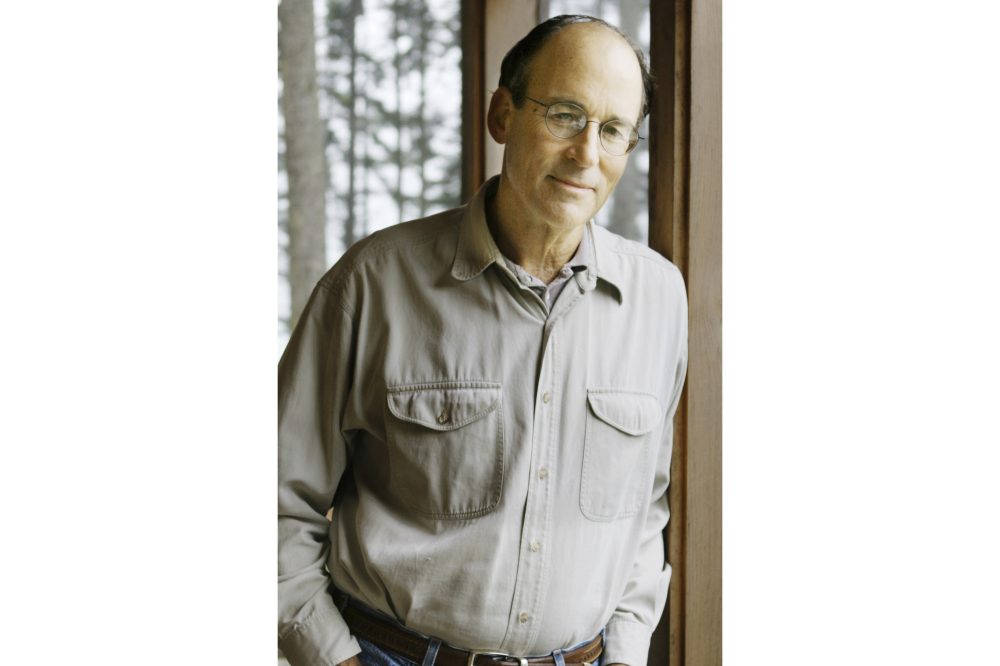

Celebrated narrative nonfiction writer Tracy Kidder, who possessed the remarkable ability to transform ordinary subjects into compelling bestsellers, has passed away at the age of 80.
Random House, Kidder’s publisher for many years, announced his death on Wednesday, stating: “Tracy’s gifts for storytelling and tireless reporting are an enduring reflection of the empathy, integrity, and endless curiosity he brought to everything he did.”
Kidder earned both the Pulitzer Prize and National Book Award in 1981 for “The Soul of a New Machine,” a groundbreaking work that explored the inner workings of an emerging computer company during an era when few people understood or cared about Silicon Valley’s operations.
Reflecting on that experience, Kidder shared with The Associated Press: “It was like going into another country. At first, I didn’t understand what anybody was saying.”
Throughout his career spanning several decades, Kidder made it his practice to dive deep into unfamiliar territories, creating meticulously researched books on subjects that might not initially appear captivating to general readers.
His 1989 book “Among Schoolchildren” required him to spend an entire academic year observing a fifth-grade classroom, where he captured the unwavering commitment of an inner-city educator in Holyoke, Massachusetts. Four years later, “Old Friends” emerged from his observations at a nursing facility, where he documented both the harsh realities of aging in America and the inspiring way two companions preserved their dignity despite physical limitations.
Converting his observations from the Northampton, Massachusetts nursing facility into a compelling story presented unique challenges, Kidder explained to the AP.
“Not a lot happens, and yet I think when you read it, you feel that a lot does. Small things have to count for a great deal,” he explained.
Kidder’s 2003 work “Mountains Beyond Mountains” chronicled a physician’s mission to deliver healthcare services to Haiti. This book introduced Kidder’s writing to younger audiences as colleges across the country incorporated it into their curricula.
“Mountains Beyond Mountains changed my life—and the lives of so many others around the world,” author John Green, who wrote “The Fault in Our Stars,” posted on social media Wednesday.
The book’s influence extended beyond literature, inspiring the indie rock group Arcade Fire’s 2010 song “Sprawl II (Mountains Beyond Mountains).”
Throughout his writing career, Kidder deliberately avoided focusing on personal interests such as fishing or baseball, worried that spending extensive time writing about his passions might make him “feel sick of it.”
Born in New York City in 1945, Kidder pursued his education at Harvard University, where he joined ROTC hoping to avoid being drafted for the Vietnam War.
Following graduation, contrary to his expectations of receiving a Washington-based communications intelligence assignment, the 22-year-old Kidder found himself deployed to Vietnam. There, he led an eight-person rear-support radio research unit tasked with intercepting enemy communications to determine their positions.
This perplexing chapter of his life became the subject of his 2005 memoir “My Detachment,” a frequently amusing account that provided perspective on the support personnel who comprised the majority of the 500,000-plus American military members stationed in Vietnam during the peak deployment period when Kidder served from 1968-1969. For Kidder, who never experienced combat and knew enemies only as “dots on a map,” the conflict remained somewhat abstract.
Following his military service, Kidder and his bride, Frances Gray Toland, relocated to the Midwest so he could attend the University of Iowa’s renowned creative writing program. There, he embraced the New Journalism movement championed by authors such as Tom Wolfe and Truman Capote.
Kidder disliked being called a “literary journalist,” telling the Dallas Morning News in 2010 that he considered the label “pretentious.”
He also objected to the term creative nonfiction, saying: “It suggests we make things up.”
Rather, he viewed himself as someone who told stories.
“I don’t think of fiction and nonfiction as all that different, except that nonfiction is not invented,” he explained to the AP. “But I take exception to those people who think nonfiction should not appropriate the techniques of fiction … They belong to storytelling.”